As voter suppression ramps up and election sabotage starts to play out, democracy defenders are strategizing in and across sectors and geographies, breaking silos between electoral work, community defense, and mutual aid. They’re preparing to defend voters, the election process, and if needed, the election results–even as they gear up to turn out an anti-authoritarian vote too big to be denied.
Widespread and determined though this resistance is, it receives far less attention than the wholesale assault on the basic right to vote and the entire elections process. Convergence Magazine is launching a series on election protection to help right this balance, and help readers plug into opportunities for action. In this article we sketch an overview of the types of organizing underway. In a subsequent piece, we’ll dig into preparations to defend the results and, if necessary, to engage in sustained action against efforts to sabotage the elections.
Nothing is new, but much is different
Since the Constitution’s framers debated the new country’s stance on slavery, we have seen constant fights to maintain and expand democracy, with the rights of Black people central to the struggle. The social movements to abolish enslavement, for voting rights, for economic, social, and cultural power have expanded the contours of democracy, within the confines of structural limitations–but each advance towards authentic democracy was met with backlash.
For a brief moment after the Civil War, Reconstruction brought multi-racial democracy and an expansion of public institutions. Movements for women’s and workers’ rights also flourished–but the violent overthrow of Reconstruction ushered in Jim Crow and a turn to expansion of empire and the power of the ruling elite.
Slow media for fast times. Sign up for our newsletter.
Resistance persisted, bringing the 19th amendment, the New Deal reforms, protection for (some) workers’ rights, desegregation, the Voting Rights Act and expansion of rights for women, immigrants, LGBTQ+ people. After the New Deal came McCarthyism and anti-union laws like Taft-Hartley. After the expansion of democracy with the Civil Rights Act, right-wing corporate forces began plotting their long-term strategy to capture the federal courts and federal and state legislatures to entrench their interests and consolidate their power.
The Supreme Court’s 2010 Citizens United decision let loose a deluge of money in politics. In 2013 Shelby County v Holder stripped Section 5 of the Voting Rights Act, clearing the way for states to restrict voting. The 2026 decision in Louisiana v Callais virtually completed the nationalist Right’s long campaign to gut the Act when it overturned Section 2, which barred racially discriminatory maps. Post-Callais redistricting in Southern states could produce at least 19 safe Republican seats in Congress, according to analysis by Fair Fight Action and Black Voters Matter; the redrawn maps “would likely lock out minority political power at the state level for a generation,” the groups found.
Today, 24 states require voters to present photo IDs, and three others are considering initiatives or legislation to do the same. Twelve states have laws requiring people to present proof of citizenship to vote; 28 states are using federal immigration status data to check their voter rolls.
Callais can wreak havoc far beyond the South: “MAGA, Trump, and the autocrats understand that their most expedient route to total control is the gutting of Black political power,” Fair Fight Action CEO Lauren Groh-Wargo said on “Meeting the Moment” with Anat Shenker-Osorio and Michael Podhorzer. And barrages of demands and edicts from the Trump administration further menace people’s rights to vote–and have their votes count.
The Trump administration is spearheading a full frontal assault on democratic institutions and processes. The election threats come as Trump has deployed the National Guard and ICE as paramilitary forces to terrorize immigrants and communities of color more broadly and weaponized the Department of Justice (DoJ) to target political opponents and a plethora of “leftist” groups and media outlets. In a rambling prime-time TV speech, he told viewers that he will challenge the midterms, and signaled how he will do it. He has seized unprecedented executive powers, and had those affirmed by the Supreme Court. “This cycle is not normal,” said LaTosha Brown of Black Voters Matter. “If we do not stop the consolidation of power now, it will shape the political landscape in this country for at least the next 50 years. We can’t for a moment close our eyes to the urgency.”
In the face of all this, pro-democracy forces have been gathering, planning, developing blueprints, and working across sectors and fronts, beyond the traditional silos, and beyond each election cycle, to meet this moment. As the blueprint document “Act Free to Be Free” puts it: “This election calls for “multi-sector, constitutionally grounded, multi-racial, broad-based mobilization of civil society, ready for the best and prepared for the worst.”
To more clearly understand the different ways that grassroots groups and their allies are defending democracy, we start by breaking down the specific threats and how they could play out during the midterms (and in some cases, have been playing out during the 2025 special elections and the 2026 primaries).
Disinformation and denial: laying the groundwork for sabotage
Casting doubt on election results is a special kind of voter suppression tactic, one that lays the groundwork for election sabotage. Denialism is dangerous, and persistent. The Right has waged a years-long campaign to undermine confidence in elections. Election deniers have become more brazen in their tactics: close to 200 are running for Congress and statewide offices. Others are serving on local election boards; in Georgia, they’ve taken over the state board. They’re mobilizing private individuals and groups to contest people’s eligibility to be on the rolls or cast a ballot–over 100,000 challenges have been filed since 2020. And now, election deniers populate the DoJ and occupy the White House.
Federal attacks on voting
Elections are controlled by states and administered locally. Organizers in many places–especially but not limited to the South–have contended with escalating voter suppression since the Shelby v Holder decision in 2013. Repressive laws have metastasized to other states. Today, 24 states require voters to present photo IDs, and three others are considering initiatives or legislation to do the same. Twelve states have laws requiring people to present proof of citizenship to vote; 28 states are using federal immigration status data to check their voter rolls. We’ve seen purges of voter rolls in Florida, North Carolina and Georgia–including the erasure of more than a half-million voters by Georgia Secretary of State–and 2018 gubernatorial candidate–Brian Kemp. He won his race against Stacey Abrams by just 54,723 votes. Since 2020, local election workers have been harassed and threatened by election deniers. Election workers also have to deal with cuts in funding that result in too few poll workers, less training, and reductions in the numbers of polling places and hours of operation.
The constitutionally mandated state-level control over elections has been challenged by the Trump administration in several ways. So far, most of these have been held back by the courts. However, in a recent ruling the Supreme Court has signaled its willingness to grant the Executive Branch greater powers over elections. In an August 24 ruling, the six Republican-appointed justices stayed a lower court’s injunction against Executive Order 14399, which, among other things, would place limits on mail-in voting. While the ruling is limited in scope, it does, as Justice Ketanji Brown Jackson argues, “needlessly inject chaos and uncertainty into the upcoming midterm elections.” These constant threats and actions create dangerous levels of chaos and magnify local challenges to ballot access.
Claiming the need to check for illegal voters, the DoJ has sued 31 states demanding that they turn over all voter registration data. Federal district courts have tossed 18 of those suits and, as of the end of July, none have prevailed.
The SAVE Act, also cast as an attempt to prevent unauthorized voting, would have disenfranchised millions, including women who changed their names at marriage, and naturalized citizens. It failed to pass in time to affect the midterms, but remains a threat, and a concern in the minds of voters. Speaking for the authoritarian forces in his party, the President says the quiet part out loud: “If we pass the SAVE Act we will never lose an election again.”
Refusing to let the 2020 election go, the DoJ seized ballots from Fulton County, Georgia, and the FBI seized data from the partisan post-election audit in Maricopa County, AZ. DoJ demanded 2024 election data from Michigan. Chad Bianco, the Trump-aligned sheriff of Riverside County, California, seized 650,000 ballots from the 2025 vote on the state’s redistricting initiative.
Some local boards of elections and community organizers in heavily Democratic areas, like Fulton County and DeKalb County, and there are others we’ve yet to hear about, are preparing for voter intimidation at polling places as well as ballot challenges from bad-faith poll watchers. They also have to take seriously the administration’s threats to deploy ICE agents and the National Guard at or near polling places.
The most egregious of the administration’s attacks on civil society took place on June 11, 2026, when more than 100 FBI agents launched a violent investigation of the Ohio Organizing Collaborative (OOC), which had registered more than 600,000 voters over the course of a decade, most of them in the state’s multiracial urban centers. The FBI raided the organization’s Cleveland offices, seizing equipment and interrogating workers—and fanned out across the state, questioning volunteer canvassers and organizers. Agents held people for hours, sometimes grilling them in the presence of their children.
This was not enforcement, organizer Doran Schrantz said; it was “militarized state authority repressing opposition for political purposes.”
Threats do not stop with the election itself.
Trump and his followers have normalized delays in seating duly elected officials. North Carolina Republicans repeatedly challenged the 2024 election of a progressive Democrat to the state Supreme Court; she was not seated until a federal judge intervened six months later. Speaker Mike Johnson delayed seating Congresswoman Adelita Grijalva of Arizona for seven weeks after she won a special election in 2025. In Louisiana, when Calvin Duncan, a Black man who had been wrongfully incarcerated, won his 2025 election for county clerk, the state legislature hastily passed a law abolishing the position.
Pro-democracy forces are preparing for the worst-case scenario: an outright coup. The forces that prevented the January 6, 2021 coup attempt are no longer in place. It is not far-fetched to imagine armed militias attempting to take over statehouses in battleground states.
Democracy defenders to the rescue
They don’t usually wear capes, but the groups and individual activists at the frontlines are heroically protecting free and fair elections. They include community organizers, local election workers, clergy and other faith leaders, poll workers and poll watchers, legal defense providers, funding aggregators, educators, parents, workers, and neighbors. Many belong to organizations and networks including Indivisible, Black Voters Matter, May Day Strong, the Movement Voter Project, Seed the Vote, the Working Families Party, People’s Action, immigrants rights organizations, mutual aid groups, and more; they’re networking and coordinating with other kinds of resources as part of a broad election defense front. The Election Safeguards Response Network, with its “Hands Off Our Vote” program, is one site that is holding much of this coordination.
In Florida, State Rep. Angie Nixon–now the Democratic nominee for US Senate–used her megaphone to call out the redrawn maps as racist. In Tennessee, State Rep. Charlane Oliver stood on a table in the legislative chambers, unfurled a banner that read “No Jim Crow 2.0” and “Stop the TN Steal,” and sang “Lift Every Voice and Sing.”
This list of organizations and descriptions of their strategic frameworks and planned actions is far from exhaustive, in part out of respect for security: Organizers understandably hesitate to make some details public, given the weaponization of DoJ against both civil society groups doing voter engagement work (Ohio) and local election boards that have been accused of fraud (Fulton County, GA).
Election defense frameworks: addressing each phase
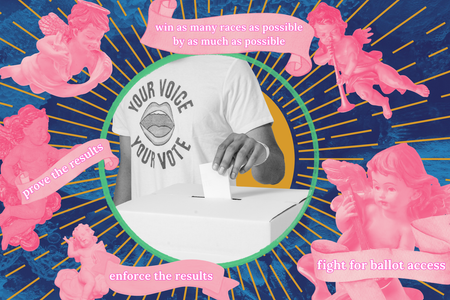
At an early 2026 forum on defending the vote and protecting the results, Seed the Vote Organizing Director Dylan Cooke laid out a framework for understanding the overlapping phases of election defense work, adapted from Hardy Merriman and Hold the Line. Cooke described these as fighting for ballot access before and during the election, winning as many races as possible by as much as possible, proving the results during the vote counts, and enforcing the results after all votes are counted. At the time of this writing, Seed the Vote is deeply engaged in the first two phases while preparing for the next two phases.
As 2020 showed, vigilance can’t stop when the votes are in. Election protectors will need to support election workers, monitor counts and recounts, and help voters “cure” their mail-in or provisional ballots by fixing any issues with missing or questionable signatures, etc. If MAGA forces attempt to throw out results or delay certification, mass mobilization of civil society will be necessary to defend the process.
A more comprehensive blueprint called “Act Free to Be Free: A State and Local Pro-Democracy Framework” has been developed by community, faith, and nonprofit leaders in Minnesota and elsewhere. This blueprint for defending elections in these extraordinary times draws upon recent histories of resistance in the face of authoritarian violence. What happened during the ICE occupations in Minnesota became a proving ground for combining rapid response with deeply rooted organizing infrastructure.
Elements of the blueprint include:
- Doing a thorough power analysis to understand the threat landscape – the vulnerabilities and the relative power of people and institutions that can impact elections.
- Recruiting community leaders who have robust networks of relationships in their neighborhoods, schools, congregations, etc.
- Making sure the networks are truly multi-racial, as both a core value and as a “strategic necessity.”
- Being clear about roles and who is doing what: legal, communications, tactical, grassroots deployment. Coordinate and communicate.
- Making the price of compliance with authoritarians too high. For example, have clergy and local leaders meet with election officials and get them on record about their commitment to fair and free elections.
Throughout these phases, lay the groundwork for sustained actions, including strikes, to reject attempts to sabotage the elections. On this point, the memo is succinct: “If they try to take our right to free and fair elections, we cannot have a ‘day of action.’ We need to suspend the daily order of things.”
To develop effective strategies, groups need to know where the risks are. The creators of the Federal Election Interference Risk Map plotted the 733 counties across 23 states where they saw the most risk of interference in competitive elections. Thinking ahead, Ash-Lee Woodard Henderson challenged groups to lay the groundwork for making localities in all 50 states more competitive–especially those where democracy is already under attack. She built a map for that here.
Many related actions come into play throughout the election phases.
Call out what is happening
For the fight and win phases, it is important to call out the injustices, mobilize responses, and counter the lies.
Less than three weeks after Callais, “All Roads Lead to the South” brought around 6,500 people to Selma and Montgomery, AL to signal their determination to continue the fight for voting rights. “We brought thousands of people together to say we are not taking this lying down. We are organizing ourselves,” said LaTosha Brown of Black Voters Matter.
Rapid mobilizations at state houses in Georgia, Mississippi and South Carolina responded to Republican initiatives to redistrict away representation for people of color.
Faced with highly visible public pressure, Republican state legislators in Georgia backed away from a special session called by the governor to take up redistricting and implementation of the new, chaos-breeding voting rules in SB189. Numerous groups including Black Voters Matter, Fair Fight, The People’s Agenda, Georgia STAND-UP and the ACLU of Georgia had mobilized at the Capitol, across the state and on social media in opposition to the plan.
Elected officials also stood up and spoke out. In Florida, State Rep. Angie Nixon–now the Democratic nominee for US Senate–used her megaphone to call out the redrawn maps as racist. In Tennessee, State Rep. Charlane Oliver stood on a table in the legislative chambers, unfurled a banner that read “No Jim Crow 2.0” and “Stop the TN Steal,” and sang “Lift Every Voice and Sing.”
Be unstoppable
Organizers pulled together #HandsOffOhio and stood up a mass call the day after the raid on the Ohio Organizing Collaborative and another call less than a week later. Response to the first call totally overwhelmed the Zoom; 2,000 people signed on to a support letter. OOC didn’t skip a beat in their voter registration work. They were out on the doors the day after the raid. “When something like this happens, we need to just speak up about it and call it out as loudly as we can, because who knows who could be next?” said Caitlin Johnson, who works with #HandsOff partner Innovation Ohio. “This was not a one-off.”
Make sure people can vote
Frontline organizers are doubling down on the work of voter education, ensuring that people have the information they need to cut through the web of chaos spun by those seeking to suppress the vote.
In some cases, this means supporting local election administrators and poll workers who tend to be underfunded, overworked, and sometimes, put under pressure. We spoke with organizers at All Voting is Local chapters in Ohio and Georgia, and the ACLU of Georgia’s Local Election Advocates and Defenders program, to learn more about how their work with local boards of elections supports people exercising their right to vote. With their allies in the states, they track federal interference and potential extremist actions, coordinate rapid response to defend voting and to ensure that every vote is counted and that elections are certified.
In rural Lincoln County, GA, for example, community activists working with the Georgia ACLU got busy when the elections board proposed consolidating all 16 polling locations into one. They learned that the county’s bylaws prohibited consolidation if enough people signed petitions opposing it. “We got the required amount of signatures and forced the board to back down,” said ACLU of Georgia’s community organizer Tori McFarland.
In Ohio, All Voting is Local is part of the nonpartisan Ohio Voter Rights Coalition, which monitors statewide changes to voting rules. “The legislature slipped a provision for voter ID copies in absentee ballots into HB 472. People mobilized, under the slogan ‘hands off our vote,’ and we got the Governor to veto it,” said Steve David of All Voting Is Local, Ohio.
The coalition also advocates for resources for election boards. “A lot of the changes they are expected to make require funds that are not there. Advocating for the funds they need is one of the ways All Voting supports election officials,” David said.
While this year’s preparations build on existing election protection infrastructure like 1-800-OUR-VOTE, they also are learning from recent mobilizations to defend communities against ICE raids.
There is a clear line that runs through volunteers’ efforts to protect communities facing militarized attacks from ICE and efforts to protect voting rights. Voting rights work must tap into resistance to ICE and the mutual aid and support for immigrant communities.
Results in primary elections this spring and summer show voters’ hunger for more effective responses to these intertwined crises. From DC to Michigan, in Florida, Minnesota, Colorado, and Kansas, voters have responded to progressive messages about the economy, the unchecked power of billionaires, data centers and ending ICE raids.
“Sometimes as a sector, we can bucket things a little bit too aggressively,” said Indivisible Co-Executive Director Leah Greenberg. “The reality is that we have a multi-front authoritarian attack fueled by a ‘divide and conquer’ strategy that regularly deploys, for example, racialized and xenophobic attacks as the vehicle to achieve their overarching goals (to seize and hold onto power). … The networks that spring up to resist one form of authoritarianism are often the networks that you turn to for another.
“And so when you think about the extraordinary surge of hyper-local grassroots activism that has come about over the last year and a half (to resist ICE, for example) … These are the people who will be activated if (the state) deploys ICE with the aim of suppressing the vote… Those are not different efforts.”
Vote early, win by a lot
“When we look at countries around the world that have ousted dictators through elections… the ones that are successful are those where we win by a lot,” Seed the Vote’s Cooke said. Seed the Vote, which sends volunteers to help local power-building groups canvass in key elections, consulted with state and local partners to identify seven races where they could have the most impact. They will focus on campaigns for Congress in Arizona, California, Michigan and Pennsylvania, and the races for US Senate in Texas and governor in Michigan. They’re integrating election defense into their doorknocking and preparing to support their local partners after the vote, if necessary.
Early voting will be critical to build momentum that helps with turnout. GOTV organizers are encouraging people to check their registrations and vote early and in person, particularly in states where access to mail-in voting is limited, and where new voting laws have been rolled out. This allows more time to address issues with registration and new requirements. It also gives organizers a read on where the problems are – aggressive poll-watchers, understaffed polling places, problems with access to polling places, canceled polling hours, long lines, and more. With new, and often confusing election rules, there tend to be more provisional ballots. Early voting may help ensure those ballots are counted.
With the authoritarian elites doing everything they can to keep people from voting, “Voting itself is an act of resistance,” Maria Peralta said.
But voting against them is not enough. We have to have something to vote for.
Blocking to build
The fight to defend elections takes place as the cost of living climbs and everyday necessities become increasingly unaffordable for working people while the oligarchs siphon wealth upward, when the company constructing a data center in rural Georgia can expropriate people’s backyards while the cost of electricity and water jump. It takes place as the planet is literally burning while oil companies’ profits double, as Congress approves $85 billion for war while kicking more than 700,000 children off food stamps. As militarized ICE agents are ripping parents away from children and snatching neighbors off the street, as the nation’s capital city has been occupied for more than a year by National Guard troops.
Results in primary elections this spring and summer show voters’ hunger for more effective responses to these intertwined crises. From DC to Michigan, in Florida, Minnesota, Colorado, and Kansas, voters have responded to progressive messages about the economy, the unchecked power of billionaires, data centers and ending ICE raids. In Tennessee, where the state legislature rushed through a racially motivated and partisan map, progressive champion Justin Pearson won 65% of the vote in a high-turnout Democratic primary election. As Ash-Lee Woodard Henderson pointed out, Pearson’s primary victory in the gerrymandered district took place “on the anniversary of the Voting Rights Act, under a map drawn to erase (his district).”
Voting is not just about showing up, as Working Families Party Southern Regional Director Britney Whaley said. “When I think about voting rights, I’m thinking about not just voting rights for the sake of voting, but voting so that we can actually change the material conditions of our communities so that working-class people in this country can live with dignity and respect, and so that we have systems that work for us,” she said.
Did you enjoy this article?
Becoming a member is the best way to ensure we keep publishing articles that meet the moment. Memberships start at just $5 a month and come along with a variety of other perks; join us today.