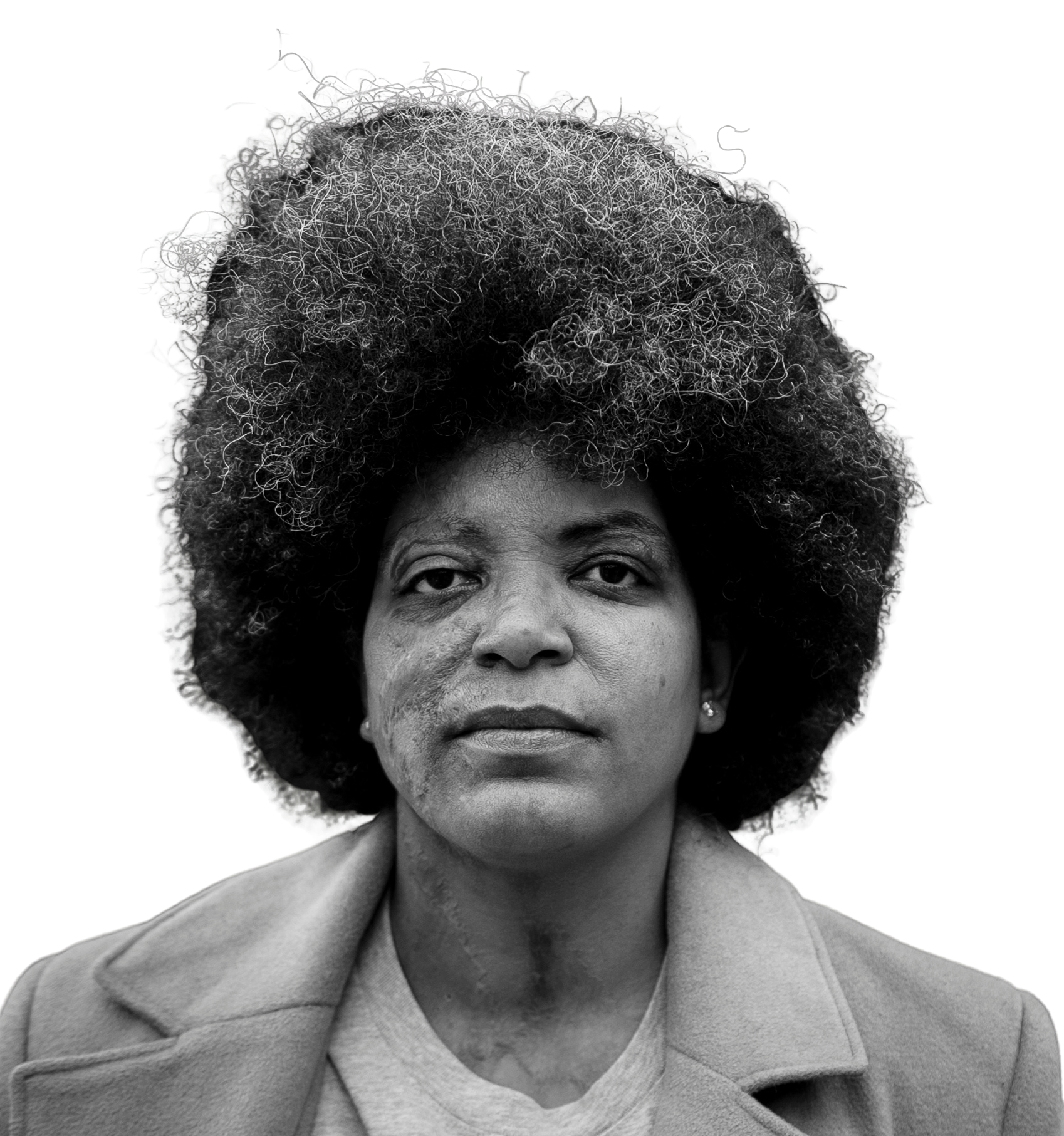
On May 7th, a state senator named Charlane Oliver climbed on top of her desk in the Tennessee Senate chamber and held up a sign that read “No Jim Crow 2.0, Stop the TN Steal.” Other senators linked arms on the floor. Neighbors from across the state chanted from the galleries. And the Republican majority kept right on voting, because they had the numbers, and within hours Governor Bill Lee had signed a new congressional map. That map takes Memphis, a majority-Black city and the heart of the only majority-Black district the state has, and slices it into three pieces. One of those pieces now runs a couple hundred miles east into rural country, with the MAGA majority praying it’s far enough that the Black vote inside it can’t decide much of anything.
That was almost three months ago. Most of the country has moved on, if they paid attention in the first place. And there’s one simple reason most of us aren’t still livid about what happened in my home state.
Tennessee isn’t on the map.
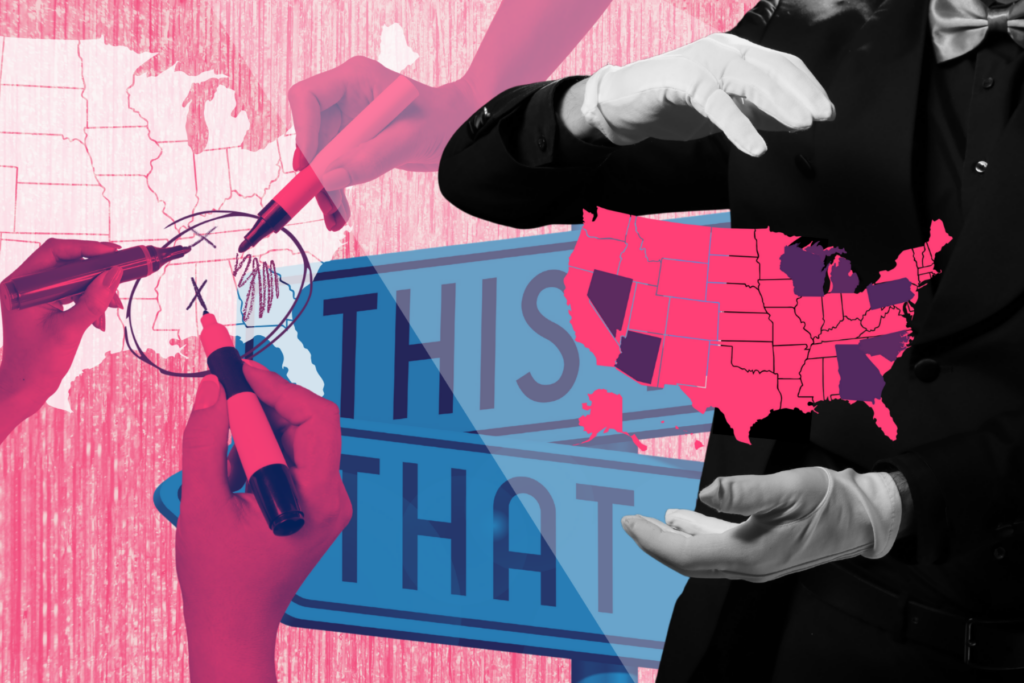
The one we’ve all been handed, the one that gets pulled up on cable every two years, with the same seven or eight states colored in: Pennsylvania, Michigan, Wisconsin, Arizona, Nevada, North Carolina, Georgia. The battleground map. It decides where money goes. It decides where field organizers get hired, where doors get knocked, and where candidates fly in for rallies. If your state is on it, you matter. If your state isn’t, you’re “safe,” and safe means skipped, conceded.
Slow media for fast times. Sign up for our newsletter.
In Tennessee, they carved up Memphis…[th]e goal, which right-wingers named without any attempt to be covert about it, is a 9-to-0 delegation in a state that currently sends one Democrat to Washington.
Tennessee is red. So nobody was surprised or interested in supporting those who were on the ground, fighting with all they had, when authoritarians carved up Memphis to consolidate their wealth and power in what essentially is a one-party state.
What actually happened, in one month
Here is what the battleground map could not see, all of it inside the four weeks after the Supreme Court handed down Louisiana v. Callais on April 29th and told the states that Section 2 of the Voting Rights Act no longer means what it meant for forty years.
In Florida, Governor DeSantis signed a new map on May 4th that redraws the state into a 24-to-4 Republican advantage and goes straight at Democratic seats in Tampa, Orlando, and South Florida. One of the clearest targets is Darren Soto’s Latino district in Central Florida. Up to four seats, gone.
In Tennessee, they carved up Memphis. To do it, the legislature first had to repeal its own decades-old law banning mid-decade redistricting, then reopened candidate qualifying so the new lines could take effect for the August primary. The goal, which right-wingers named without any attempt to be covert about it, is a 9-to-0 delegation in a state that currently sends one Democrat to Washington. And on July 23rd, a federal panel refused to block the map while the lawsuit against it continues. The judges wrote that “the road to a reliably 9-0 map runs through Memphis,” and reasoned that because the motive was partisan, the harm to Black voters doesn’t count. Early voting under the new lines opened July 17th. Memphis votes August 6th, on the anniversary of the Voting Rights Act, under a map drawn to erase it.
In Louisiana, the state that gave the case its name, Governor Landry suspended the May 16th primary outright, throwing out roughly forty thousand votes people had already cast, so lawmakers could go back and draw a map that erases the second majority-Black district, the one Cleo Fields won in 2024. He signed it on May 29th. The white voters who brought the original lawsuit are already back in court arguing that even the one remaining Black district is too many, and Black voters are now challenging the new map the only way Callais left open: proving intentional discrimination under the Constitution itself.
Three states. One month. Each one removing the ability of Black or Latino communities to elect someone who answers to them. And almost none of it became a redline or trigger moment for the majority of this country, because the places where it happened are places the map told us aren’t important when it comes to elections.
Why these places, and not the others
The battleground map measures one thing: whether a place is close to flipping. But close is not the same as where the harm is landing, what communities would flip with investment, or where our neighbors are being systemically locked out of the vote through voter suppression policies.
Look at what stacks up in these states at the same time:
- You have redistricting, fresh and deliberate.
- You have attacks on the machinery of voting: the Justice Department demanding voter files state by state, the FBI walking out of the Fulton County elections hub in Georgia on January 28th with nearly seven hundred boxes of 2020 ballots, all of it flying the banner of election security while doing the suppressing.
- And you have the thing that makes it permanent: the legal floor is gone. For four decades, Section 2 of the Voting Rights Act was the reason a state couldn’t simply draw Black people out of power. Callais took the reason away.
Where do those three things land hardest, all together? Not Pennsylvania. Not Arizona. They land in the South. They land in Tennessee and Louisiana and Mississippi and Alabama and Georgia. They land exactly where the map tells the rest of the country there’s nothing worth defending.
That is the whole point. The places taking the worst of this are the places written off as already lost.
The part that hasn’t happened yet
If you think the redrawing is over, listen to the people doing it, because they are not whispering.
In Alabama, a federal panel ruled at the end of May that the Republican map was drawn to discriminate against Black voters on purpose, and ordered the state to use a fair map for 2026. Alabama ran to the Supreme Court on an emergency basis to use the discriminatory one anyway. In the first week of June, the same six Justices who decided Callais said yes. So Alabama will run its 2026 elections, starting with the special primary on August 11th, on a map with one majority-Black district in a state where Black people are more than a quarter of the population. Terri Sewell’s seat survives. Shomari Figures’s district goes back to lines where Black voters will have to fight to carry it.
In Mississippi, the governor canceled a redistricting session this spring but went out of his way to promise that Congressman Bennie Thompson’s district, the Delta seat held by the man who chaired the January 6th committee, will be redrawn before 2027. He said Thompson’s “reign of terror” would be over. He said he is in constant contact with the White House about it.
Before Callais even came down, Fair Fight Action and Black Voters Matter Fund had projected that Republican legislatures could pick off as many as 19 additional US House seats and 191 Democratic state legislative seats across the South if they pushed every map to the limit. People called those numbers hyperbolic. Then Tennessee passed. Then Louisiana passed. Then Alabama got its stay.
Attention plus organizing can be a treatment for the illness that is voter suppression, and Georgia is the only state that’s gotten the full dose. This country has never even tried to fill the prescription in Tennessee. Or Louisiana.
Cliff Albright, who helped build the projection, wrote this June that the warning turned out to be an understatement. For scale: in the worst single election of the backlash that ended Reconstruction, 1876, four Black members of Congress lost their seats. The maps moving right now put nineteen members of the Congressional Black Caucus at risk. That doesn’t just read like a worst-case scenario. It reads like a schedule.
And then there’s Georgia
One state broke the pattern.
Georgia’s governor declined to redraw for 2026 only because voting was already underway, then called a special session for June 17th to redraw the maps for 2028 instead. Same playbook as everywhere else. For weeks, Black-led organizations and coalition partners ran calls to action across the state. Thousands of Georgians packed the Capitol. Turnout in the primaries and runoffs climbed. And on the first day of the session, Republican legislative leaders sent the governor a letter saying they would not take up redistricting at all. The session adjourned June 23rd without a single new map.
Their letter blamed pending lawsuits, and some of them admitted they worried a rushed redraw would fire up the other side’s voters in November. Pressure is pressure, and organized people generated it. There’s even a state-level voting rights act, named for Henry McNeal Turner, sitting in the Georgia Senate right now.
The one state the country has been watching, because the battleground map happens to include it, and where organized Black-led pressure met that attention head-on, is the one state where the map didn’t move.
I know you’re probably thinking: Ash, Georgia only held because Georgia is competitive, because the map told everyone it’s a battleground state. You’re right. Organized pressure raised the price of the redraw in a state where the majority has to pay that price at the polls. In Tennessee, a supermajority pays nothing at the polls, so the price has to come from somewhere else: from the lawsuit still moving through federal court, from infrastructure that outlasts one primary, from a country that finally makes taking the South expensive.
…I am not asking anyone to feel sorry for the South. I am asking us to stop using a map that was built to win one kind of election to decide where the whole fight is.
Attention plus organizing can be a treatment for the illness that is voter suppression, and Georgia is the only state that’s gotten the full dose. This country has never even tried to fill the prescription in Tennessee. Or Louisiana. The map made sure of it. Memphis on August 6th and the Louisiana challenge are the next trials, and we get to decide whether they run with us or without us.
So what are you asking, Ash?
The people in these states have been organizing the whole time. Without the field budgets, without the cable map, without the planes full of volunteers, without the donation pool, with the quiet understanding that the rest of the country had decided their states were a foregone conclusion. The map that called Tennessee safe is the same logic that let them take Memphis with barely a headline. The two things are not a coincidence. Neglect is what makes the place vulnerable, and that vulnerability is what they’re cashing in on.
So I am not asking anyone to feel sorry for the South. I am asking us to stop using a map that was built to win one kind of election to decide where the whole fight is. The country is being redrawn in the places we agreed to concede. If we keep treating them as background, we will keep finding out what happened to them months late, after the lines are already law.
The people fighting the Memphis map are some of the people who’ve been doing the work the whole time: the Memphis A. Philip Randolph Institute, Memphis for All, Free the 901, MICAH, Tennessee for All, the Tennessee Immigrant and Refugee Rights Coalition, and The Equity Alliance, the organization Charlane Oliver helped build years before she ever stood on that desk. Every one of those names is a link. Pick one, pick three, it’s one fight. If you’re far from Memphis, an hour still counts.
Winning looks like support that’s still standing on August 7th: organizations fully funded for the long haul, not the length of a news cycle. The shifts and the calls are for turnout nobody can call an afterthought. And the seat, a choice that survives November and gets sworn in, is the long fight all of it feeds. The right wing’s prayer is that money shows up too late in the electoral cycle and isn’t sustained. Support that stays, a monthly gift instead of a one-time surge, is how our movements in safely red states stop being safe to attack.
Charlane Oliver knew exactly what she was doing standing on that desk. She wasn’t going to stop the vote. She was making sure that when it happened, it happened in the light, where someone might finally turn and look.
Georgia is what it looks like when enough of us do.
I know I say it all the time these days, but: we don’t win without each other. That has never once meant just the people who are easy to reach. It has always meant the ones the map left off.
Pay attention. Fight with us. As goes the South…
Republished from Ash-Lee’s Medium with small edits.
Did you enjoy this article?
Becoming a member is the best way to ensure we keep publishing articles that meet the moment. Memberships start at just $5 a month and come along with a variety of other perks; join us today.