With horns, trumpets, clarinets and flutes belting melodies and drums laying down a beat to move the sleepiest feet, the 19-piece Brass Liberation Orchestra took the stage to open Bay Resistance’s August “Get Ready” People’s Assembly.
“All we need to beat fascism is each other,” the presentation’s lead slide reminded attendees.
The next slide laid out the stakes. “Health access, scientific advances, right to choose, public schools, LGBTQ rights, trans people, immigrant families, food assistance, voting rights, civil rights” are all threatened if pro-democracy forces can’t win and defend the election.
Several hundred people crammed into the auditorium at San Francisco’s Mission High–so many that organizers had to place a hasty order for more pizza for lunch. The morning program named the moment–electoral autocracy–and laid out the tasks.
Slow media for fast times. Sign up for our newsletter.
“Win the election so we can defend it,” Seed the Vote’s speaker said; the group is incorporating election defense information into its door-knocking in strategic states.
Be prepared to engage in mass nonviolent noncooperation in case of serious election sabotage: “No work, no school, no shopping,” as May Day Strong puts it.
This last call marks a sharp escalation from the kind of election protection work that became routine after the presidential election in 2000. That year, rioting Republicans in suits stopped the vote count in Florida, the Democrats relied on the courts, and SCOTUS handed the White House to George W. Bush.
In cities and towns around the country as well as virtual spaces, similar trainings have been rolling out, convened by national networks like May Day Strong and Indivisible, and co-sponsored by local community groups. These events prepare volunteers to exercise their constitutional rights to take action to turn back attempts to sabotage the election results.
Threats of sabotage and the groundwork for it surface in every news cycle, from executive orders that inject uncertainty into the elections to last-minute poll closings, voter roll purges, and fake voter registration sites that mine personal data. These interventions could impact certifications and seatings–possibly throwing everything into chaos when the House of Representatives convenes on January 3, 2027.
Election defenders are equipping masses of people with tactics to confront everything from the mundane to the worst-case scenario. “If we shape the narrative, if we ground in love and in our power, if we plan the work for all the phases of election protection and then work the plan, I promise you we will win,” Cliff Albright from Black Voters Matter said at one of Indivisible’s election protection trainings.
Election defense everywhere all at once
Hundreds of election-defense projects are blossoming around the country, connected by vigorous networks. They draw on participation from legacy groups such as the Lawyers’ Committee for Civil Rights Under Law, the ACLU, and Common Cause; organizing networks like People’s Action; and some labor unions. They’re powered by newer organizations and fueled by the energy of tens of thousands at the grassroots. They identify emphatically as non-partisan, and cover the political spectrum from the committed Left to Republican Never-Trumpers.
Networks
May Day Strong has been building its network of labor and community groups since 2025. Under the banner “Workers Over Billionaires,” the network is pairing election defense with advocacy for its affordability agenda. This includes a Corporate Accountability Week of Action in October to call out corporations it has identified as “pillars of this administration’s anti-worker billionaire agenda”–and call them in to supporting democracy.
Democracy Defenders Fund is one of the founding members of the non-partisan Election Safeguards Response Network (ESRN), which is helping to anchor “an unprecedented level of communication and coordination” among vote protectors across the country, Maria Peralta said. “We all need to recognize our superpowers and make space for each other, lean in on what we know how to do best,” she added.
With chapters across the country, including in less-organized rural and small-town areas, Indivisible is turning its capacity to quickly mobilize mass numbers of people toward election defense. Through their Battlegrounds Election Defense Corps, volunteers are learning about specific threats and preparing for rapid response. SURJ (Showing Up for Racial Justice) has been doing scenario planning, forming collaborative networks, and training its base for election defense.
Tending the Soil, an alignment of five BIPOC-led groups in Minneapolis, called a grassroots gathering together in Minneapolis in August. We Are Ground Control exists to connect volunteers with democracy-defense opportunities. The group vetted 800+ groups and came up with a list of 65 that connect people to election work tied to durable organizing, on a website searchable by zip code.
Trainings and Tools
These networks are offering training and toolkits to empower concerned community members to take up the election work where they are. ESRN offers a “Hands Off Our Vote” toolkit. Hold the Line, developed by a group of people with deep experience in nonviolence training, offers a step-by-step guide, online training, and ongoing support to empower people to build small, local election defense teams. They start by asking people to “figure out what else is going on in your landscape and figure out if you want to tap into it,” said Hold the Line co-founder Hardy Merriman. “But in a lot of parts of the country, it might be that people say, actually, we’re gonna be the infrastructure. We’re gonna be the thing that other people tap into. And we wanted to create something that could enable that…we try to make it simple by letting people know that it starts with finding a few friends or neighbors.”
The Commons Library makes a wealth of resources accessible, including the guide to election defense scenarios developed by Daniel Hunter and Choose Democracy. The No Kings Coalition is hosting a series of election protection trainings throughout October, and offers links to past trainings here.
Statewide, local and sectoral preparations are rolling out alongside those offered by the national networks. For example, the Arizona Center for Empowerment and LUCHA (Living United for Change in Arizona) are hosting Constitutional Observer Trainings every Monday until Election Day to train poll monitors. In New York City, HandsOffNYC held a two-day election defense training in conjunction with Freedom Trainers, the New York Central Labor Council, the Interfaith Center of New York, the New York Immigration Coalition, Make the Road NY, the NAACP and Common Cause.They are following up with sector-specific and organization-specific trainings, and with high-visibility actions to build their numbers and collective muscle.
GenVote’s “Power Back” tour/Election Defense Movement School drew in youth and students in 12 cities and rural communities across Texas, Arizona, North Carolina, Florida, and Michigan.
LookLoud offers free tools for organizers for creating large colorful banners containing messages that call out the regime’s attempts to rig the election while demonstrating that mass numbers of people are fighting back. Their visuals make the resistance visible, and joyous, which encourages others to get involved.
An alliance of artists and musicians provides a downloadable playlist for GOTV events called Joy to the Polls. Concerts and rallies are taking place throughout October in Philadelphia, Atlanta, Raleigh, Durham, and Phoenix.
Build the early vote
Across the ecosystems, organizers are building the early vote as a foundation for election defense. Early voting can reduce the impact of attacks on Election Day and questioning of the count afterwards. The work started with registration drives, targeting diverse communities. Color of Change and Black Voters Matter focused on Black voters through canvassing, phone-banking, and social media messages, for example. MPower Change held a National Muslim Voter Registration Day and produced a multilingual series of videos to encourage and inform voting. As part of their efforts to get out the vote, groups are urging people to check their voter registration and update it if needed.
Seed the Vote, Working Families Party, and many other groups from local to national in scope are urging early voting in their GOTV organizing. People’s Action has been training thousands of volunteers to engage prospective voters in deep conversations about their concerns and hopes, demonstrating how joining with others can help them address their concerns and act on their hopes.
The October 17 No Kings mobilization built on the momentum of the three previous No Kings events that brought 20 million people into the streets–and harnessed the power of protest to amplify voting. With 10 days left before the big day, volunteers had already put more than 3500 events on the map around the country, in all kinds of communities, aiming to turn out the largest early vote in US history. Where election calendars allow, these events included going to the polls or dropping off mail-in ballots en masse. Organizers combined this push for early voting with joyful, cultural moments–from live music to flash mobs, barbeques, and Halloween costume contests, and even a “paws to the polls” dog walk. These events encourage early voting and also build support for post-election actions, whether those are monitoring vote counts, making calls to action, or escalating tactics in the face of efforts to subvert election results.
Protect voting, secure each vote
In meetings and mass calls, at the doors and on social media, the message comes through: election protection starts with securing each vote, especially given the chaos of changing rules that is part of the ongoing election sabotage. Organizers advise everyone to check their voter registration and update it if needed; take ID and documentation to the polls; demand a provisional ballot if they’re told they can’t vote.
And the mechanics of elections need attention, too. We’ve seen threats before, but not at this scale, and not with an administration that states its intent to intervene in the mechanics of voting, telegraphing its intentions to reject results they don’t like. Each group in the election defense ecosystem is preparing for these escalating attacks on voting and elections:
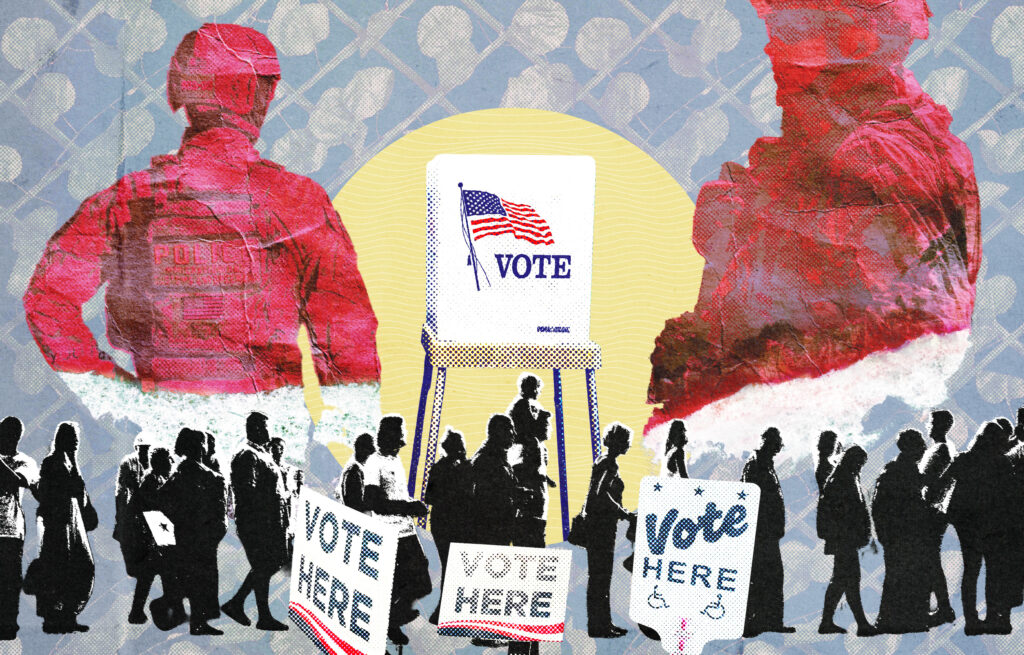
- Deploying ICE or the National Guard at polling sites. The threat to deploy ICE and the National Guard at polling places may have the intended effect of deterring eligible voters from immigrant communities. It is not legal, but challenging the law seems to be part of the regime’s playbook, along with attempts to create a crisis that justifies federal intervention. They know they will be sued; they also know this will take time. Even as early voting starts, ICE has been ordered to escalate arrests. The regime has exchanged militarized occupations for stealth abductions, but the pace of deportations has only picked up. Some of these raids appear to target contested Congressional districts, such as the 22nd district in California’s Central Valley.
- Immigrant justice groups like LUCHA in Arizona and the Immigrant Defense Network are guiding the prep work so canvassers can reassure voters and so poll-watchers can stand up to federal agents. ICE Watch will be involved in rapid response at the polls, looking out for harassment and illegal presence of ICE agents or the National Guard.
- Attempting to intimidate and/or mislead voters. There will be people at polling places who will question Black and Brown voters’ rights to vote. Most of them will be MAGA election deniers–but some may be from the US Department of Justice’s Civil Rights Division, which was created in part to ensure that Black and Brown citizens can freely exercise their right to vote. Volunteers also are preparing to help redirect voters who show up and find that their polling place has changed. And also to advise them that if there is any problem with their registration, it is their right to request and submit a provisional ballot.
Voters can get help if they think their ballot will not be counted by calling the Election Protection Hotline at 1-800-OUR-VOTE to report any issues. But the nonpartisan hotline, anchored by the Lawyers’ Committee for Civil Rights and fortified by some 300 partner groups, can also help with questions at earlier phases of the voting process–and connect voters with help in 11 different languages. - Harassing or targeting election workers. The DoJ and Homeland Security continue to threaten election officials with criminal prosecution for allowing undocumented people to vote (which they don’t do) or for not complying with Trump’s new election rules (which they don’t have to do unless their state legislatures comply). These threats are meant to wear election officials down so that they will fold under pressure. In states like Ohio and Georgia, coalitions of non-partisan pro-democracy groups, including All Voting Is Local, are drawing attention to these threats and offering support to local election officials who want to run free and fair elections.
- Monitoring vote counts, ballot curing, and recounts. Indivisible volunteers, Black Voters Matter, and local groups that are part of ESRN are prepared to stand up to election deniers who get aggressive during the vote counts and ballot curing. They also are preparing for recounts, with support from legal defense teams at the Lawyers’ Committee, ACLU and others. Some races will be tight; recounts are likely.
Women’s March is planning coordinated local actions to protect the vote called “Women Take Back.” They’re thinking about “the process and intent behind the clinic escorts that women have been doing for many years around abortion clinics….we’re keeping ourselves safe, escorting folks, taking back the night, taking back our rights, and standing watch,” Executive Director Rachel Carmona said. She drew a direct line from bodily autonomy to election defense, citing the lack of consent that pervades the actions of the Trump administration, from the sexual assault charges against the President himself to “having people who have been accused of rape in his cabinet, from having a war without consent to having ICE incursions in cities without consent, and in fact, stealing elections, which is a lack of consent at the level of democracy.”
Refuse to cooperate
One of the worst-case scenarios–the House refusing to seat duly-elected Democrats–is not far-fetched, given Speaker Mike Johnson’s pledge to make sure Republicans retain control. Johnson has signaled his willingness to fire the nonpartisan clerk and install someone who will refuse to list Democrats on the roll of those elected to the 120th Congress. The crisis this would precipitate includes lawsuits, more refusals, and cases that may go all the way to the Supreme Court. During these weeks or months of delays, Congress would be paralyzed.
To prepare for such a blatant power-grab and other post-election chaos, organizers have drawn lessons from anti-authoritarian movements around the world.
“The movements that I’ve seen be most successful are the ones that use protest or civil disobedience and nonviolent intervention as on-ramps to get people to noncooperate,” said Hardy Merriman. “Noncooperation for me is about helping people understand that really one of the most powerful things they can do is to go beyond protest, actually shift their behavior and obedience patterns in targeted and strategic ways.”
While many forms of protest are symbolic, noncooperation aims to disrupt society’s routine functions until the injustice is righted. It includes a multitude of tactics that carry varying levels of risk, such as consumer boycotts and divestment, strikes and work slowdowns, occupations of public spaces and closures of roadways. Think, for example, of the San Francisco General Strike of 1934, or the Montgomery, Alabama bus boycott of 1955-56.
Make violence backfire
Under the umbrella of noncooperation, groups have developed different guiding frameworks. One such is a strategy for making authoritarian abuse backfire. Australian social scientist Brian Martin originated the backfire strategy; Harnessing Our Power to End Political Violence (HOPE PV)–a project of the 22nd Century Initiative, Horizons Project, and Political Research Associates–has refined it and mapped ways it can be used in election defense.
Backfire is both an organizing and a narrative strategy, built on five steps (sometimes called the five R’s). As explained by Merriman, author of the HOPE-PV guide, they are:
- Reveal – Reveal the injustice, and show that people are ready to resist.
- Redeem – Humanize the target of abuse, bridge social distance with key communities, and counter attempts to devalue the victim.
- Re-frame – Seize the story, define who the perpetrators are, and make demands about what must change.
- Redirect – Call on people to mobilize and take action to support people or groups targeted with abuse, or to impose costs on those who perpetrate or enable abuse. Don’t rely on official channels to deliver justice.
- Resist – Stand up to intimidation or attempts to bribe people into silence or inaction. Make new authoritarian attacks backfire.
Organizers in Minnesota made the ICE murders of Renee Good and Alex Pretti backfire during Operation Metro Surge. Mayor Zohran Mamdani is illustrating how an elected official can make violence backfire as he speaks out against a recent surge in ICE violence in New York City, including one recent death.
Bring down the pillars
Back in the auditorium at Mission High, Bay Resistance described five pillars of authoritarianism. Authoritarian regimes depend on different sectors of society going along with them and upholding their legitimacy, especially business, the military and police, the media, faith institutions, and civil servants. Nonviolent action and noncooperation can weaken these pillars, especially when activists form relationships with people on the inside of these sectors who can resist and refuse to comply with illegal orders.
Groups in the May Day Strong network are already systematically targeting corporate pillars. The Corporate Accountability Week of Action in early October called out corporations it has identified as “pillars of this administration’s anti-worker billionaire agenda”–and called for them to support democracy. Hands Off NYC and May Day Strong did this with a banner drop in Grand Central Station, followed by a march to JP Morgan Chase. The week of action also focused on Target and Amazon/Whole Foods.
Bay Resistance is developing strategy keyed to the San Francisco Bay Area’s unique position: the region is home to deep-rooted social movements as well as the tech billionaires who finance and equip MAGA. This makes it a particularly significant site for economic noncooperation should that be needed to defend the election results. They also encourage Bay Area activists to deploy to the most vulnerable areas, in states and localities where voters are being intimidated or blocked from voting, where votes are at risk of not being counted, or where legitimately elected candidates are at risk of not being seated.
They and others recognize that turning back election sabotage will require sustained mobilization. The call issued last spring by Act Free to Be Free is echoing across the election defense ecosystem: “If they try to take our right to free and fair elections, we cannot have a ‘day of action.’ We need to suspend the daily order of things.”
Did you enjoy this article?
Becoming a member is the best way to ensure we keep publishing articles that meet the moment. Memberships start at just $5 a month and come along with a variety of other perks; join us today.