
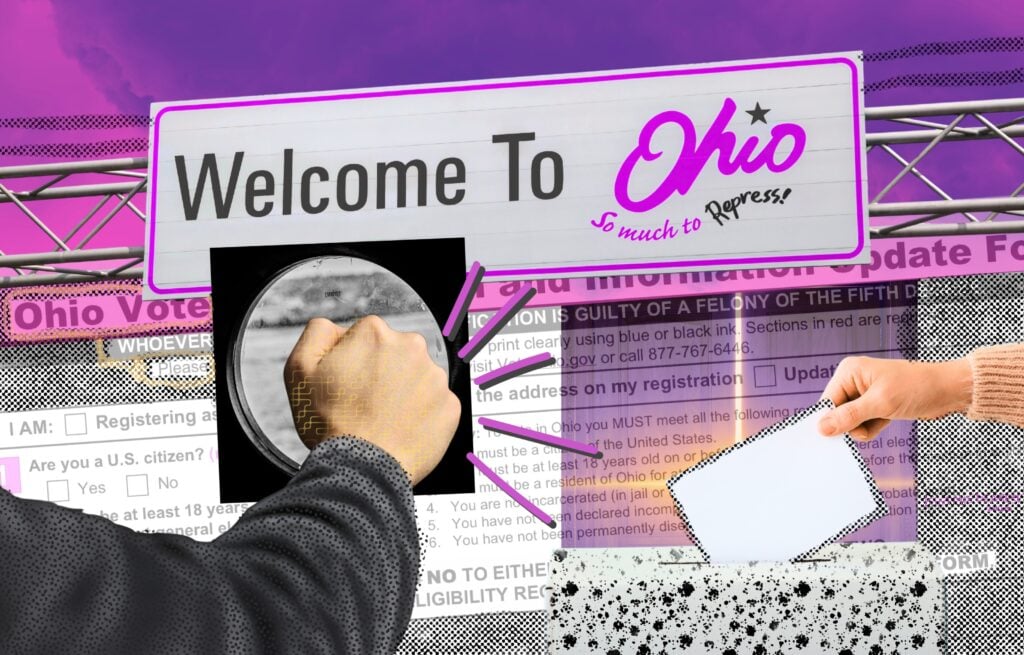
On Thursday, June 11, FBI agents searched the Cleveland offices of the Ohio Organizing Collaborative and fanned out across the state—to the homes of its leaders, its staff, and people who had done nothing more than basic canvassing. The agents carried subpoenas. They seized laptops and phones. They knocked on doors in front of children and asked everyday Ohioans whether they were committing voter fraud. A Collaborative board member put the count at more than one hundred agents.
I want to be precise about what happened here, because precision is the most damning account. The loose version of this story—they’re trying to steal the election—is both too big and too small. Too big, because there’s no evidence of a mechanism to cancel a vote that hasn’t happened yet. Too small, because it lets you treat this as a single outrage rather than what it is: a repeatable procedure, run before, run elsewhere, and run again.
This is a procedure, not an incident
Read it next to the rest of the year. In February, the Bureau raided a Georgia election hub tied to the 2020 conspiracies. Agents have opened inquiries into voting protocols in Wisconsin, subpoenaed voting records in Arizona, and sought reviews of voting machines in Puerto Rico. Prosecutors in California have gestured at the Los Angeles mayor’s race after the president suggested, with nothing behind it, that the result was rigged.
Ohio is not a departure from that sequence. It’s the next entry. And the targeting is legible: the Collaborative works in Cleveland, Columbus, and Cincinnati—the liberal anchors of a state that has otherwise trended toward authoritarian candidates, and the metros where the voters are youngest and Blackest and most underrepresented on the rolls. You don’t need a leaked memo to read that map. The map reads itself.
Slow media for fast times. Sign up for our newsletter.
How you manufacture fraud from compliance
Here’s the part that requires honesty, because the regime is counting on us to be sloppy with it.
Any operation that registers voters at scale, using paid or volunteer canvassers, will generate bad forms. This isn’t a secret and not a scandal; it’s arithmetic. When you pay people per form collected—and county officials have noted that these groups do—a fraction of any large workforce will cut corners, and a few will fabricate outright. The Collaborative isn’t immune to this. In 2017, one of its paid canvassers pleaded guilty in a registration-fraud scheme. That happened. Pretending it didn’t only hands the other side the argument.
None of it—none of it—explains a hundred-plus federal agents conducting predawn visits to canvassers’ homes across an entire state, seizing devices, and interrogating volunteers on their porches in front of their kids.
Minor, self-flagged, routine paperwork errors don’t summon that machinery.
But hold the next fact next to it: In most states, including Ohio, a registration group cannot simply throw out the suspicious forms it collects. It is required to submit them, and to flag the questionable ones for election officials to catch. That’s the law working exactly as designed—the bad forms get turned in, marked, and screened out before a single fraudulent ballot is ever cast. Which is precisely why the experts keep telling you that voter fraud is vanishingly rare and that altering an actual outcome would take a massive, coordinated effort that has never once materialized.
So when federal agents seize the records of a group that did what the law requires, they’re not discovering fraud. They’re collecting the paper trail of compliance and preparing to recast it as guilt.
I strongly believe they are not investigating fraud. They’re, in a manner of speaking, manufacturing it—out of the very compliance the law demands.
The disproportion is the whole story
This is the line I’d ask you to hold onto, because it survives every counterargument the other side has.
Concede the bad forms. Concede the 2017 plea. Concede that a paid-canvass operation is an imperfect thing run by imperfect people. None of it—none of it—explains a hundred-plus federal agents conducting predawn visits to canvassers’ homes across an entire state, seizing devices, and interrogating volunteers on their porches in front of their kids.
Minor, self-flagged, routine paperwork errors don’t summon that machinery. The gap between the conduct and the response isn’t a detail of the story. It is the story. When the punishment is wildly out of scale with the offense, the scale is telling you the offense was never the point.
Here are some examples of instances when disproportionate crackdowns made the case that they were politically motivated:
The Fugitive Slave Act renditions (1850s)
The clearest early case. To return Anthony Burns, one escaped man, to slavery in 1854, the federal government locked down Boston, deployed troops and marshals, and spent a sum often put in the tens of thousands—a lot of money back then—to march a single person back into bondage past crowds of thousands. No one needed an army to recover one enslaved laborer. The army was the message—to abolitionists, to the enslaved, and to a North being told that the slavocracy could command federal force on free soil. The scale announced that the point was the legitimacy of the system, not the recapture.
The Black Codes and convict leasing (Reconstruction onward)
This is the anchor case, and the purest version of the logic. The “offenses” were vanishingly small by design: vagrancy, loitering, not carrying proof of a labor contract. The response was forced labor, the chain gang, a carceral apparatus that re-subordinated an entire emancipated population. The triviality of the trigger and the enormity of the response, taken together, tell you the offense was a pretext for restoring control over Black labor. When the “crime” can be anything, the crime was never the point.
Haymarket (1886)
Four anarchists hanged for a bombing none was shown to have committed. The evidence connected them not to the act but to their speech and their organizing for the eight-hour day. Executing the orators to punish a thrown bomb is a disproportion that points straight past the defendants to the labor movement the state actually wanted broken.
[T]he likeliest payoff—to pre-build the evidentiary theater for contesting results they don’t like.
The Palmer Raids (1919–1920)
Thousands arrested in coordinated nationwide sweeps, often without warrants or charges; hundreds of immigrants deported over the nominal offense of foreign radicalism. The dragnet was so indiscriminate that the mismatch between the procedure and any individual wrongdoing was itself the tell: the target was the immigrant left and the labor movement, with the goal of chilling everyone adjacent to them. Note how cleanly the voter fraud welded to the ‘noncitizens’ frame rhymes with this.
Japanese American incarceration (1942)
A hundred and twenty thousand people imprisoned on the “offense” of ancestry, dressed as military necessity. Here the offense was essentially nonexistent, and this was known to the government. This is the limiting case of the principle: when the response is total and the offense is null, the response is the whole truth. Race was the point.
Fred Hampton (1969) and the MOVE bombing (1985)
The two that rhyme most directly with Cleveland, because both were pre-dawn or all-out raids on a home. Hampton was killed in his bed in a raid built out of COINTELPRO’s war on Black political organizing—the nominal pretext nowhere near the scale of the operation. In 1985, Philadelphia police dropped a bomb from a helicopter onto a row house over charges that began as parole violations and weapons counts, killing eleven people including five children, and burning down sixty-one homes. You don’t bomb a city block to serve a warrant. The destruction of the block was the point—the destruction of a Black radical commune and a warning to anyone like them.
Back to Ohio: The immigration seam
There’s a second frame being stitched to the first, and it’s the one I’d watch most closely. Last fall, Ohio’s Republican secretary of state referred more than a thousand apparent noncitizen registrations to the Justice Department, along with a claim that 167 noncitizens had cast ballots across four federal elections since 2018. It’s not yet confirmed that Thursday’s search grew from those referrals. But note the choreography: as agents moved on the Collaborative, the US Attorney for the district was in Washington at a press conference announcing immigration cases.
That’s the fusion to watch—voter fraud welded to noncitizens. It’s a more durable narrative than fabricated forms, because it runs on the engine the regime already has at full throttle. If you want to know what story they’re building, watch which two fears they’re trying to braid together.
What it’s actually for, and what we do
Strip away the maximalism, and the function becomes clear enough. This action is built to intimidate the people who register voters, to chill registration in the precincts where it matters most, to manufacture a fraud narrative with the borrowed authority of a federal seal, and—the likeliest payoff—to pre-build the evidentiary theater for contesting results they don’t like. That last one isn’t speculation. It’s the 2020 playbook, started early. The investigations are the props; the contestation is the show. Could it escalate toward something worse, toward pretexts for delaying or voiding a count? It’s a tail risk worth naming. It’s not the base case, and we lose credibility if we lead with it.
Register more voters, in the same precincts, more visibly, this month. The chilling effect only works if we cooperate with it.
So we don’t take the bait. We don’t amplify the fraud frame by panicking inside it. We name the procedure for what it is—intimidation dressed as enforcement—and we make the disproportion impossible to look away from. We get lawyers to the canvassers and we don’t let a single volunteer stand on a porch alone. And we register more voters, not fewer, because the entire point of the exercise is to make us flinch.
A hundred agents isn’t a sign of strength. It’s the number you reach for when the case is thin and the clock is short. They’re telling on themselves. Our job is to make sure everyone can read it.
So here’s the work
General resolve is not a plan. If you run a voter registration program, or you support one, here is what “not flinching” actually requires you to do, starting this week.
Get legal in place before the knock, not after.
Every organization that registers voters needs counsel on retainer or a committed pro bono firm now, plus a one-page rapid-response protocol that everyone—staff and volunteers—has read. Put a 24-hour legal hotline number on a card and in every canvasser’s phone. The single most important sentence in this whole piece, operationally, is this one: no one talks to a federal agent without a lawyer present, ever, full stop—not to “clear things up,” not to “just answer a few questions,” not to seem cooperative. That isn’t obstruction; it’s the most basic exercise of a right, and agents are trained to exploit the instinct to be helpful. Train people to say one line: “I won’t be answering questions; I want to speak to my lawyer”—and to repeat it.
Know exactly what happens when agents arrive.
Designate, in advance, who is the on-site point person at the office and who is the backup. That person’s job: ask whether agents have a warrant, ask to see it, read what it actually authorizes—the address, the items, the scope—and confirm whether it’s signed by a judge. A subpoena is a demand for documents on a timeline and gives you the chance to respond through a lawyer; a search warrant lets them search now. You do not have to consent to anything beyond what a warrant specifies, and you should say clearly, out loud, “I do not consent to any search beyond this warrant.” Don’t physically interfere, don’t lie, don’t destroy anything—but don’t volunteer access, passwords, or statements either. Film the encounter if you safely can.
Practice good data hygiene as a standing discipline
Collect only the voter data you actually need and retain it only as long as you must. Encrypt devices and drives, use strong passcodes rather than biometrics (fingerprints, retina scans, facial recognition, etc.) where you can, keep secure backups offsite so a seizure doesn’t erase your operation, and move sensitive internal coordination onto encrypted messaging. The goal is simple: a seized laptop should yield as little as possible, and losing it should not stop your work.
Build the buddy system into the schedule, not the afterthought.
No canvasser works a door alone in a targeted area. Pair people, check in on a preset cadence, and stand up an accompaniment roster so that anyone who is visited at home—especially in front of their kids—has a trained person and a lawyer’s number within reach within the same hour. Burnout, fear, and isolation are the actual weapons here; the schedule is where you defeat them.
Stand up mutual aid across organizations before anyone is hit.
The regime’s method is to isolate one exposed group and turn a coalition into a series of private, frightened calculations. Refuse the isolation in advance: agree now, in writing, that when one organization is raided, the others show up: with statements, with legal support, with money, with bodies at the press conference. Pool a rapid-response legal defense fund across the field so no single group faces the cost alone. Solidarity that has to be invented after the fact of being targeted arrives too late.
Discipline the message—yours and your members’.
Brief your people on how to talk about a raid before one happens. Lead with the disproportion (a hundred agents, porches, children) and the lawful compliance that’s being recast as guilt. Do not repeat the fraud allegation to “debunk” it; repeating it spreads it. Don’t lead with the most catastrophic interpretation; name the documented function—intimidation dressed as enforcement—and let the facts carry it. Designate trained spokespeople so the story doesn’t get told by whoever is most rattled.
And do the thing they are trying to stop.
Register more voters, in the same precincts, more visibly, this month. The chilling effect only works if we cooperate with it. The most powerful answer to a hundred agents is a registration drive that is larger the week after than it was the week before, run by people who know their rights and know they aren’t standing on that porch alone.
If you take nothing else: get the lawyers lined up, build the buddy system, network the mutual aid before the next raid, and keep registering. That is what it looks like to make the disproportion backfire instead of work.
Did you enjoy this article?
Becoming a member is the best way to ensure we keep publishing articles that meet the moment. Memberships start at just $5 a month and come along with a variety of other perks; join us today.