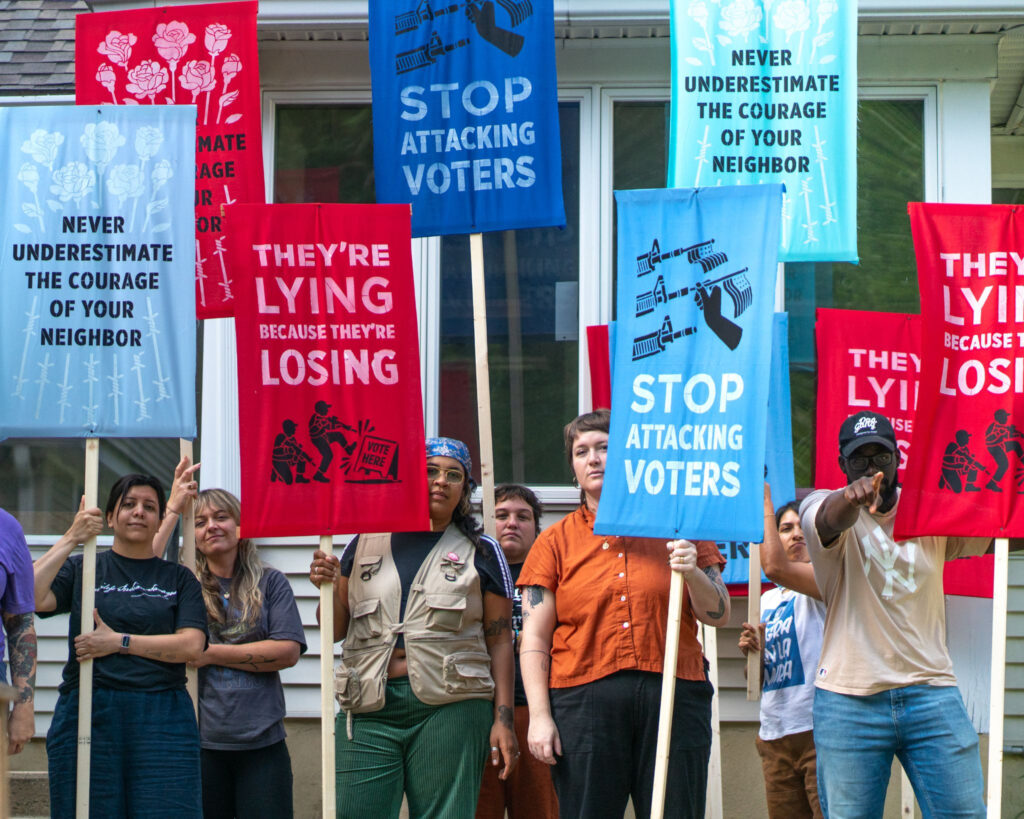
Convergence: Tell us about your shareable election defense visuals. What are these tools you’ve created?
Rachel Schragis: Earlier this month we released an online drive of visual resources our movements can use in our efforts to prevent and respond to election sabotage and interference, before and after the midterm elections in November. The drive holds a set of fully fleshed out designs, design elements, and photographs that any group can use in the ways they see fit. You can see it at lookloud.org/electiondefense.
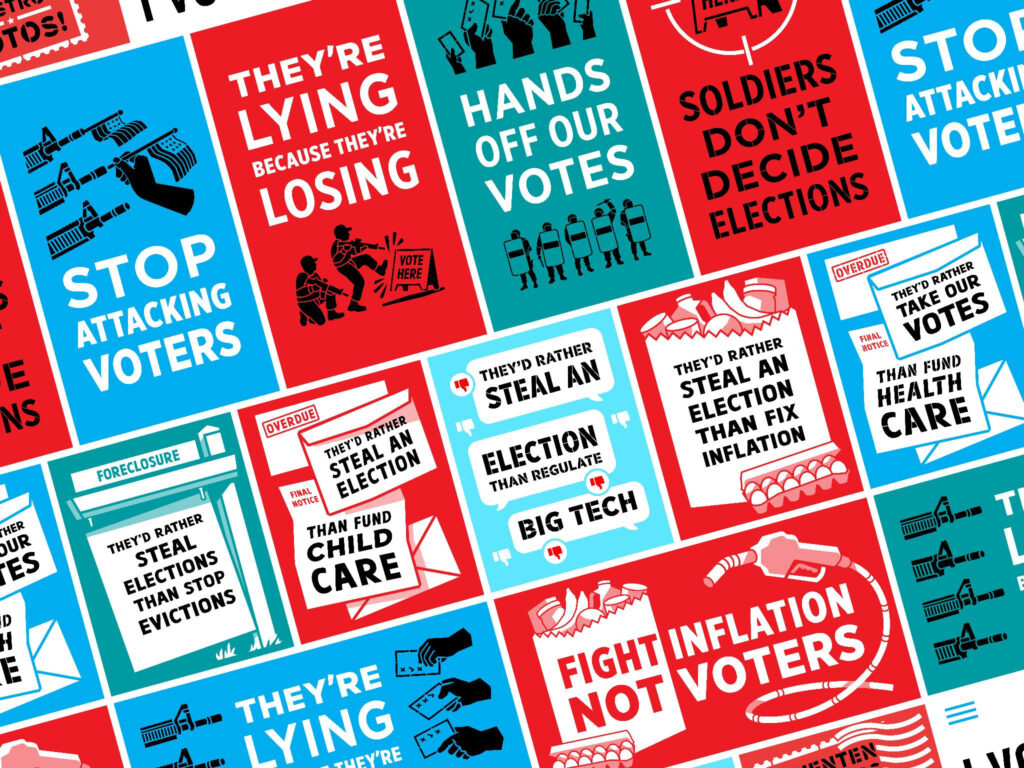
The drive includes four kinds of imagery that our movements could need in the upcoming months:
- Imagery that directly accompanies the core message, “Hands Off Our Vote” that so much of the country has coalesced around;
- Imagery connecting election defense to the real stakes of affordability in our lives;
- Imagery pre-figuring resistance to the sabotage and intimidation, and
- Imagery addressing fraudulent interference related to mail-in ballots and the postal system.
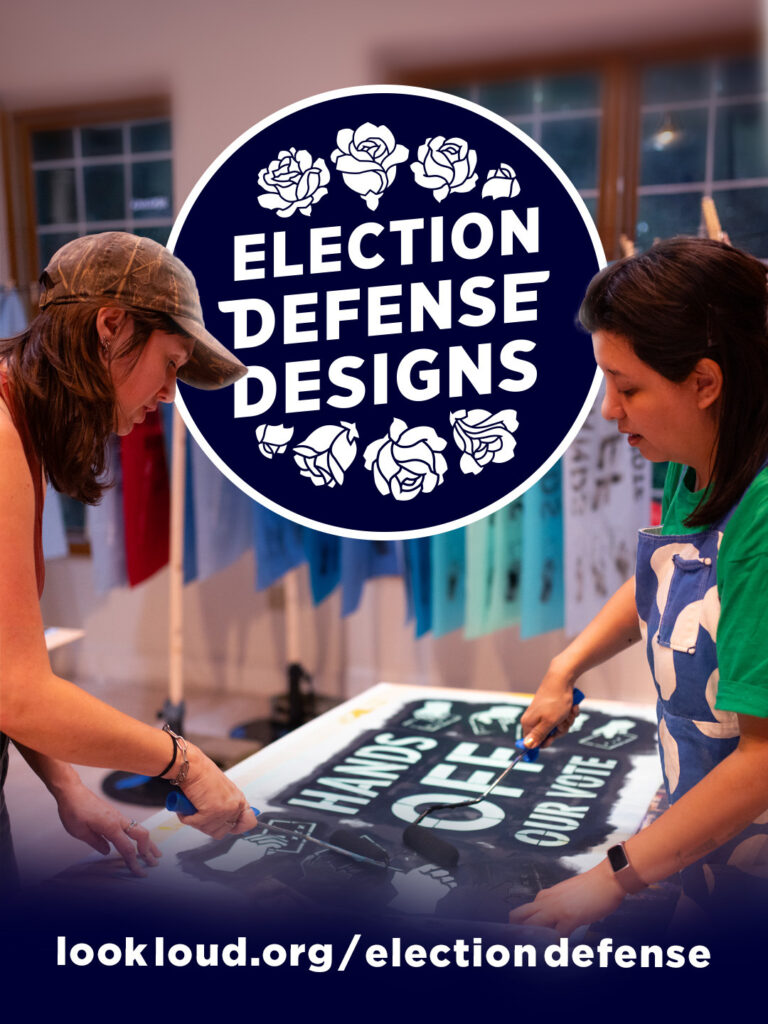
The drive includes everything we could think of creating that could make it easier to use visuals in midterm organizing. There are files prepped to make it easier to send designs to a printer, post designs online, hand-paint designs from a projection, or print them by hand using a stencil. There are photos, customizable design files in Illustrator, design elements isolated as clip art, lists of suggested slogans, and how-to guides for all the technical skills you need to pull it off. We also offer more writing from us on why we did this project, and a form to keep in touch or ask us questions.
Convergence: What’s the role of your work in addressing the strategic goals in this moment? And more specifically, how do banner designs about the voter suppression in the midterms address the moment?
Slow media for fast times. Sign up for our newsletter.
Rachel: We were first asked to take on an election sabotage preparedness project in 2020. Even that long ago, we observed that there was rigorous theory in our movements of how we beat back the encroaching authoritarian efforts to sabotage elections—but we also saw a gap between the research and the complex realities of organizing our people to rise to the moment. These designs are an attempt to help bridge that gap.
Josh Yoder: Our people need to see some momentum around voter suppression before they’ll mobilize around it. This isn’t unique to this issue. One of the things we saw working in the climate justice movement is that as soon as you present a plan, a lot more people start believing in climate change. Most people will acknowledge the problem after they see a plan to fight it. And for the record I think that’s reasonable.
This is also true in research from FrameWorks Institute. People aren’t getting mobilized by messaging about voter intimidation or ballot tampering alone. People are mobilized by seeing resistance, like ICE protests in Minnesota. Sign and banner designs are a good way to show there’s resistance happening. That might look like joy in the face of repression. It might look like anger. Sometimes it’s both. There’s both in the drive.
Rachel: Daniel Hunter from Freedom Trainers says, “Preparation is a form of power.” In the labor movement, you show the boss how serious you are about striking by making the signs, and sending him a photo. So if you apply that to this strategic moment, seeing piles of signs is a tangible way of conveying that we are making a plan! In the drive there’s a whole folder of photos that we took. These are for any organizer to grab and use in their fliers, IG graphics…wherever our movements need to show ourselves that the work to stop the theft of elections is real—we’d invite you to use our photos to help.
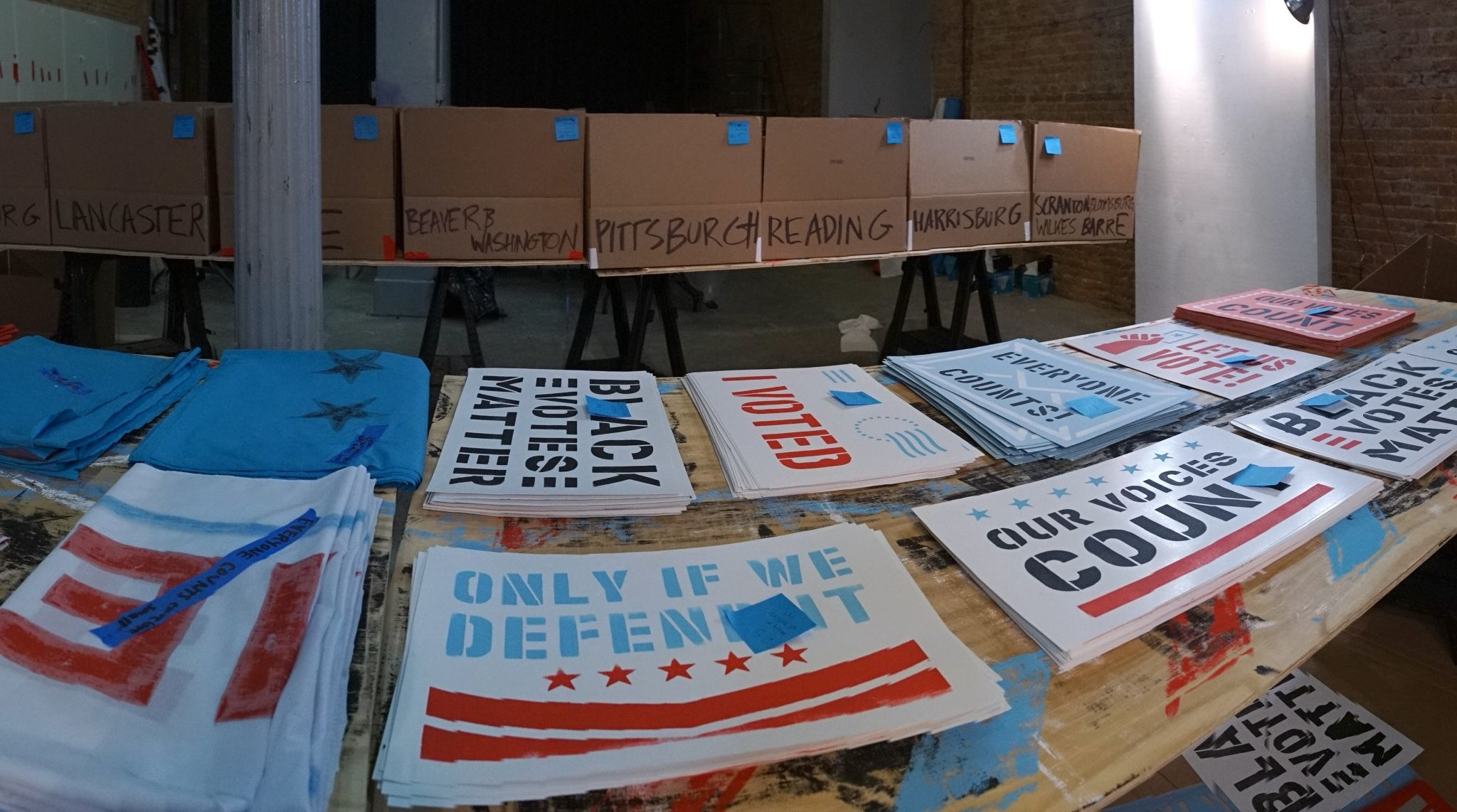
Rachel: Just having an on-point sign or banner can do so much to build power. But what’s most electric to me about visuals as a component of organizing strategy is that the very process of making it builds power, too. My mentor Jenny Romaine at Jews for Racial and Economic Justice says, “A production cycle is a guaranteed win.” By that she means producing visuals together can be the good news even when there is no good news, and the process of doing it together provides an experiential, collaborative roadmap of the process of organizing. In this time of despair and uncertainty, people are hungry for tangible ways to see and feel how enormous our potential collective power is. Designing and producing signs and banners meets that need.
Convergence: How do you develop organizations’ capacity to do visual strategy themselves?
Josh: We mostly work directly with groups on the ground. But a lot of siloed groups are developing messaging around the same issue right now. Design libraries like this work as a “see it, do it” model. New messaging, especially in short slogans, is deceptively labor-intensive to develop. But once it exists, it’s easy to imitate and adapt — and that imitation and adaptation builds capacity for the ecosystem.
Rachel: Capacity building happens on two levels for us: first the direct accompaniment and sharing concrete tips, and then the modelling of what’s possible. We do our best to share the stories of what we learn in our collaborations at our trainings, on social media, through storytelling at art builds we run, and via a tin of stickers we carry with us everywhere to cross-pollinate the imagery and stories of movements we support. So that others can “see it, do it,” as Josh said.
Convergence: Creating the content for the election defense drive must have involved a lot of testing and refining. Tell us how you found the most resonant images and messages?
Rachel: These designs started with a literature review of all the messaging and organizing guides about election defense that we could get our hands on. Then we held two listening sessions, attended by about 50 organizers, comms people, and cultural workers from organizations involved in election defense across the country. We used the research we’d read to craft questions about how our movement’s theory translated into their work on the ground. We leaned on resources written by Freedom Trainers, Election Safeguards Response Network, May Day Strong, and FrameWorks Institute.
From there, we narrowed down to a design committee of about 15 people who expressed an investment and understanding of our work- including staff and leaders from All Voting is Local Georgia, All Voting is Local Pennsylvania, Democratic Socialists of America, FrameWorks Institute, Grassroots Power Project, Hands Off Ohio, Hands Off NYC, Jews for Racial and Economic Justice, Loud Light Kansas, May Day Strong, People’s Action, Southerners on New Ground and Strong Economy for All.
Josh: Like most big listening projects, different organizers had very different needs for their messaging, and these needs often conflicted. Everything in the drive is designed for people to riff on and adapt to their own needs. So the ultimate evaluation will be how people use it.
Some of this is new messaging that will probably feel uncomfortable. A lot of organizers we work with expect new messaging to “feel right” when they hear it, but in my experience most new messaging “feels wrong” to most of us, myself included. It feels wrong when it’s brainstormed. It feels a little less wrong when it’s mocked up as a sign design. And it doesn’t start feeling right until it’s being held by a crowd of people in the street. That’s part of the point of this design drive. Make some “new” messaging feel real enough to be worth debating.
Convergence: Please tell us a bit about the choice to make a red, white, and blue option. What do you say to people who see it as being soft on American imperialism?
Josh: My family background is Amish and Mennonites. One of the key tenets of those faiths is that you do not fly flags because of our history of being forced to fight in Europe’s religious wars. Which is to say, picking up an American flag isn’t a casual thing to me.
If we have to mobilize against white supremacists trying to shut down polling places in November, the news story is going to be, “Some people are trying to destroy democracy and some people are trying to save it.” If the news cameras show up to a crowd of “patriots” facing off against a crowd of people who won’t touch the flag, people who would otherwise be on our side are not going to see us as the ones trying to save democracy. Better to both be red white and blue and force people to look more closely at our values.
Rachel: In our listening sessions we heard the contradiction loud and clear: to do the political work this drive needs to do, the designs have to be red white and blue, and also cannot be red white and blue. So the design challenge is to make it be both at the same time.
Our pragmatic solution is to make it a lot of different shades of blue, and some that are a little bit more green, like a Lady Liberty teal. So you can include the red in the mix or you can take it out and you’re left with a palette that associates with the sky and with liberty for all.
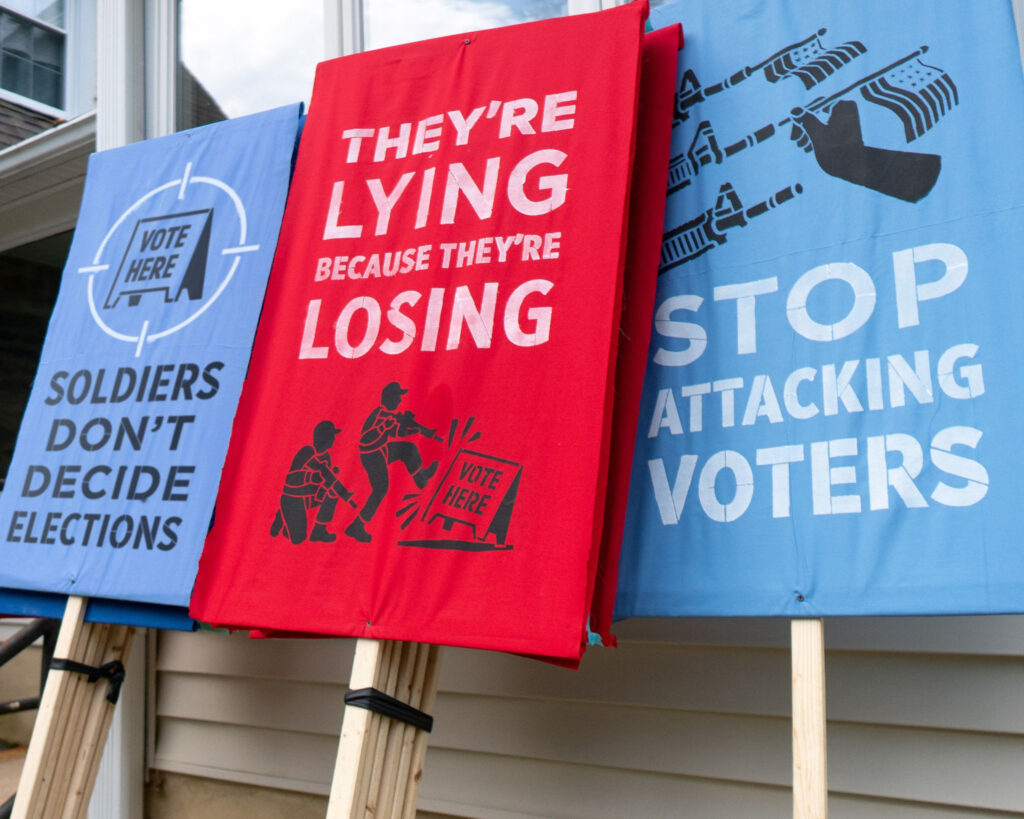
Convergence: Some of these images show armed election interference, which hasn’t exactly happened. Could imagery of armed militia-types at polling places have some blowback? What is your thinking about this?
Josh: At their core, events like the FBI raids in Ohio and Georgia are agents with guns interrupting democracy. It’s on us to keep bringing the news narratives of procedural infighting that demobilize our people—like the wrangling over mail-in ballots—back to the crisis of democracy that we can mobilize around.
We’re trusting organizers to decide when this kind of imagery will mobilize their people, and when it will scare them away from the ballot box. We take that concern seriously.
The hardest part of developing these designs has been that most interference won’t look like anything at all. It’ll be bureaucratic. Ballots not getting mailed. Not approving voter rolls. Shutting down polling places. How do you depict that in a way that outrages people to turn out in the streets?
We’re taking a potentially controversial guess that visibly showing our people standing up to guns is going to be empowering in some contexts, like purple counties that are safe enough to mobilize, but have to face off with counter-protestors. A lot of the power to save voting rights is going to come from big cities with liberal politics, areas where imagery like this won’t make sense. But it’s important that people in those areas are pulling messaging from the frontline of voter suppression, not the other way around.
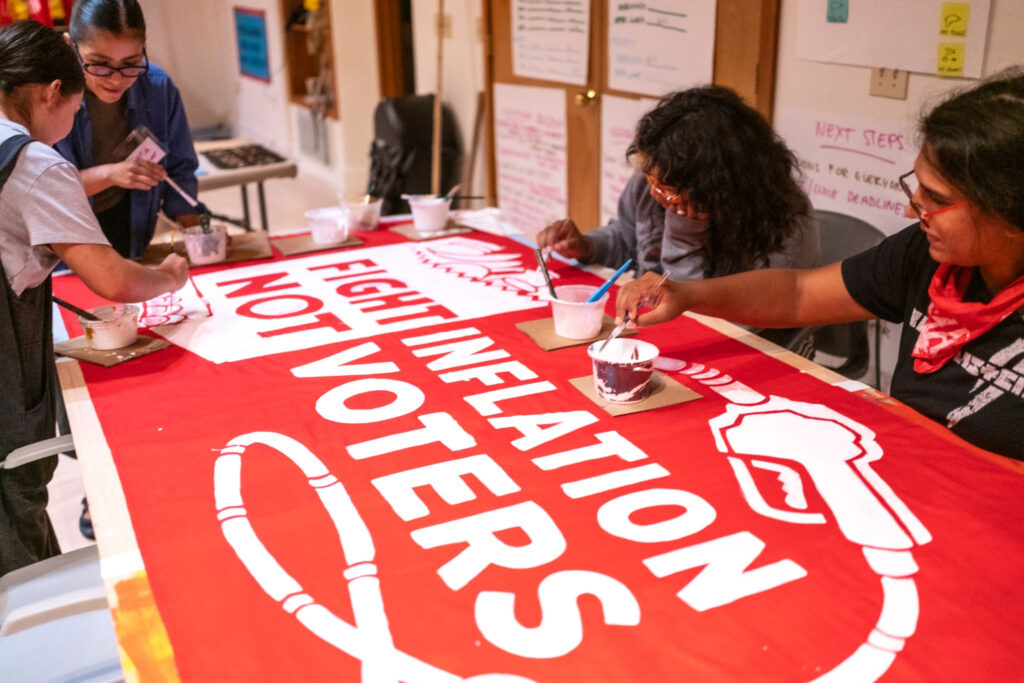
Convergence: You show a lot of imagery that’s not directly related to voting: the gas pump, the foreclosure sign. Why include these in a series about election defense?
Rachel: In our consultations we heard that we need more palpable tools to help the public believe that standing up to election sabotage can help change the material conditions of our lives. Living in New York City and being part of the vast effort to elect Zohran Mamdani makes that possibility quite palpable for me. We saw how imagery and rhetoric about New Yorkers’ material conditions were key to his grabbing public attention, winning, and starting to enact policies that really do change New Yorkers’ day-to-day lives.
Part of how we’re going to protect elections is to build the narrative of what we’re actually protecting. It’s on our movements to bring the billionaires back into the frame here. The people bankrolling election sabotage are doing it to make sure the government continues to not have to do shit for regular people, and instead continues to do less and less for us and pocket the money for themselves more and more. But that’s a mouthful to explain at the same time as we’re calling out the complex mechanisms of election interference. As a result we’ve seen a lot of organizers struggle to bring the economic piece into the conversation about the election. These signs are us taking a swing at just that.
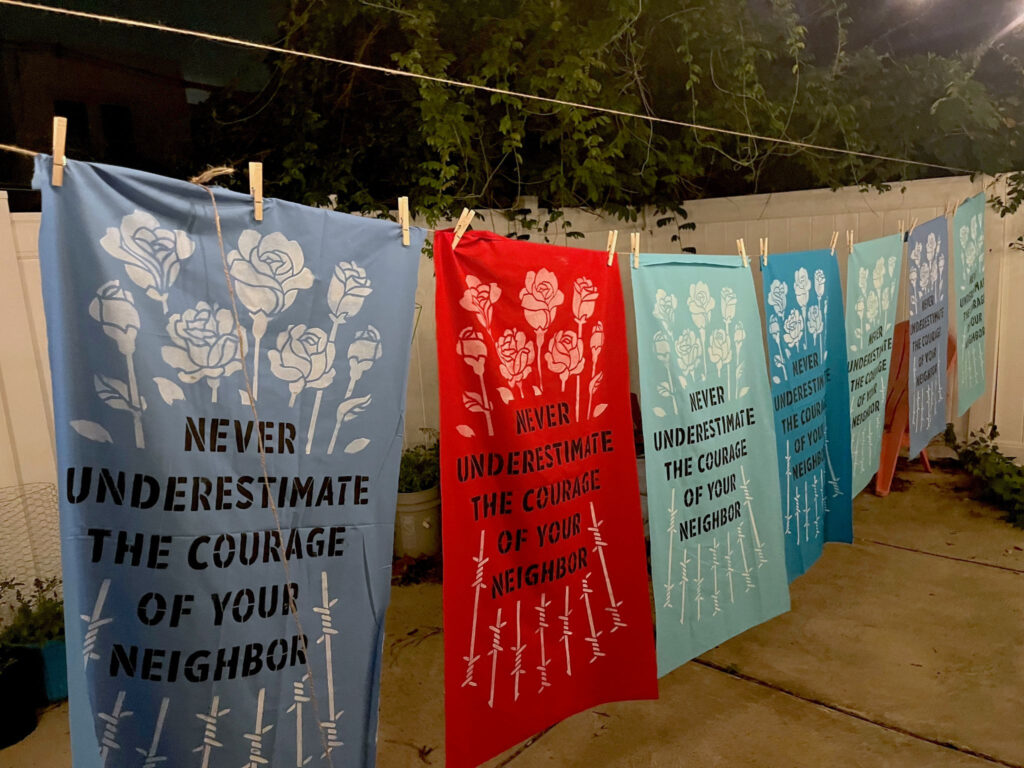
Convergence: How about the image that says “never underestimate the courage of your neighbor”?
Rachel: We put in this image to give our people a visual tool to lift up the acts of civic responsibility rooted in love that we are taking with and for our neighbors everywhere, and to situate election defense as part of that larger arc. We chose the word “neighbor” because it is a word that is often evoked in our movements against ICE kidnappings, and that also describes what election protection is. It’s our neighbors that make elections happen: being poll workers, monitoring ballot submission. And it’s our neighbors who are voting.
Convergence: The Right promotes a narrative that past elections have been stolen and the midterms will be stolen too — by the Left, the Democrats, immigrants and others who hate America. They have their catchy phrase “Stop the Steal.” Do you worry about reinforcing their narrative by focusing so much on the very real ways that this administration is interfering in the elections? To put it another way, how is “Hands Off Our Vote” different from “Stop the Steal”?
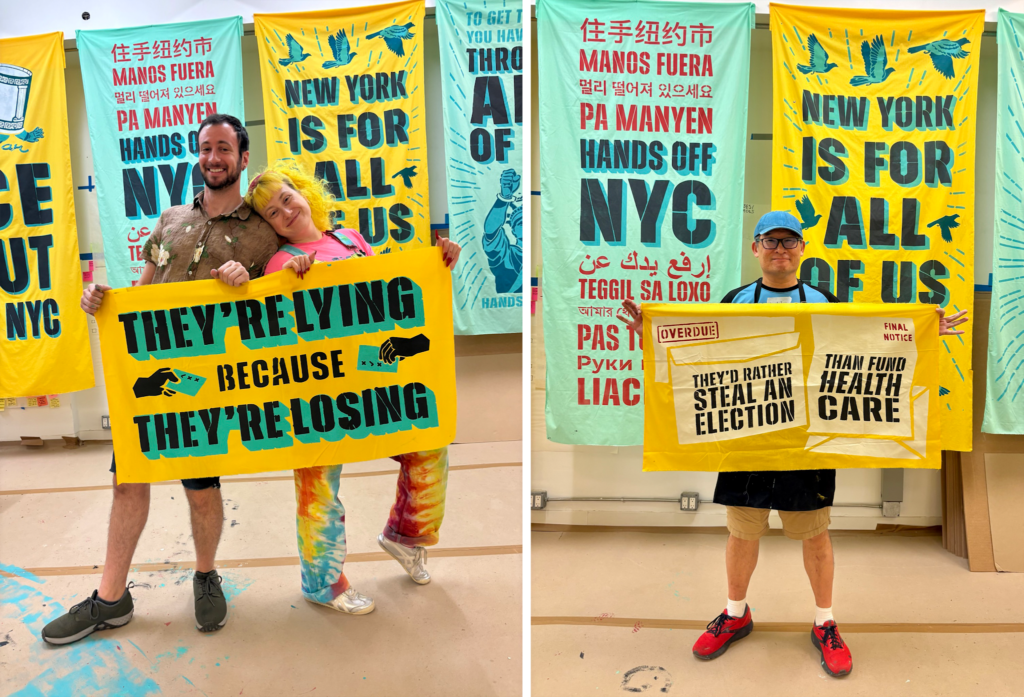
Josh: Yes, we worry about this a lot. Like the use of red, white, and blue, if they talk about threats to elections and we’re too scared to—we lose.
We’re also working under tight word constraints to make signs and graphics, because people don’t read or remember signs that are longer than six words. It can be hard to distinguish our narrative from theirs in short slogans. But if they’re controlling the memorable zingers, and we’re stuck talking in wonky multi-paragraph manifestos that perfectly thread the narrative—we lose.
Rachel: This is another contradiction that we just have to live with—that we have to make sure to differentiate our story entirely from the right-wing narrative and contend with their narrative at the same time. Integrating visuals into our organizing gives us tools to hold so much more detail and context: the words we say, the languages we say them in, the pictures we add, who is holding the signs, and where and how we stage ourselves—all of this expands our collective capacity to tell the truth in public. And as Josh said, “If we don’t try to contend for the truth, we lose.”
Convergence: Do you know how people are using the drive? What happens next?
Rachel: We used the process of creating the drive to help us connect with organizers who would put it to use.
In October, we’re supporting mass public art builds using these designs in Atlanta and Philadelphia. We’re already seeing other people run with the components of the drive that best work for them—for example, our friends at Many Hands Workshop have been iterating on the designs to support Hands Off NYC’s citywide election defense efforts. Soon we know Hands Off Ohio will be doing the same with support from the movement artists at AA Team. In August, we tested some of these designs with the trainees at our annual Visual Strategy Intensive and sent home banners with folks across the country. Within days, our new friends at Centro De Trabajadores Unidos en la Lucha (CTUL) in Minneapolis were using these photos to invite folks to create materials for upcoming anti-authoritarian and democracy defense actions. .
We’re so curious to witness what other kinds of concrete solidarity and collaboration the drive can spark.
If you want info on how to join one of our upcoming art builds, have questions on how to use these designs, or anything else, reach out to us @look_loud on Instagram or through the form found on the drive at lookloud.org/electiondefense. We see this project as a way to reach out towards a larger movement, and we really love whenever people reach back out to us.
Did you enjoy this article?
Becoming a member is the best way to ensure we keep publishing articles that meet the moment. Memberships start at just $5 a month and come along with a variety of other perks; join us today.