

Since taking office, Trump and MAGA forces have made considerable advances in implementing Project 2025 and consolidating authoritarian power—but many of these moves have proved unpopular and undermined their support. With Trump’s approval ratings dropping and elements of his coalition defecting, conditions look promising for pushing back MAGA in the midterm elections.
But there are at least two sources of concern. With their support declining, the MAGA forces are likely to step up their efforts to interfere with the elections—doing everything from stopping people from voting to refusing to seat elected officials to unleashing violence. And even if elections go smoothly, will the anti-MAGA forces be prepared to govern in a way that brings about real change? Or will we face business-as-usual Democrats who answer to billionaires and waffle on key reforms? A growing number of billionaires support authoritarian rule because they directly benefit from it or know they could not amass such wealth under a true democracy.
Labor unions can play a crucial role on both fronts. When unions are engaged in democracy movements, the odds of defeating authoritarian rule increase, according to political scientists who examined cases of democratic backsliding.
This moment calls for unions to step up to defend against MAGA attacks and guard the gains of working people. But we’ve never had real democracy in this country; it is also a time to go on offense, and fight for a true, expansive and inclusive democracy. We need bold union leadership to block authoritarianism and build real democracy.
Slow media for fast times. Sign up for our newsletter.
So what are unions doing to meet the moment? A handful of locals have been leading by example for at least a decade, including the Chicago Teachers Union, SEIU Local 26 in Minnesota, and the United Teachers of Los Angeles. Those unions provide excellent lessons on how to build internal power and long-term strategy, putting them in strong shape to meet the moment. In this article I share lessons from a handful of other unions, as well as May Day Strong–a national coalition of unions, community organizations, faith groups and others working to build power to block authoritarian and billionaire attacks and build a progressive movement for multiracial democracy.
National Nurses United
Perhaps the union that has taken the boldest steps towards a comprehensive strategy is the National Nurses United (NNU). Under the leadership of a new Executive Director, Puneet Maharaj, the NNU has undertaken a rigorous planning process to develop strategies for defense and offense. The union came up with their “Vision for a Healthy Society,” a 10-point program that puts patients, nurses, communities and the planet over profit. The Vision is a long-term agenda. Its bold, expansive demands, such as the right to health and freedom from corporate domination, can’t likely be won in the next few years; they will take power building and stepping-stone fights to achieve. But this vision anchors NNU’s work so that nurses know what they are fighting for, not just what they are fighting against.
While they develop leaders and build capacity for winning the long-term vision, the union is also fighting to block authoritarianism. They’ve developed new educational materials and social media to teach members about authoritarianism and the unique role unions and nurses have to play in this moment. NNU is not shying away from the fight, noting: “Unions have a long, successful history of defeating fascism. The Trump administration’s actions over the past 15 months have made it clear: It’s time to take up the mantle again.” They’ve created Nurses for Democracy to engage more members in voter turnout and election defense, and to be ready to push for their bold vision. The program involves political education and civil disobedience training. This summer, nurses from around the country met in Chicago to get trained in non-cooperation and de-escalation, and to dive deeper into scenarios for election defense this fall.
NNU’s democracy defense also includes spirited offense against the corporations that are enabling and profiting off of the authoritarian regime. The union is taking on Palantir for a number of reasons. First, Palantir directly supports authoritarian leaders and practices by providing surveillance technology and systems used in immigration enforcement and in Gaza and elsewhere. The company has been moving into the healthcare system, and now its software is being used for nurse scheduling, replacing humans who can assure safe staffing ratios. Working with the Purge Palantir coalition, NNU has been protesting at a number of sites, demanding politicians return Palantir donations and that HCA Healthcare drop their use of Palantir software. They held a national day of action against Palantir on August 27, and plan to join an international action in late September.
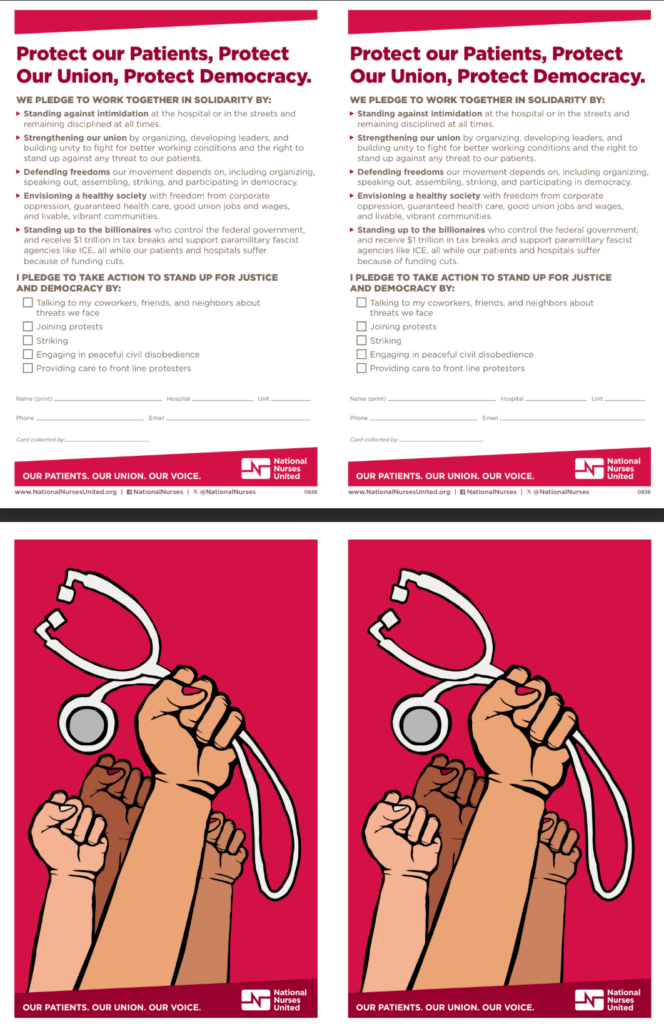
As part of their fightback against fascism, NNU has recently rolled out a “Red Line Pledge” campaign, with a goal of having one-on-one conversations with 75 percent of their membership to assess their readiness to take action to protect patients, the union, and democracy in the event of subverted elections or other red lines being crossed. Members will be asked to sign pledge cards (CARD PASTED BELOW).
Finally, NNU knows it can’t win the defensive or offensive fights on their own. No union or organization is powerful enough to do that, and so they must work within a united front. To that end the NNU has stepped up its engagement with May Day Strong.. Nurses helped organize May Day 2026 actions, and NNU representatives play an active role in May Day Strong committees.
National Education Association
The National Education Association has also taken steps to meet the moment. The union has argued that attacks on education are attacks on democracy, and vice versa. The NEA has invested staff and resources in helping state and local affiliates organize to defend democracy and public education.
The union is taking on the billionaire class through its support for Tax the Rich campaigns. The Massachusetts Teachers Association (MTA) led the way with its Fair Share amendment, which raised taxes by four percent on income above one million dollars. Passed by voters in 2022, the tax has been a huge success, bringing in billions of dollars with no evidence of wealthy people leaving the state. Max Page, president of the MTA at the time Fair Share was passed, is working with affiliates around the country to pass similar measures and the NEA has set aside resources to support 19 Tax the Rich campaigns around the country. These campaigns take a variety of forms. For example, the Vermont NEA affiliate is helping to lead the Fair Share for Vermont campaign, which would create a new tax bracket for the top one percent of Vermont taxpayers.
NEA is also an active participant in May Day Strong. They’ve sent hundreds of member leaders to national May Day Strong convenings, including seasoned leaders and newer activist members. In 2026, the NEA helped anchor over 1,000 May Day actions around the country. In North Carolina, anticipating significant educator participation in the “Kids Over Billionaires” action, at least 22 school districts across the state decided to close for the day.
The 2026 summer meeting of the National Council of Urban Education Associations, an independent body representing the interests of NEA’s local affiliates, featured a panel discussion highlighting the ways NEA locals are resisting authoritarianism and defending student rights. Union leaders from St. Paul, Minnesota, Pueblo, Colorado, and Lee County, Florida shared the work they’ve been doing to fight ICE, resist union busting and censorship, and move from servicing to organizing. Union leaders stressed repeatedly the urgency of the moment and the existential threat facing our educators and schools. At the same time, they were clear that defending against attacks isn’t enough: we need to stay focused on a vision of schools that our students and educators deserve.
Philadelphia
The Philadelphia AFL-CIO Central Labor Council (CLC), and UNITE HERE Local 274 used May Day 2025 as an opportunity to build new relationships between unions and community organizations.
UNITE HERE 274, which represents private-sector hotel and food service workers, has been punching above its weight for a while now. The union knows how to organize workers and win strong contracts. They are not afraid to strike, and they have members who are highly engaged and skilled in leading workplace actions. And the local has played a pivotal role in electoral politics in recent years.
But President Rosslyn Wuchinich knew that this moment calls for even more. Fighting authoritarianism and making multiracial democracy real will require the local stepping into new strategies.
Wuchinich has worked with new Philadelphia CLC leaders to pull together a coalition—Workers Over Billionaires—comprised of labor unions, faith and community allies ready to do more. The CLC’s Chief of Staff, Jana Korn, has functioned as the organizer of the group, and the CLC’s organizing director and communications director are also providing support to locals.
Last May Day, they organized a rally with Bernie Sanders that drew a huge crowd under the banner “Workers Over Billionaires.” But in an even more significant event, the elected leaders of UNITE HERE 274, the CLC, AFSCME District Council 33, AFSCME District Council 47, AFGE District 3, and Teamsters 623 led a large group blocking one of the city’s major freeway entrances. Those leaders, along with 70 other labor, community and faith members and leaders, got arrested together. The event built new relationships and trust, and marked the first time in decades the labor council organized mass civil disobedience.
From there, Workers Over Billionaires knew they needed to dig in deeper. They began by pulling together elected leaders and getting agreement that they needed to be able to speak in a unified voice around a broader agenda, and that the unions had to make a real commitment to engage their members. This meant the union could not just show up as a spokesperson to a meeting or events, but had to bring this program back into their membership. A lot of unions might be able to mobilize around a contract fight but can they engage members around a broader agenda? Wuchinich says, “the work inside of your own membership is the most important thing.” Members had to get engaged in order for this program to work.
In December 2025 they brought together about 80 staff from unions and allied community organizations for a two-day workshop and training to build relationships, a sense of shared purpose, and trust. They used exercises to develop shared values and then laid out the arc of a campaign timeline.
The training included developing a rap to use in organizing conversations with members. Between January and March, they went to their members and asked:
- What are the biggest challenges facing you, your community, your coworkers, and your family? What keeps you up at night?
- If you and your family, your co-workers, and your community were in charge, what would you do differently?
They used these answers to begin to build a working-class agenda for Philadelphia. In March they brought together 300 worker leaders for a two-hour event to preview the agenda. People read off parts of the statement and spoke about the meaning of the proposal in their own life and work.
On May Day 2026 they held an event to ratify the working-class agenda, with large banners representing different planks of the agenda, and a sign reading, “The next 250 years are for us.” Different groups spoke to different elements of the agenda and different campaigns, but it all felt cohesive and part of one united movement.
“I think we in unions really underestimate how important it is for people to be together,” Wuchinich said. “It pays massive dividends, to just get people in a space with people from other unions and community groups and feel part of something much bigger than just their own organization.”
You can talk to people about a big vision but actually being there together is what makes it real. And building the long-term vision allowed people to see how their fights are connected. “We’re all endorsing this much broader agenda, and we might be taking leadership more specifically on one or two pieces of that ourselves, but we all see it as one thing, it’s all necessary. We all need all of these things,” she said.
In the afternoon, they held a rally with about 5,000 people. Most encouraging was the fact that many people were there with organizations, reflecting serious progress in groups doing intentional turnout. The group marched past various corporate targets, including many that were employers the unions or community were fighting, including the Sheraton hotel where UNITE HERE members were picketing. The police tried to block the crowd from entering the private driveway but the crowd remained strong, chanting, “Let us through!” until the police eventually gave up. “Our members were on fire. It was electric and a huge shot in the arm too, for those workers haven’t won their contract yet,” said Wuchinich.
The process has been incredibly successful in terms of bringing together labor and community in a unified voice on a broader agenda“It is historic in this city. I can confidently say, we’ve never seen anything like this this century in Philadelphia,”she said.
The second goal, getting more unions to do deeper internal organizing within their membership, has had mixed results. For some unions, this is a new skill or one that hasn’t been flexed in a long time. But several are working hard at it, and it helps that the program is running through the CLC and can provide some resources.
Other unions do have a practice of internal organizing and do it regularly, so they faced the challenge of connecting that ongoing work with this broader alignment effort. The best case is to tie these things together, so when organizers talk to their members they are engaging them on both fronts (the short-term contract fight and the long-term agenda).
More unions and community organizations have gotten involved in Workers Over Billionaires since last year, among them AFSCME DC47. The council represents nine locals, two of the largest representing technical and administrative employees for the city of Philadelphia. But beyond that, their members include workers at the zoo, many of the museums and more. DC47 has been growing. And according to Robert Harris, the vice president, and political and legislative director, this has created a virtuous circle: new organizing brings in new members who want to see their union move into more organizing, which in turns pushes the council from a service model to an organizing model. Many of these new members, Harris said, see the union as not only giving them a voice on the worksite, but also a base for “fighting for democracy in the city of Philadelphia, and in the state of Pennsylvania, and beyond.”
DC47 began to work with the CLC, UNITE HERE 274 and a few other unions in the 2023 mayoral election. This built relationships among union leaders, and laid the groundwork to deepen the coalition-building and develop internal organizing conversations. The council brought leaders to the three-day training run by the coalition. And some other members attended a one-day Saturday training at the union hall.
Harris is honest about the challenges. While a lot of members were excited and enjoyed the training, many didn’t follow through with the commitment to go back to their worksites and organize 10 co-workers. Some of the members that attended the training are active in progressive groups and were possibly reluctant to intermingle those priorities with this worksite organizing agenda. Or it might be that the “workers over billionaires” frame isn’t resonating, or they are not yet able to connect workplace power with broader fights.
And for some, it is a new muscle to build and will take time. Harris knows they need to keep providing education and connecting the dots for their membership, and making the case that working in coalition gives workers a stronger voice.
Since May Day 2026, the groups have hosted a week of action leading up to July 4th and World Cup games and are now figuring out next steps, with an eye to a possible focus on election defense. But the group will continue to work on their long-term Working Class Agenda which unites them around a positive vision.
May Day Strong
Many of the unions profiled here are active in May Day Strong.
The coalition began testing its muscle by hosting May Day and Labor Day actions around the country in 2025. They then launched Solidarity Schools, which brought together leaders and members to learn political economy and organizing skills, such as building strong alignments and developing shared campaigns. After hosting more than 5,000 actions on May Day 2026, the network has turned its attention to building the power to disrupt business as usual if necessary this fall, preparing for economic noncooperation in case of an acute election steal.. They are hosting webinar trainings and Solidarity Schools around the country to prepare. They’ve also launched a corporate strategy to pull out the corporate pillar supporting authoritarianism, which includes canvassing in neighborhoods to get small business to sign onto the Business for Democracy Pledge while putting street heat on some of the bigger corporate players aligned with the administration,
But the network knows it can’t just focus on elections; it must also help organizations be ready to push forward a bold affordability agenda coming out of the midterms. Like the unions profiled here, they know that the fight can’t just stop with elections and blocking the right.May Day Strong is working with movement allies to develop a freedom charter to unveil in 2027. An effective movement against authoritarianism must also build the progressive forces needed to bring in the world that we deserve.
Did you enjoy this article?
Becoming a member is the best way to ensure we keep publishing articles that meet the moment. Memberships start at just $5 a month and come along with a variety of other perks; join us today.