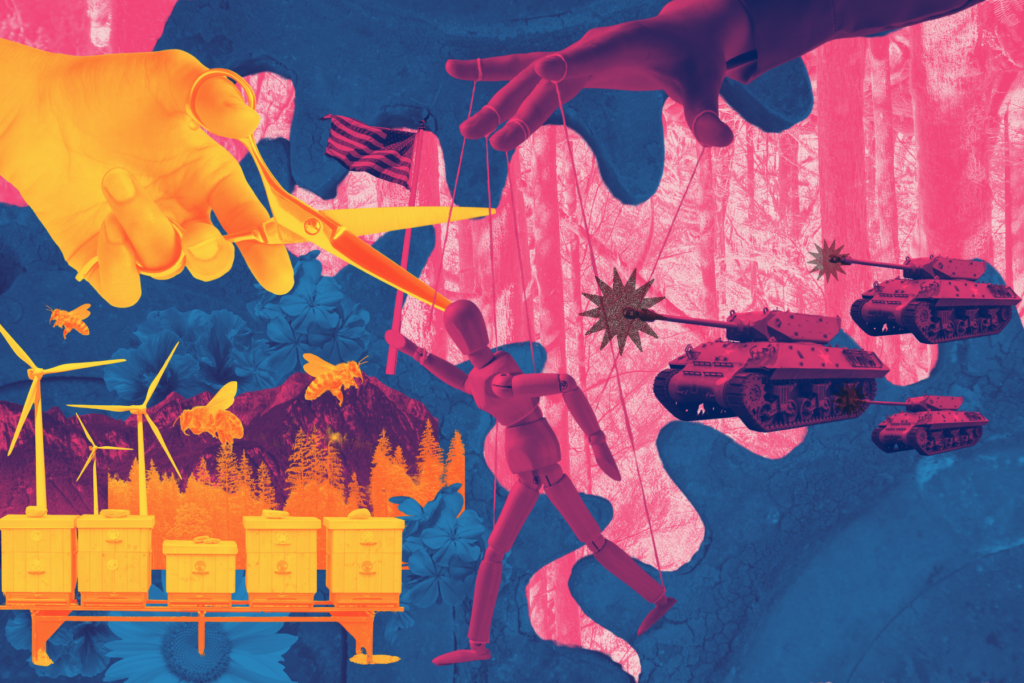
US support for the Gaza genocide, the US-Israeli war against Iran, the resources stolen from social programs to make war, the reimportation of the pathologies of militarism – all against the backdrop of accelerating climate change – underscore the urgency of transforming US foreign as well as domestic policy. But a return to the policies of previous administrations would be only tinkering around the edges of a much deeper problem. Those were still based on the need to maintain US global hegemony. Though declarations about adhering to a “rules-based world order” and a measure of multilateralism may have softened some elements of imperial rule, use of punitive sanctions, CIA coup-making, backing for right-wing dictatorships, and military force were always the bottom line.
Instead of returning to some supposedly better past, we need to develop and popularize a forward-looking, positive vision of a US role in the world that provides security and prosperity to the US people because it advances security and prosperity for the majority of people all across the globe.
The starting point for such a vision in today’s interconnected world is global cooperation against threats to human survival – a global effort to transition away from fossil fuels, major steps toward demilitarization focused on reducing and eventually eliminating nuclear weapons, building strong international institutions that prioritize solving conflicts via diplomacy rather than war, and a new international economic order that places safeguarding labor and migrant rights and facilitating economic development in every country over maximizing corporate profit and control of the world economy by a few great powers. An additional benefit of demilitarization and reduction of inter-state tensions is that it sets more favorable conditions for movements for democracy and working-class power within countries to pursue their goals.
Readings
- John Nichols, “Bernie Sanders: This War Must Stop Immediately,” The Nation, March 30, 2026.
- Max Elbaum, “Saying No to the Empire Is Not Enough,” Convergence Magazine, March 25, 2026.
- If you have time, this additional document is strongly recommended: Grassroots Global Justice Alliance, MADRE, and Women Cross DMZ, The Feminist Peace Playbook: A Guide to Transforming US Foreign Policy [PDF]
Key Points
- A fleshed-out program based on this framework can be an effective tool for countering the American exceptionalist ideology that permeates US culture. Resting on the longstanding position of the US as the hegemonic global power and promoted unceasingly by the political class and mainstream media, the idea that the US is an inherently virtuous nation whose actions are those of the world’s “good guy” has long defined US “common sense.” Antiwar and solidarity movements have long stressed the right of all nations to self-determination, and refuted claims by Washington that US wars and interventions are to “protect democracy”; in fact they are violations of that right that in reality advance the interest of US capital. Movements in solidarity with the peoples of Vietnam, South Africa, Central America, Iraq, and most recently Palestine have spotlighted the destructive role the US has played in each case and at least temporarily won a portion of the population to an overall critique of US imperialism. At times, energetic social movements have convinced majorities of the importance of arms control agreements and aggressive steps to fight climate change. But it will take both massively strengthening antiwar, solidarity and climate-justice movements and promoting a positive vision of the US role in the world to get the foreign policy change we need.
- To translate a progressive vision into a material force, that vision has to be carried and fought for by political actors. Social movements from below are the driving force of that, but it is also important to make it a force inside the political system, in particular by building a bloc of electeds who popularize and fight for it, especially at the federal level where foreign policy is decided. Since Trump’s 2016 victory and Bernie Sanders’ breakthrough campaign that same year, there is a growing number of progressives running for office and winning at all levels, up to and including Congress. We can expect an even bigger wave of progressives, including many socialists, running for office in 2026 and 2028, with reasonable odds that one or more Leftists may contend for the Democratic Party presidential nomination. An overall progressive platform that includes an outline of a transformed foreign policy for use in 2026 and 2028 is a much-needed item for the peace-and-justice arsenal.
- Militarism, bullying, and contempt for democracy are central features of authoritarian and fascist regimes. Without challenging the deployment of these “abroad” they will come back to be deployed “at home.” Movements for progressive change are undercut and if they are vulnerable to “rally around the flag” wars and demonization of other countries and peoples. Only a mass-based political force that acts on the basis of an internationalist understanding of “an injury to one is an injury to all” will be durable enough to defeat the threat of MAGA fascism and set the US on a very different trajectory.
- There is a potential approach to meshing peace, solidarity, and anti-fascist movements that comes out of the experience of Palestine solidarity work in this last three years: The fight for Palestinian rights and an end to Israel’s current genocidal war-making was at the cutting edge not just of the of the fight for peace and for defense of international law, but also for the right to protest here in the US, the defense of the higher education system against MAGA assault, and the fight against racist dehumanization of peoples of color.
Only by making further breakthroughs in Palestine solidarity will the fight against white Christian Nationalism and fascism stand on a durable foundation. And the more democratic space there is in the US, the more favorable conditions are for building Palestine solidarity and other movements for peace and global justice. Thus the fight to beat back fascism and expand democratic freedoms is important to changing policy on Israel-Palestine and US foreign policy in general. - The front-burner fight for immigrant rights is another area where the direct connection between US foreign and domestic policy is increasingly apparent. It is destructive US policies around the world that drive many people to leave their home countries. MAGA paints immigrants, especially those from the global South, as foreign invaders and uses this to justify large-scale repression at home. ICE – essentially a KKK paramilitary functioning with government sanction – is unleashed on immigrants, people of color and the population as a whole to terrorize the US people into submission to authoritarian rule. This is a battlefront in which the fights to defend democratic rights and the fights against militarization and for a changed relationship with people across the globe are increasingly intermeshed.
- Campaigns to cut the military budget and shift funding priorities to human needs are widely seen as ways to build links between peace/solidarity movements and “domestic” movements. Similarly, there has been a very fruitful discussion and some important positive experience in working with the concept of a “just transition” away from a fossil fuel economy and away from a militarized economy.
Discussion Questions
- What are the key components of a post-MAGA US foreign policy that is both desirable and possible to achieve by, say, the end of the first term of a post-MAGA President in 2032?
- It takes powerful grassroots social movements to drive progressive change. Where do you see the most potential for movements powerful enough to change US foreign policy to arise? What kinds of strategies and campaigns do you see as most likely to build such movements? How does the electoral arena and the fight for progressive governing power fit in?