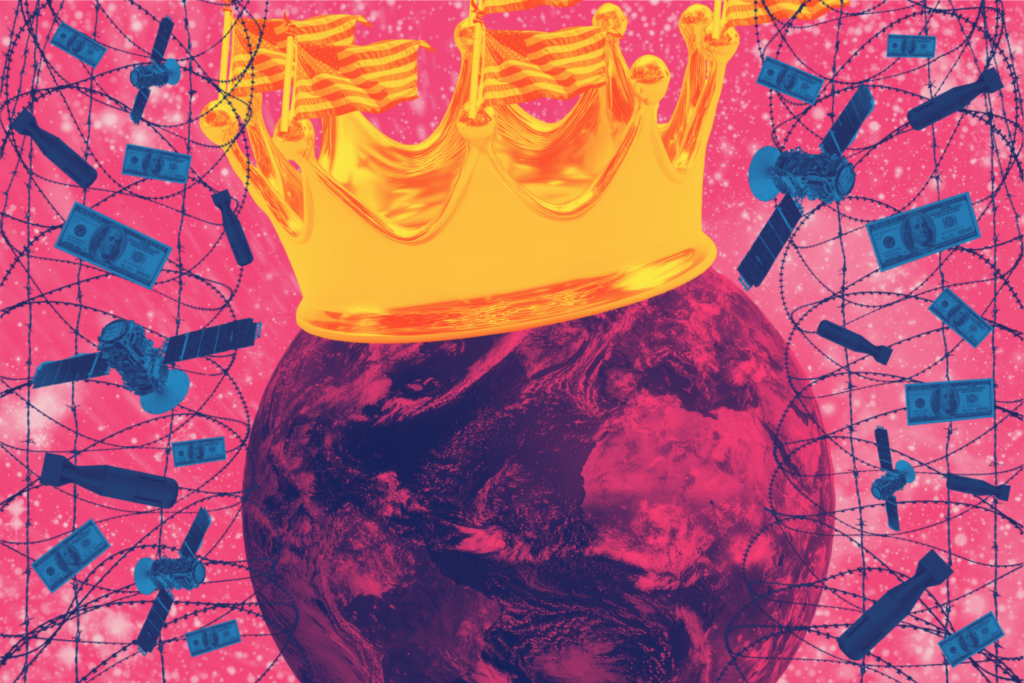
We live in an interconnected world where the very survival of the human race is threatened. Viruses and the fallout from nuclear explosions know no borders. An interruption of supply chains in the Middle East raises the price of fertilizer in Iowa and threatens food security across the globe. Destruction in the Amazon Basin wreaks havoc on the climate in New Delhi, Paris, and Los Angeles.
In this kind of interconnected world, there will be security for no one unless there is security for all. Weaving the fight for human survival together with the imperatives for solidarity with people fighting for self-determination and against all forms of oppression, and with workers fighting for their rights, is extremely complex.
The landscape of global politics has undergone big changes over the last 40-plus years. And we are in the midst of another round of dangerous change today. Adjusting to the shifts from the Cold War era to the US-dominated neoliberal period, and now to a world of growing multipolarity and naked might-makes-right militarism places major challenges before progressives and the Left.
Readings
- Katrina Vanden Heuvel, "The Urgent Search for an Alternative World Order," The Nation, March 10, 2026.
- Walden Bello, "Trump, the Dying Multilateral Order, and the Global South," Foreign Policy in Focus, March 13, 2026.
Key Points
- After the Cold War ended on terms favorable to the US-led capitalist side, the winners were able to reshape the world order in the direction they had started to take in the 1980s. So began the era of neoliberalism, capitalist globalization, and the “Washington Consensus.”
This period saw a massive shift of wealth upwards and the integration of nearly all parts of the globe into an interconnected global capitalist system. Especially in the wake of 9/11 and the “War on Terror,” the main justification for increased militarism and domestic repression shifted from fighting communism to an Islamophobic version of fighting “terrorism.” - The neoliberal world order hit a huge bump with the global financial crisis of 2008. In its wake, trends that had been developing for some time came to the fore; the relative weight of the US in the world economy, which had been in slow but steady decline, was further reduced.
Downstream from economic growth, political power was spreading out to other countries, especially in the global South. The US retains immense economic power (the dollar is still the world’s primary reserve currency, for example) and has by far the most powerful military on the planet. But in the age of “asymmetric warfare,” Washington cannot win its “forever wars.” The overall result has been a notable though uneven decline in US global hegemony and the emergence of a more multipolar world. - The 2008 financial crisis hit those who had already been negatively affected by the pathologies of neoliberal economics the hardest: workers and the poor. Weakening the social safety net, starving the public sector, and increasing wealth polarization were all direct or knock-on effects of the crisis. The resulting upsurge in popular anger fueled progressive movements in many countries. But more powerful was the growth of well-financed right-wing, nationalist, racist, and misogynist movements across the globe. The MAGA movement’s rise in the US is part of this global trend.
- Trump 2.0 foreign policy has many continuities with Washington’s stance pre-Trump. Like all US administrations since World War II, Trump 2.0 aims at keeping the US the most powerful state in the world and at maintaining the US ruling class’s accumulation of more wealth and power by exploiting other nations and peoples. There is simultaneously a shift in strategy which is structurally rooted in the need to retrench (that is, limit the areas where it intervenes directly in order to better achieve its aims) in face of the decline of US economic strength, the rise of other powers, and Washington’s inability to win in its “forever wars.”
- The particular form of Trumpist retrenchment is extremely dangerous. Trump and MAGA see the world as an arena in which only the amount of force a country has matters. Considering values like democracy or human rights when formulating policy are thought to be somewhere between naïve and treasonous. International agreements and multilateral institutions and especially any agreements focused on combatting climate change are regarded simply as shackles on US power. The US needs to remain the world’s number one power in terms of “lethality” and will act unilaterally whenever it wants to.
In this vision, special attention is paid to the Western Hemisphere, to be controlled by Washington via use of direct military force (as in Venezuela), economic bullying (as in Cuba), and interference in other countries’ elections (as in Argentina, Honduras). This is the “Monroe Doctrine” extended and made more naked as the “Donroe Doctrine.” - The US will retain control of the Middle East via support for Israel and deals with the oil-producing police states. The US would maintain dominance over other spheres through military superiority, threats, bullying, and with use of overwhelming force. Trump’s proposal to increase the already bloated military budget by 50% to $1.5 trillion per year is for that purpose.
Trump’s claims about America First “isolationism” or that he is a “Peace President” are ludicrous. It is might-makes-right imperialism, infused with white Christian nationalism, misogyny, glorification of violence, and toxic masculinity. - Trump 2.0 foreign policy and domestic policy are two sides of the same coin. They are products of the same longstanding US structures – oligarchy, the military-industrial complex, Big Tech, and the National Security State – all now in the hands of a MAGA bloc determined to consolidate white supremacist authoritarian rule. This is especially apparent in the portrayal of immigrants from the global South as “foreign invaders” and the way militarized anti-immigrant repression is used as the cutting edge of repression directed at all peoples designated as “other” as well as dissenting voices.
Discussion Questions
- What aspects of Trump 2.0 foreign policy continue longstanding features of US policy and what aspects are new and different? Regarding new features, how much do these reflect structural imperatives (for example, the need to retrench given a decline in US relative global power), how much do they stem from MAGA’s racist and fascist drive toward authoritarian rule, and how much from Trump’s particular character as a “Mad King”?
- What are the main dangers in the foreign policy Trump 2.0 is pursuing? How do these relate to Trump 2.0 domestic policies?