

Drawing on a pair of visualizations found in two well-known books of history, this sketch aims to reinforce a certain way of seeing past incarnations of the Left in the United States. That is to say, a certain way of understanding how these incarnations worked and successfully exerted the power to change the world. In turn, these visualizations provide a certain way of seeing ourselves–the kind of collective historical actor we all aspire to become as we struggle to build today’s US Left anew.
One heartening recent development is the growing prevalence of the “Block and Build” strategy (as articulated in the pages of this magazine) across the US Left, rooted in the concept of the united front. More and more people and organizations recognize the strategic necessity of forging a broad united front to block the Right while simultaneously building a powerful and distinguishable Left bloc within it.
But rather than see united fronts both past and present in terms of a one dimensional line, such as a segment of a conventional left-right spectrum, the visualizations sketched below highlight the value of seeing them in terms of a different geometric figure: as sets of concentric circles, with the Left forming the very core.
Set #1: Mid-19th Century
James McPherson’s Battle Cry of Freedom, one of the most popular books on the Civil War, opens with the Mexican-American War, this country’s first major act of imperialist aggression in Latin America. While leading to the formation of the southern border that our fascist administration polices so brutally today, this war ignited the conflict over slavery.
Slow media for fast times. Sign up for our newsletter.
Many critics in Northern states viewed the invasion as a concerted attempt to expand the territorial, political, and economic might of “the Slave Power,” or the white enslaver class. They joined together across the two-party aisle to back the Wilmot Proviso, a congressional measure seeking to ban slavery on all land expropriated from Mexico. Although this early example of sectional unity failed in the short run, the upswell of support for the Wilmot Proviso gave birth to the Free Soil Party.
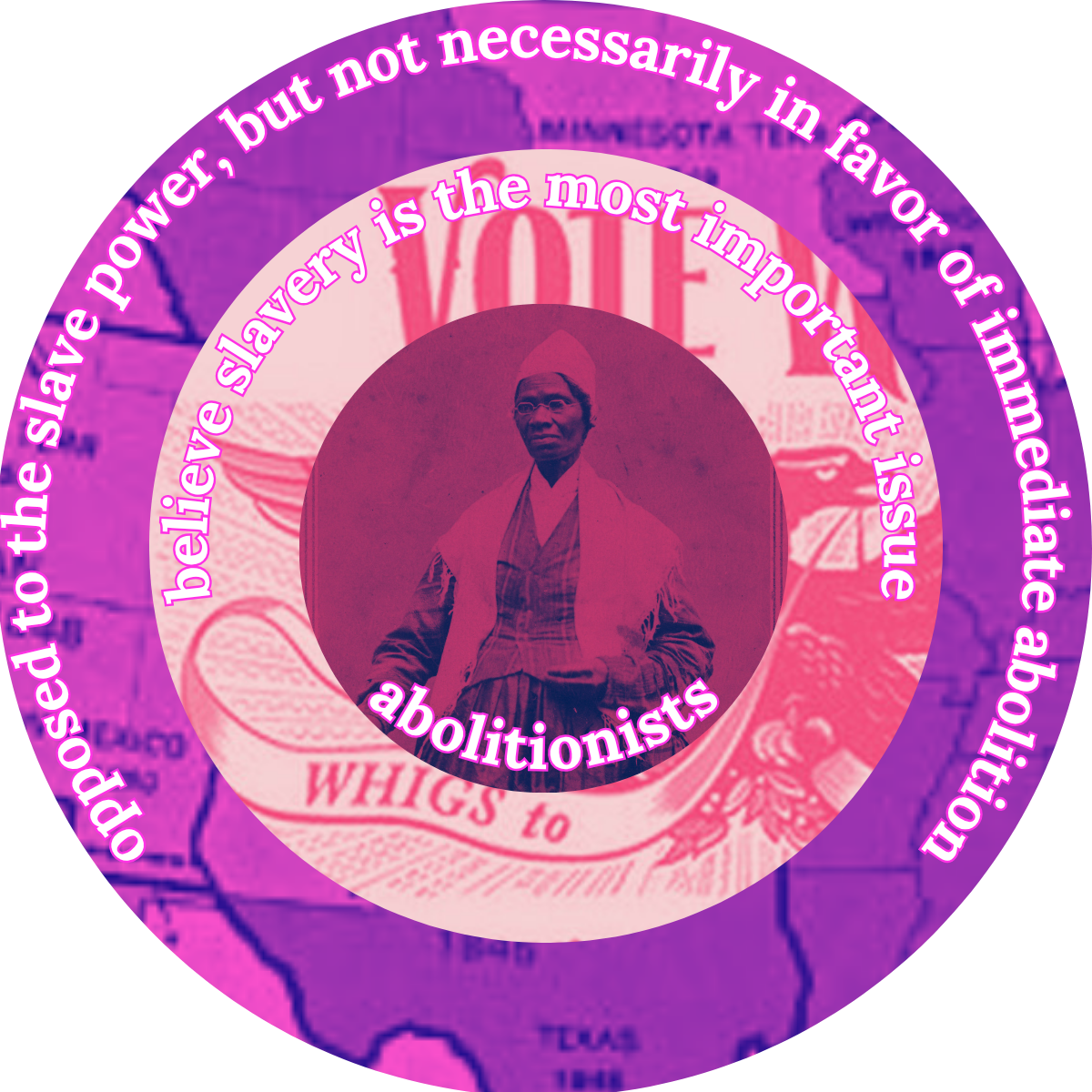
In one early chapter, McPherson makes a memorable recommendation for how to picture the breadth of forces comprising this emerging movement:
Free-soil sentiment in 1847 can be visualized in three concentric circles. At the center was a core of abolitionists who considered slavery a sinful violation of human rights that should be immediately expiated. Surrounding and drawing ideological nourishment from them was a larger circle of antislavery people who looked upon bondage as an evil—by which they meant that it was socially repressive, economically backward, and politically harmful to the interests of free states. This circle comprised mainly Whigs (and some Democrats) from the Yankee belt of states and regions north of the 41st parallel who regarded this issue as more important than any other in American politics. The outer circle contained all those who had voted for the Wilmot Proviso but did not necessarily consider it the most crucial matter facing the country and were open to compromise.
Indeed, as McPherson points out, the outermost circle included people like Whig Congressman Abraham Lincoln, who viewed slavery as an unqualified evil but nonetheless disavowed abolitionism at that time. Some in the outermost circle opposed the extension of slavery while vehemently disavowing any solidarity with enslaved black people whatsoever–like Democratic Congressman David Wilmot himself, who put forward his proviso out of his stated concern for the interests of “free white labor” rather than “morbid sympathy for the slave.” But when the Free Soil Party ran its first presidential candidate in 1848 (Martin Van Buren, hardly a consistent antislavery proponent), even Frederick Douglass chose to attend its first convention, fully recognizing the blinkered political and moral vision of some members, yet aflame with the possibility of forging a popular majority that could credibly challenge slavery.
Here’s a sketch of McPherson’s visualization:
It was this set of forces which eventually formed the basis of the Republican Party in 1854, founded to counteract the Slave Power’s increasing domination of the federal government. As early Republican leader Thaddeus Stevens remarked, “Even in a bad, wicked cause, [the South] shows a united front. All her sons are faithful to the cause of human bondage, because it is their cause. But the North–the poor, timid, mercenary, driveling North–has no such united defenders of her cause, although it is the cause of human liberty.” The purpose of the Republican Party was to develop precisely such a united front, and just six years later, it succeeded in sending Lincoln to the White House.
The boldest visionaries championed a multifaceted program: full civil and voting rights, land confiscation and redistribution, progressive tax reform, free public education, labor rights, women’s suffrage, and government protection against white supremacist terrorism.
The Southern united front responded by seceding and founding the Confederate States of America–a white supremacist, fundamentally antidemocratic state revolving around the principle of racial exploitation. The goal of this state, Confederate Vice President Alexander Stephens infamously declared in his “Cornerstone Speech” was to become “the first, in the history of the world, based upon this great physical, philosophical, and moral truth”: “that the negro is not equal to the white man; that slavery subordination to the superior race is his natural and normal condition.” When this new government fired the first shots at Fort Sumter in the name of this principle in 1861, the Republican Party led the Union to war.
Over the course of the Civil War, the core at the center of this set–including abolitionists, some Union officers and soldiers, Radical Republicans in Congress and Lincoln’s Cabinet, and above all, free and enslaved black people–played the crucial role in bringing about the Emancipation Proclamation, transforming what appeared to be an ambiguous struggle to defend the Union into a definitive struggle to smash the Confederacy and its cornerstone of slavery. To quote Thaddeus Stevens once more, this core believed that the Union must “treat the war as a radical revolution,” in order to depose “a slave oligarchy which would repudiate the odious doctrine of the Declaration of Independence, and justify the establishment of an empire admitting the principle of king, lord, and slaves.”
Elsewhere across the planet, some who were busy promoting a new idea–socialism–recognized the world-historical import of this struggle. None other than Karl Marx wrote in a letter on behalf of the First International to President Lincoln after his second election victory in 1864: “The workingmen of Europe feel sure that, as the American War of Independence initiated a new era of ascendancy for the middle class, so the American Antislavery War will do for the working classes,” a line he reprised in the preface to the first edition of Capital. In Marx’s view, the Civil War constituted “the matchless struggle for the rescue of an enchained race and the reconstruction of a social world.”
As soon as the war ended and the conflict to determine what exactly that “reconstruction of a social world” should look like began, the core, flying the banner of Radical Reconstruction, fought to achieve not only full political equality for black freedpeople but their complete social liberation and thereby the creation of an authentic multiracial democracy for all. The boldest visionaries championed a multifaceted program: full civil and voting rights, land confiscation and redistribution, progressive tax reform, free public education, labor rights, women’s suffrage, and government protection against white supremacist terrorism. To fight for this program, they built organizations inside and outside the Republican Party, such as the Union Leagues.
Crimes against humanity perpetrated through white supremacist terrorism against black freedpeople and their most committed white allies, combined with the defection of erstwhile white allies both North and South, doomed the radical revolution that was Reconstruction and facilitated the radical counterrevolution that was Jim Crow. This temporarily halted what W.E.B. Du Bois, Reconstruction’s greatest ever chronicler, dubbed at once “the finest effort to achieve democracy for the working millions which this world had ever seen” and “one of the most extraordinary experiments of Marxism that the world, before the Russian Revolution, had seen.”
Set #2: Mid-20th Century
Du Bois wrote those words in 1935, a seminal year in the trajectory of the second set of concentric circles.
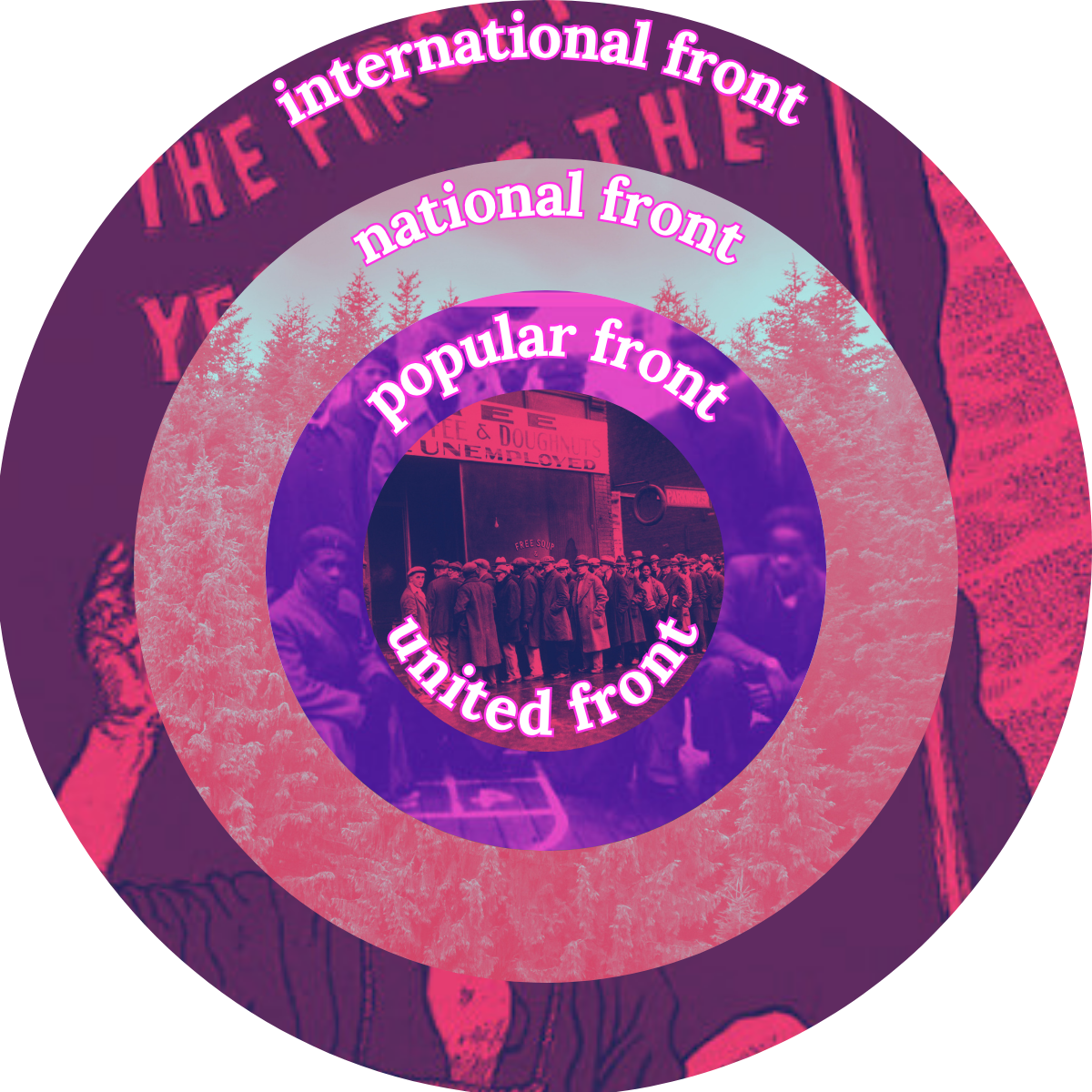
Eric Hobsbawm’s The Age of Extremes, one of the most popular Marxian overviews of the 20th century, features a revealing title for one early chapter: “Against the Common Enemy,” in this case signifying the rising tide of international fascism. To explain the strategy that many leftists embraced to take on this common enemy, Hobsbawm coincidentally makes the same move as McPherson:
Essentially the strategy put forward…was one of concentric circles. The united forces of labour (the ‘United Front’) would form the foundation of a wider electoral and political alliance with democrats and liberals (‘the Popular Front’). Beyond this, as the advance of Germany continued, the communists envisaged an even wider extension into a ‘National Front’ of all who, irrespective of ideology and political beliefs, regarded fascism (or the Axis powers) as the primary danger.
Actually, Hobsbawm offered this visualization earlier in two remarkable essays commemorating the 40th and 50th anniversaries of the Third International’s official adoption of this strategy at its Seventh World Congress in 1935. In the second essay, Hobsbawm adds one more outer ring: an “international front” consisting of all states and all peoples opposed to fascism around the world.
Here’s a sketch of Hobsbawm’s visualization:
Just as Marx believed that the struggle against slavery constituted a pivotal step on the road to socialism, Hobsbawm makes a similar contention about this approach to the struggle against fascism. “[It was] more than a temporary defensive tactic, or even a strategy for eventually turning retreat into offensive. It was also a carefully considered strategy of advancing to socialism,” he writes.
To prove this point, Hobsbawm offers a striking quote from the Third International in 1935: “It may be said that in a number of countries the united front government will prove to be one of the most important transitional forms [from capitalism to socialism].” Fifty years later, Hobsbawm was still convinced: “The people’s fronts remain to this day the socialist strategy which most frightens the enemy…Because they are afraid of the strategy of the broad alliance. They would much prefer the revolutionaries to isolate themselves, the more sectarian in spirit, the better.”
During the 1930s and 1940s, leftists pursued this strategy in one form or another across the Earth: from Spain (where the government of el Frente Popular and the international fighters it summoned tragically lost out in the civil war against Francisco Franco and his European fascist backers) to China (where Mao Zedong and the Chinese Communist Party joined together in a tenuous alliance with their mortal enemy, the Kuomintang, to win the war against Japanese fascism and make a signature contribution to the theory and practice of the united front).
Leftists in the US–including a wide range of organized and independent socialists, but especially the members of the Communist Party–pursued this strategy at the height of the New Deal, organizing for a multiracial social democratic state, for industrial democracy through mass unionism in the workplace, for an end to Jim Crow in the South and all kinds of racial oppression everywhere, and for solidarity with oppressed peoples resisting fascism abroad.
This core gained inspiration from their predecessors in the mid-19th century. As we have seen, Du Bois resuscitated the glory of the First Reconstruction precisely at this time. Leftists often steeped themselves in the iconography of the Civil War. Those who risked or sacrificed their lives in Spain called themselves the Abraham Lincoln Brigade. It’s no coincidence that the title of the most famous novel to emerge from this incarnation of the US Left, John Steinbeck’s The Grapes of Wrath, invoked the “Battle Hymn of the Republic.” So did CIO members whenever they sang “Solidarity Forever,” words written to that very same tune. To quote the original lyrics that inspired both the “Battle Hymn of the Republic” and “Solidarity Forever”: John Brown’s body was a-mouldering in the grave, but his soul was marching on.
Like the visionaries of the First Reconstruction, those of the Second saw their movement as the foundation for “a radical redistribution of political and economic power,” to use Dr. King’s phrase.
In addition to opposing the rise of fascism around the world, these leftists faced a formidable threat from the radical Right in the US: the conservative coalition comprising elected and administrative officials from both major parties, particularly those in the Jim Crow South; the most reactionary corporations and their political organizations like the National Association of Manufacturers and the American Liberty League; right-wing media moguls like William Randolph Hearst and Colonel Robert McCormick; violent antiunion forces at the state level like the Associated Farmers in California and the Citizens’ Alliance in Minnesota; anticommunist government bodies like the Dies Committee and eventually the House Un-American Activities Committee (HUAC), plus little HUACs at the state level like the Tenney Committee in California; and white supremacist paramilitaries including the Second Ku Klux Klan, the Black Legion, the Silver Shirts, the German American Bund, and the Christian Front.
Once the US entered World War II on the side of the Allied Powers in 1941, leftists contributed their energies and lives to the international front against fascism either as soldiers in the armed forces or as civilians fueling the war effort.
During and after the victory of this struggle against fascism abroad, key organizations and individuals animating what some scholars call “the Black Popular Front” ramped up their struggle against the variant of fascism ruling at home: Jim Crow apartheid. Indeed, from Ella Baker to A. Philip Randolph, most of the older generation of leaders in the fight against the South’s white supremacist patriarchal oligarchy in the 1950s and 1960s emerged from this earlier period in the 1930s and 1940s, pioneers of “the long civil rights movement.”
These movement elders joined with movement youth to build an intergenerational, interracial, cross-class movement intent on destroying the very social order which had destroyed the First Reconstruction and, in doing so, achieve the Second Reconstruction. Like the visionaries of the First Reconstruction, those of the Second saw their movement as the foundation for “a radical redistribution of political and economic power,” to use Dr. King’s phrase.
This black freedom struggle served as the bridge between the Old Left of the 1930s and 1940s, devastated by the Second Red Scare, and the New Left of the 1960s and 1970s–our most recent progenitor.
10 Theses on Sets #1 and #2
Many of the following descriptions apply not to everyone on the US Left in these two earlier eras, but rather to its most clear-eyed and farsighted members:
- They recognized the existential threat posed by the radical Right in their respective era and its antidemocratic vision.
- To defeat this radical Right, they operated within a united front bringing together a broad alliance of forces.
- Within this united front, they formed a core fighting to shape and lead it by advancing a vision of transforming and expanding democracy in the US.
- To enact this vision of transforming and expanding democracy, they fought for a political program made up of concrete structural reforms aimed toward the dismantlement of intertwining oppressions (i.e., of race, class, gender, and more).
- They fought for this concrete political program by deploying people power, deliberately forged on the basis of interracial unity.
- They exerted this people power by building and aligning organizations.
- Through these organizations, they waged fights to transform and expand democracy across every terrain of the existing capitalist state and society.
- They saw their project of transforming and expanding democracy as a revolutionary project pitted against the radical Right’s counterrevolutionary project of destroying democracy.
- They saw the struggle between these two projects in the US as part of a global struggle.
- They believed that the outcome of this struggle would enable or prevent the prospect of an emancipatory (for some, in particular during the era of the second set, a specifically socialist) future.
Set #3: 21st Century
Following the united front against slavery (a form of proto-fascism) in the mid-19th century and the united front against fascism in the mid-20th century, today we can imagine the united front against fascism in the 21st century as a set of concentric circles.
By now, it is beyond dispute that the main enemy of progress is the radical Right which has captured the Republican Party, and through it, control over all three branches of the federal government plus state trifecta control in almost half the country.
This radical Right seeks to roll back every advance which previous incarnations of the US Left and their broader united fronts achieved. In fact, this particular radical Right developed in reaction to those struggles, building power throughout the mid- and late-20th century. The right-wing infrastructure buttressing MAGA preceded the rise of Donald Trump and it will outlast him. Its proponents invoke this historical lineage: honoring Confederate traitors, performing the Nazi salute in public, pursuing imperialist fever dreams of Manifest Destiny and sowing death and destruction across the Global South, all while actively erasing or peddling lies about the legacy of past democratic struggles.
Against this common enemy stands a united front consisting of millions of people and numerous organizations nationwide.
Here’s a sketch of today’s visualization:
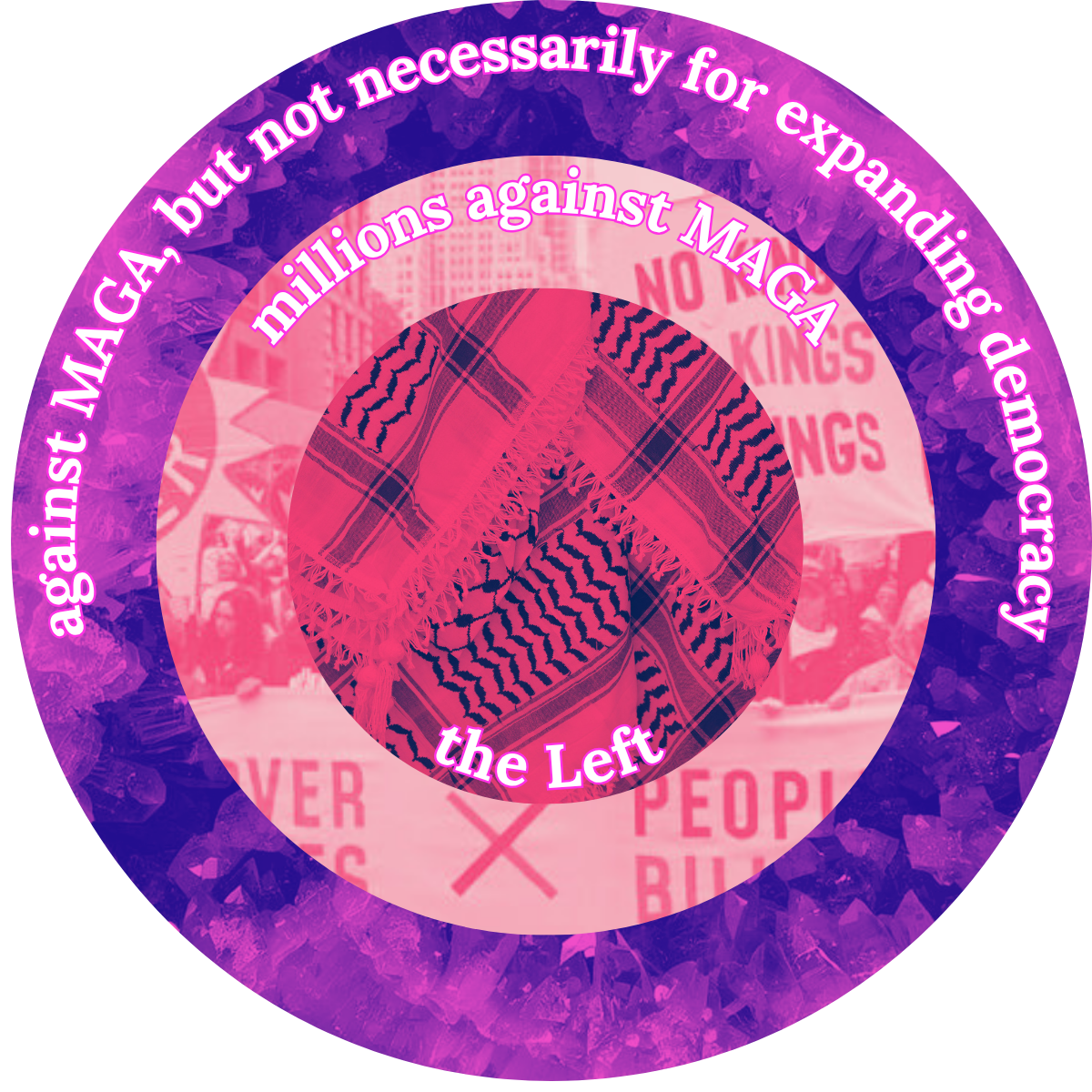
Of course, this diagram illustrates an objective set of forces. There’s no formal coalition uniting all the organizations and individuals which make up this set, although they have come together in recent attempts to defend democracy by defeating MAGA’s candidates at the ballot box–sometimes successfully, sometimes not. Many who participate in this united front don’t think about their participation using that term. But a rapidly increasing number, especially those within the Left, do.
Up to this point, the most backward forces located in the outermost ring have represented the leadership of this united front. Namely, top centrist Democratic elected officials–opposed to the radical Right, but lacking any vision of not only defending democracy, but transforming and expanding it–have appeared as the hapless faces leading the charge. Indeed, through their ineptitude, their complicity with various ruinous domestic and foreign policies, and their fear of the Left, they have smoothed the path for the ascendancy of the radical Right and patently fail to offer a viable path to defeating this mortal danger in the long run.
But there is another actor that’s demonstrated the potential to win leadership over this loose alliance against fascism and steer it toward victory: today’s incarnation of the US Left.
This Left is made up of a finite number of various organizations operating at the national and especially the state and local levels. Most important are certain cases of mass organizations, including labor unions in our workplaces; tenant unions in our apartment blocks; independent political organizations inside and outside the electoral, legislative, administrative, and judicial arenas of the state; community and faith organizations fighting for vital causes in our neighborhoods, including from immigration defense to gender liberation to a green transition to peace, self-determination, and justice abroad. It’s also made up of an increasing number of Democratic elected officials at all levels of government who are self-described progressives and socialists, working in alliance with,and often emerging from, this organizational base. What all share in common, tacitly or explicitly, is the recognition of the paramount need to build the united front to defeat the Right and a drive to build the power of the Left within it.
Still, today’s Left doesn’t yet act on the stage of US politics with the coherence that the visual representation of the innermost circle above suggests.
We would share our own common political program committed to expanding democracy (some call it “the Third Reconstruction”), consisting of concrete transformational reforms, distinguishable from the policies of centrist Democratic elected officials, and diametrically opposed to MAGA’s dystopian program.
To be sure, over the last fifteen years or so, this Left has taken giant steps in its development, growing stronger and more united. Amid a succession of movement flashpoints, from Occupy Wall Street to the Black Lives Matter uprisings to Standing Rock to labor strikes to Palestine solidarity (to name only a few), new organizations have emerged or expanded across sectors. Elected officials from the Left now govern in some of the largest cities and vie for state and federal offices. In the depths of the second Trump administration, these forces are pursuing ambitious defensive and offensive campaigns and organizing impressive massive mobilizations.
But paradoxically, although this embryonic Left is stronger and more united than it’s been in decades, it’s still not strong or united enough to exert the power this moment desperately requires. In a word, the organizations and individuals which make up this Left aren’t yet self-conscious enough. There’s no plausible reason to expect millions of people to recognize, support, and join the Left when we don’t fully recognize ourselves as a multifarious yet coherent bloc with the potential to operate as one.
The mirror test is one widely known method that some cognitive scientists use to measure the self-awareness of human and nonhuman animals, evaluating whether they can see themselves in their own reflections. If today’s Left were to pass the mirror test, more of our organizations and individuals would consciously share the common view that we’re fighting to build our power within a united front to defeat MAGA and transform society.
We would share our own common political program committed to expanding democracy (some call it “the Third Reconstruction”), consisting of concrete transformational reforms, distinguishable from the policies of centrist Democratic elected officials, and diametrically opposed to MAGA’s dystopian program. We would unabashedly fight for our vision across every terrain of today’s capitalist state and society.
Our organizations would follow long-term strategic plans and carry out cross-organizational short-term campaigns rooted in mass action at the national, state, and local levels. Our leaders–from those in the rank and file to those in top offices–would fight alongside each other in every given place.
Indicators such as these are already visible in fits and starts in different parts of the country. Raising them to scale would mark the shift from a Left-in-itself to a Left-for-itself.
Playing a crucial role in this shift is the core within the core: that is, 21st-century socialists who populate the organizations of the Left. I’m not referring to all self-described socialists or all members of all socialist organizations, since that would encompass people with clashing and even contradictory views. I’m referring to that discrete slice of socialists–some members of this socialist organization, some of that one, some of none–who glimpse this larger picture, believe in this strategic orientation, and contribute to mass struggles.
These socialists see the “present-as-history,” an instant in the centuries-long quest to build a truly free society conducive to human flourishing. We study every emancipatory movement from the past and mine it for lessons–just as we relinquish every illusion about the external challenges those movements faced and the internal failures they committed.
We’re fighting for a socialist future here in the United States and around the world. Though we can’t expect to experience that future in our lifetimes, we know we can pave the road toward that future by fighting through today’s set of concentric circles: cohering our socialist current; building the power of a self-conscious Left; achieving victories for today’s united front; destroying the power of the radical Right across the land; and revolutionizing democracy in our time.
The question is: How will future historians visualize today’s US Left? Will they see us as the core of a united front that saved this democratic experiment and took it to new heights? Or will they see us as the last divided beleaguered vestige of previous incarnations, a remnant which failed to see and act on its historic responsibility? Through the choices we make–or fail to make–in the coming months and years, together we will write the answer.
Did you enjoy this article?
Becoming a member is the best way to ensure we keep publishing articles that meet the moment. Memberships start at just $5 a month and come along with a variety of other perks; join us today.