
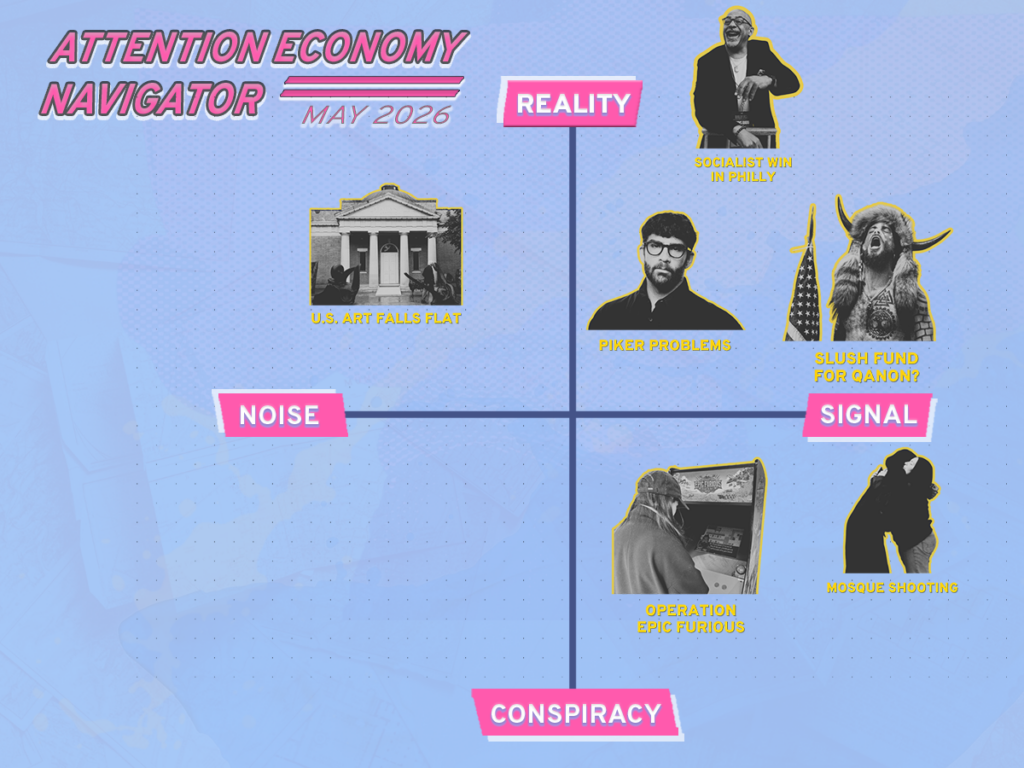
This month on the Attention Economy Navigator, our guide to what you should be paying more attention to, and what you can probably pay less attention to. And why those stories might not be what you’d assume.
You can also listen to the podcast episode featuring Dr. Shannon Mancus and Akin Olla, or watch the panel plot these stories in real time on YouTube.
High Reality, High Signal
- Chris Rabb delivered a huge primary victory for progressives in one of the bluest districts in the United States in Philadelphia.
- The district is so blue there isn’t even a Republican running in the general election, so his primary victory means he’s going to Congress.
- Rabb defeated two establishment-friendly candidates, including a very Democratic machine legacy candidate and another who walked back some of her more progressive positions on foreign policy over the course of the race.
- Akin points out that this is another example of a campaign combining a strong ground game and good coalition-building with strategic partnerships with content creators and online influencer culture. It shows some potential for the future but there are open questions about how to replicate this in other places.
- Cayden thinks this victory also meant something to a lot of people who don’t necessarily care about electoral politics!
- Trump suing the IRS for immunity for himself and his family has taken a lot of headlines, but it’s also tied to a $1.776 billion fund for his political allies who have been “wrongfully targeted by the government.” (Why does it always have to be a meme!?)
- Doesn’t this seem like it should be illegal? Dr. Shan points out this is an example of Trump using our political system and system of government in ways they weren’t intended to be used, but if it isn’t explicitly forbidden, it can be done.
- Just like Kalshi and Polymarket, the insider trading is happening on the outside now: they’re trying to create a financial incentive for acting out in Trump’s name.
- Akin thinks this might be a signal for ways that Trump plans to hold onto power even if he leaves office in 2029.
- Are we overstating the influence content creators have over our politics, or what? Hasan Piker has been grabbing headlines and people’s attention by stumping for progressive primary candidates, and at the same time the California gubernatorial primary is a testing ground for new tactics in paid partnerships with content creators.
- This is a bit of a wild west moment where the political rules around paid partnership are unclear and the mainstream political establishment is breathlessly excited about what the power of what influencers and content creators can do.
- Dr. Shan points out that not all content creators are the same: there are many types of political content creator, and creators like Ms. Frazzled really helped push the story about Rep. Eric Swalwell’s sexual misconduct into the mainstream; her research was picked up by CNN, which got a lot of credit for breaking the story in the traditional media environment.
- There’s a tension between traditional media and journalistic standards, and at the same time traditional media can rely very heavily on access as part of how they do their reporting. At the same time, content creators are trying to respond to some of traditional media’s weaknesses.
- Dr. Shan also points out that right wing content creators are being paid huge amounts of money to put content out; while there are unsettled questions about money and influence, progressive and left wing content creators are simply being outclassed when it comes to volume and quality, because making content costs money!
- Cayden highlights a dilemma around basic media literacy: we need to figure out ways to exercise discernment when we’re on the scroll, which is something that the algorithms and infinite scroll are explicitly designed to downplay.
- Akin thinks that Hasan Piker’s stumping for Chris Rabb helped but it certainly didn’t make or break the campaign. Understanding where content creators operate locally, where microaudiences exist, and who can reach which segments is going to become a bigger part of what it means to run a political campaign moving forward.
- Cayden points out that ultimately we’re going to have to grapple with this: overstating the power of content creators is harmful to building real political infrastructure, but understating it may mean we leave power on the table and create openings for the far Right to siphon off potential allies in the fight for a better world.
High Reality, High Noise
- The American pavilion at the 2026 Venice Biennale left…quite a bit to be desired, and the headlines are savage.
- Dr. Shan points out that art under authoritarianism is either super over the top or incredibly austere and boring, and this goes heavily in the austere and boring camp. The selection feels almost isolationist and reactionary compared to previous years’ pavilions.
- A lot of the selection of this artist is tied up with the Trump administration’s gutting of the National Endowment for the Arts and the pinch hitters called in to make selections were grossly underqualified and/or previously censured for “racial insensitivity.” Akin describes this debacle as a microcosm of the administration that was maybe unintentional.
- In addition to including this boring US pavilion, Russia and Israel both were invited (they weren’t two years ago), and as a result the entire adjudication committee resigned over it. This is the story that’s more interesting but is being obfuscated by the noisy headlines about the boringness of the art itself.
High Conspiracy, High Signal
- The discourse about the San Diego mosque mass shooting doesn’t do enough to examine the relationship between the larger political environment.
- Cayden is struggling with the ways that the state itself is reaching towards policies that accelerate social collapse and white nationalists still feel urgency to go out and commit acts of violence with race war as their explicit goal.
- Dr. Shan points out that this kind of nihilistic politic doesn’t conform to traditional shapes of conservatism or liberalism, and a lot of the manifestos include language about deep ecology that is motivated by a kind of blood-and-soil rhetoric that confuses people online.
- Akin is concerned that the political system itself produces a lot of this nihilistic impulse: the contradiction between what we’re told and what we feel, and the context collapse produced by the algorithmically-driven media environment, makes nihilistic political violence more appealing, especially to young people who are drawn to edgy internet weirdo subcultures.
- Operation Epic Furious, an unwinnable game about Trump’s war on Iran, makes its National Mall debut, thanks to the anonymous artist collective that brought us the Trump-Epstein sculpture and the Lincoln Memorial golden toilet.
- Dr. Shan thinks this irreverent, silly game has something real to say about the futility of engaging in the kind of neocolonial violence characterized by the war on Iran. She points out that thumbing your nose at an authoritarian is exactly what they hate the most.
- There’s also something conspiratorial about the game: it plays on humor that refers to conspiracy theories about the Trump administration’s depravity. And there’s something conspiratorial about how the creators have been able to remain anonymous so far!
- Akin thinks it’s very hard to capture our political moment through art and this game actually gets closer to a countercultural artifact that captures the vibe.
- The panel discusses the strength of games as a medium to puzzle through difficult moments and the role culture can play in shaping our politics.
High Conspiracy, High Noise
Nothing this month!
Other stories we’re watching:
- The discourse about Louisiana vs. Callais and the death of the Voting Rights Act has severely underplayed the way that organized communities in the South have been fighting back. Plus, much of the discourse still reduces voting rights to an issue affecting Black communities only. In reality, voting rights is an issue affecting all of us.
- People are trying to contextualize Sam Adler-Bell’s piece in New York Magazine from March highlighting the women leaving the far Right. Is this a flash in the pan or a larger trend?
- Is space the place? Cayden’s been thinking a lot about what it means to go to the moon during the Trump administration, and what imagining a future helps us do while we fight fascism here at home.
Did you enjoy this article?
Becoming a member is the best way to ensure we keep publishing articles that meet the moment. Memberships start at just $5 a month and come along with a variety of other perks; join us today.