
This month on the Attention Economy Navigator, our guide to what you should be paying more attention to, and what you can probably pay less attention to. And why those stories might not be what you’d assume.
You can also listen to the podcast episode featuring Francesca Fiorentini and Josh Elstro, or watch the panel plot these stories in real time on YouTube.
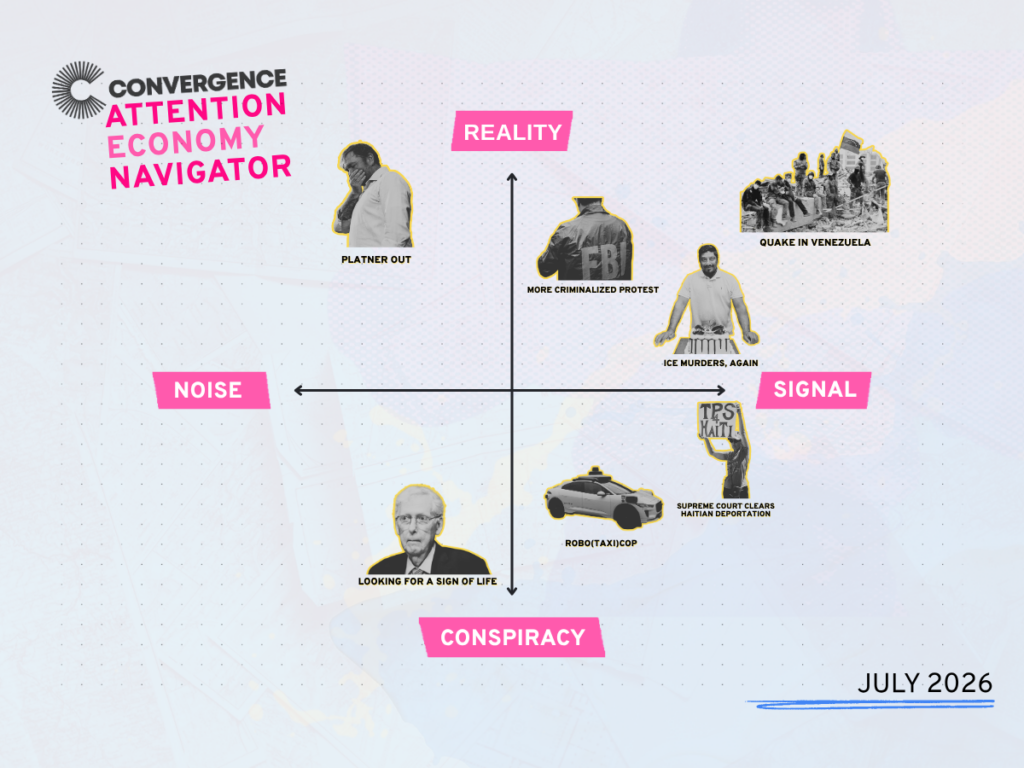
High Reality, High Signal
- In the 10th fatal shooting by an ICE officer, Lorenzo Salgado Araujo, a father of three, was killed in Houston. He wasn’t even the person that ICE was seeking.
- Francesca points out that Salgado Araujo isn’t a “perfect victim” and so coverage of his killing hasn’t been as widespread; conceding ground when targets of this kind of violence aren’t “upstanding citizens” undermines the potential for accountability in the future.
- DHS lying about the circumstances of this and other shootings deeply erodes public trust, raising questions about what happens after Trump when we have to reckon with what happened as a country; it points to the way that reporting law enforcement’s narrative first catches headlines in a media environment where the first to market gets to dominate the way people think about an event like this.
- Unfortunately, it feels like reports of police and ICE murders have been de-emphasized, not just in this case, but in others (including two in four days by the Tennessee National Guard in Memphis).
- Over 100 deportees staying in the same hotel in Venezuela are missing or dead after two massive earthquakes rocked the country. While the timing couldn’t be worse, the tragedy points up the trauma and humiliation of the deportation experience.
- Cayden thinks a lot about the way that the mainstream media framing leaves out the bigger picture including US military intervention and sanctions, emphasizing the natural disaster by cutting out the very man-made conditions that led to this in the first place.
- Francesca thinks that natural disasters and dwindling aid are just going to lead to further migration from Venezuela to points north, which also keeps getting cropped out of the frame.
- The FBI raided the homes of 8 University of Michigan students and alumni associated with pro-Palestine protests, and we’ve seen very little coverage; some of the best reporting on this has actually come from The Michigan Daily, the student paper.
- Cayden thinks that some of the reason we haven’t heard a ton about this is the targets aren’t perfect victims of state repression: their actions might be uncomfortable or we might disagree with their approach, so the narrative isn’t as neat as it might otherwise be.
- Francesca points out that every time the FBI is used for a disproportionate crackdown on free speech, it supports antisemitic theories that Jewish people get special treatment, which accelerates the narrative loop for people who are new to the issue.
- The panel discusses the way that being able to move in mass politics, working towards common goals despite disagreement, is vital and difficult in our high-scrutiny attention economy. We’re out of practice and it’s important to be able to do this to build power and to welcome newcomers to our movements.
- Francesca thinks it’s wild that we are talking about the Signal messages of some pro-Palestine protestors while a bunch of College Republicans were revealed to have been fully infiltrated by Groypers (who are actual factual antisemites).
High Reality, High Noise
- Another woman has come forward to share her experience of sexual assault by Maine Senate hopeful Graham Platner.
- The media frenzy around this newest revelation shows how unserious we are as a society about the experience of survivors: very few commentators have taken a moment to consider the perspective of Jenny Racicot, who by her own admission hesitated to come forward because she agreed with Platner’s politics.
- Josh shouts out Francesca’s conversation with Emma Vigeland breaking down the story on her show, The Bitchuation Room. She thinks that one of the ways we got here was making Platner’s candidacy all about him as opposed to the movements he (doesn’t really) come out of; there are also a lot of kind of problematic conspiratorial lines about the accusation that “they won’t let us win,” when this is genuinely just a dealbreaker.
- The panel thinks that maybe people should like, run for a lower office and develop a track record before running for one of the most powerful legislative offices in the land.
- Cayden can’t stop thinking about this cringey interview with some of the consultants who picked Platner as a potential candidate; it came out a month ago but has gone viral since the most recent revelations.
High Conspiracy, High Signal
- The Supreme Court’s decision to end Temporary Protected Status for Haitians and Syrians goes into effect the day we record, July 10. In communities with large Haitian and Syrian refugee populations, worries are palpable.
- Josh links this to the way that MAGA has targeted specific communities, like the Haitian community in Springfield, Ohio. Even Republican governor Mike DeWine has expressed worry about this policy change, pointing out that many of these immigrants have propped up economically struggling communities in the state.
- The panel talks about how the US has been involved in Haiti, in particular, for a long time, destabilizing the government and undermining the economy.
- Francesca also takes centrists to task over never settling the matter of the legal status of migrants like these when they have the power to do so: without welcoming these people unequivocally, they’ve created a permanent precarious class of immigrants who can be used as a political football, and we need to be doing more to protect them.
- Two fifteen-year-olds who decided to get drunk and shoot toy guns in a Waymo were delivered to their local police department by the driverless car.
- Cayden thinks this is a sign of the complete breakdown of our social fabric driven by big tech: the friction of getting judged by peers or a responsible adult might prevent this behavior in the first place, but it’s disturbing to see the ways that breakdown then also leads to heavy policing as a solution to the problem.
- Josh worries about the fact that the kids got locked in the car as part of delivering them to the cops: why is it a private company’s prerogative to lock them in? And is that even safe?
- Francesca thinks the LA protestors had a point: Waymo is not your friend. And definitely the avatar of the collusion between Big Tech and the state.
High Conspiracy, High Noise
- Is Senator Mitch McConnell…still alive?
- Cayden did some background reading and discovered that, if McConnell dies between now and mid-August, Kentucky will have to hold a special election to replace him; if he dies after the August cutoff date, the seat will just stay vacant until a victor in the regular election is seated in January. This rule was implemented recently to kneecap Democratic governor Andy Beshear, preventing him from appointing an interim Democratic Senator.
- It’s dark to keep a man on life support for a month to prevent this from happening, but at the same time, this guy has done a lot to make the lives of elderly, disabled, and poor Americans much, much worse.
- The unified talking points from important Republicans about having “talked to him on the phone” sounds conspiratorial even if it’s just trying to create a consistent narrative in the mainstream press.
Other Stories We’re Tracking
We generally assemble more stories than we can possibly map in a single episode. Here are a few of the ones we’ve got an eye on.
- The misogynoir and transphobia on display at Trump’s UFC fight.
- The media panic over DSA-nominated and progressive primary candidates.
- Trump’s Great American State Fair is…conspicuously empty. This inability to control cultural attention drives the fascists nuts.
- What the racist hell is this Marsha Blackburn for Governor ad?
Did you enjoy this article?
Becoming a member is the best way to ensure we keep publishing articles that meet the moment. Memberships start at just $5 a month and come along with a variety of other perks; join us today.