
This month on the Attention Economy Navigator, our guide to what you should be paying more attention to, and what you can probably pay less attention to. And why those stories might not be what you’d assume.
You can also listen to the podcast episode featuring Akin Olla and Josh Elstro, or watch the panel plot these stories in real time on YouTube.
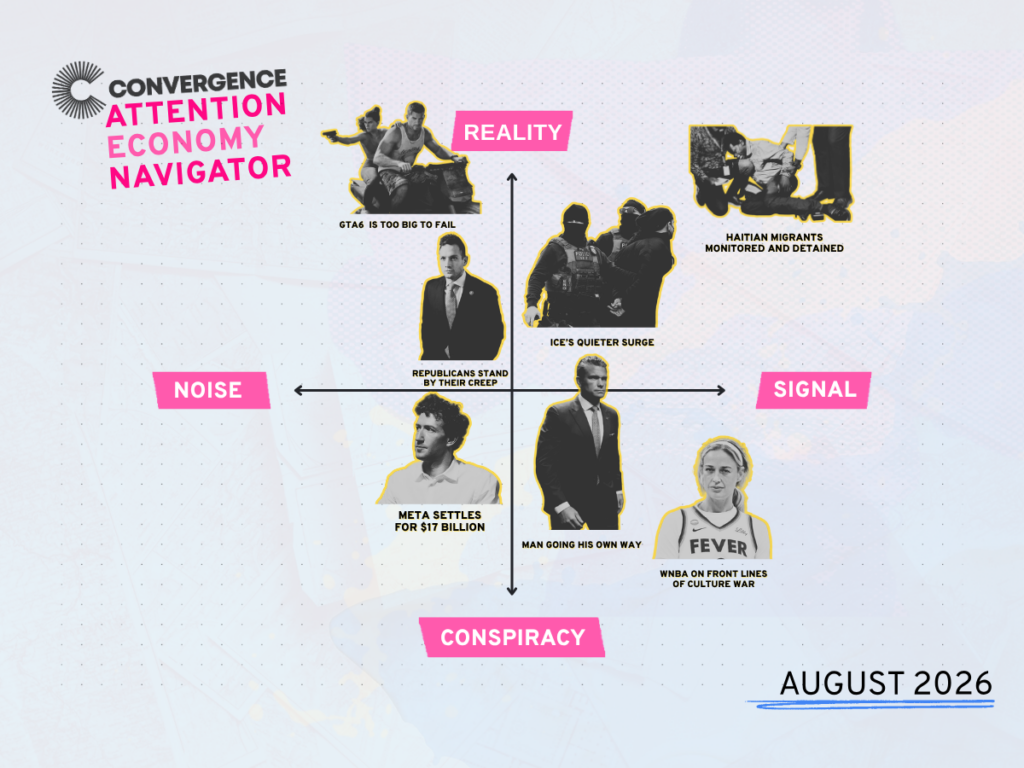
High Reality, High Signal
- DHS has started ankle monitoring and deportation of Haitian migrants who previously had Temporary Protected Status, centering on the town of Springfield, Ohio. Between the prominent pastors selected for deportation and the college student who died by suicide this week, the costs have been high.
- Ohioans have been showing up for the Haitian community, but the story has been contained to local media, for the most part.
- The guys discuss the clearly white supremacist motivations behind the deportation of Haitians at the same time that white South Africans keep getting visas to move to the United States.
- In spite of the decline in spectacular ICE raids, The New York Times reports that there has been a surge in ICE arrests over the past few months. As a case in point, investigative journalist Aura Bogado has a piece out in Injustice Watch exposing the ways that Illinois law enforcement agencies shared information with ICE, both intentionally and not, in direct violation of the state’s TRUST Act.
- This is related to the trend we’ve been tracking about the shift from Kristi Noem to Markwayne Mullin and their divergent approaches to carrying out the Trump Administration’s deportation policies.
- Cayden points out that Mullin’s DHS has a theory of the case about how the attention economy works, and how to use it against the immigrant rights movement; his own observations locally in California are that there’s been an uptick of very targeted enforcement actions where officers go after a specific person and are in and out quickly, as opposed to terrorizing a community more generally.
- The TRUST Act violations raise important questions about how state laws are actually enforced. Bogado’s investigation found that some data was being shared with ICE inadvertently, and Cayden points out that Illinois Governor JB Pritzker has talked a big game about standing up to Trump, but has often fallen flat when the rubber meets the road.
High Reality, High Noise
- A 27-minute trailer for the new Grand Theft Auto game dropped this month and the internet could not be more excited.
- The guys track the evolution of GTA’s cultural influence from supposed evidence of amoral youth culture to the biggest franchise in video game history, culminating in both GTA Online, a massively profitable microtransaction-fueled game, and now GTA 6, the most expensive title to ever be developed. Is a new GTA game the closest thing we’re going to get to a monocultural moment in 2026?
- Akin wonders if right wing culture war backlash against “wokeness” in the game, from the woman of color protagonist to likely storylines that reflect the struggles and lived realities of the majority of Americans, will drive young people (and especially young men) away from the far Right.
High Conspiracy, High Signal
- The top brass of the US military is increasingly at odds with Secretary of Defense Pete Hegseth, based on leaks from the Pentagon and other rumors.
- Akin has been tracking these storylines and thinking about what he’s learned from history: that the move from choosing who runs a country or military through patronage to choosing who runs it through competence or experience is a sign of a country modernizing and maturing, so this feels like a step backward in time, for better or worse. And it’s a clear sign of fragility at the top of the MAGA power structure.
- Cayden points out that this phenomenon of leak vs. leak creates the environment for conspiracy theories to thrive; Josh worries about the ways that this kind of story is activating the “BlueAnon” believers who want the military to break ranks with the President and defend the Republic, or whatever.
- The conclusion of the WNBA regular season has been marred by anti-trans grifts and drama kicked up by players, protestors, and more.
- The Indiana Fever’s Sophie Cunningham seems to be trying to take a page from the Riley Gaines playbook, taking low shots at trans women athletes, even though there isn’t a single trans player in the W (or even in the talent pipeline at this point).
- Enes Kanter Freedom, retired NBA player, has said he’s going to declare for the WNBA draft because he identifies as a woman. (Dude, that’s not how being trans works.) Cayden’s disappointed about this for so many reasons, and points out the hypocrisy of claiming to care about women’s sports while also bragging that, because you’re a man, you can run circles around the best in the league.
- Cayden thinks that there’s a lot to learn about where we’re at in this particular culture war moment: the number of fans supporting trans people and welcoming fans regardless of gender identity has far outnumbered the pathetic little anti-trans protests outside games, and that, increasingly, people refuse to be divided by this scaremongering. (It’s also been funny to see videos of content creators asking these protestors to name five WNBA players and watch them absolutely flop…if you ever wanted to know who really cares about women’s sports, it’s definitely a lot of queer and trans people.)
- And finally, Cayden celebrates the uptick in political figures refusing to shy away from talking about the rights of transgender people as a common sense thing, and emphasizing that we have more in common, like struggling with the cost of living or being opposed to illegal wars, than divides us.
High Conspiracy, High Noise
- Meta settled a $17.1 billion suit from a number of states alleging the platforms harm teen mental health, but not everything about the settlement is good news.
- While it’s true that the design of these platforms are very dangerous (and probably super dangerous to all of us), Cayden agrees with a lot of privacy advocates who are skeptical about the way these platform changes may be enforced and the ways those mechanisms might actually play into what the platforms want to do to us.
- One of the big challenges is also that we’re consistently presented with only two options: letting the platforms continue as they are or implement invasive identity verification functions that create huge risks for queer people, people in the informal economy, and more. Josh has thoughts as the parent of a 10-year-old.
High Reality, But Mixed Signal & Noise
- Ohio state legislator and GOP Congressional candidate Max Miller appears to have the full confidence of the President and his party, in spite of the fact he’s being accused of horrific domestic violence and has a history of substance abuse, reckless behavior, and other stuff that frankly should be disqualifying.
- Cayden links this to the ghoulish permission structure that a lot of Christian nationalist philosophy creates around men and their wives and children, creating an environment that’s very dangerous for families.
- Josh thinks that there’s something to learn about the narrative framing here: the Republican Party has just repeatedly denied any of these allegations in a case where the Democratic Party would likely have had to disavow the candidate.
- Akin points out that the UK is still reeling from the fallout from the Epstein Files but in this country, it’s kind of old news. The US has already made its decision that this kind of behavior just…doesn’t matter.
Other Stories We’re Tracking
We generally assemble more stories than we can possibly map in a single episode. Here are a few of the ones we’ve got an eye on.
- It’s faded from the national headlines, but Washington, DC is still under occupation by the National Guard. They have been for over a year. And nobody’s happy.
Did you enjoy this article?
Becoming a member is the best way to ensure we keep publishing articles that meet the moment. Memberships start at just $5 a month and come along with a variety of other perks; join us today.