

In refining our strategy and tactics, we begin with a simple premise: the US electoral terrain is not fixed. It shifts under our feet-sometimes gradually, sometimes with seismic force. Old maps mislead. Old models obscure. Back in 2014, I first proposed abandoning the conventional “two party system” framing, arguing that it concealed more than it revealed. When we lifted the hood, we found a recurring “six party” structure: not six ballot lines, but six durable political blocs nested inside the two major tents.
Every few years, the model required updating. With the 2026 elections approaching, the balance of forces has shifted again. What follows is Version 6.0–a snapshot of the political blocs contending for power, and the strategic implications for a broad, democratic, anti-fascist front.
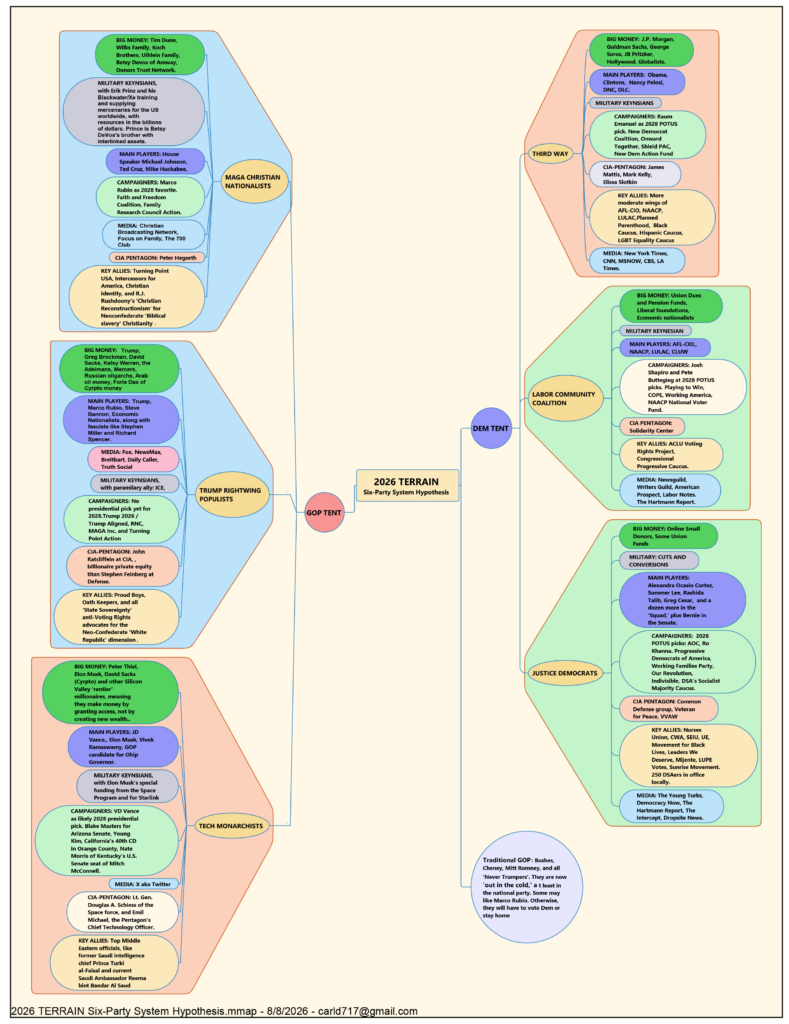
Why ‘Party’ Still Matters as a Term
Some critics object to calling these blocs “parties.” Fair enough. But the term remains useful. The Democratic and Republican Parties are not ideological parties in the European sense. They are coalition-building machines–fluid, transactional, and often internally contradictory. Thus, we argue that each contains three major blocs, with minor offshoots, whose alignments and tensions shape national politics far more than the formal party labels do.
THE GOP TENT
The Right-wing Populists
This bloc now fully dominates the GOP. Dissenters are purged, sidelined, or threatened. The number of billionaire patrons has grown, giving Trump’s “America Firstism” a deeper financial base and wider global reach.
Slow media for fast times. Sign up for our newsletter.
The economic worldview remains rooted in producerism: “producers” (workers, small business owners, real estate developers, small bankers) versus “parasites” (the unemployed, immigrants, Muslims, poor people of color, and other stigmatized groups). When they punch upward, the target is usually George Soros or “globalist elites,” often coded with antisemitic tropes. When they punch downward, it is the familiar litany of scapegoats–people of color, immigrants, LGBTQ groupings, and more.
From the beginning, to build this bloc, Trump fused his campaign with the Alt Right, white supremacists, fascist revolutionaries, and segments of conflicted white workers whose anxieties around immigration, Islam, gender, and status made them susceptible to grievance politics–the “birther” conspiracy theory against Obama, the refusal to accept the 2020 election results, and the Jan. 6, 2021 attempt to block certification–all revealed the bloc’s counter revolutionary potential.
Starting in 2025, Trump’s second term intensified the fascist turn, giving it some depth: irrational tariff wars, billionaire-friendly tax cuts, ICE paramilitary deployments against blue cities, and reckless foreign adventures that weakened US global standing. Steve Bannon, pardoned and mythologized, continues to serve as the bloc’s chief ideologue and organizer, blending producerist rhetoric with a “Leninist of the Right” strategy aimed at smashing the administrative state and building and deepening a reactionary civil society base.
Worthy of note, MAGA’s historical lineage is unmistakable: Jacksonian ethnic cleansing, Know Nothing nativism, Calhoun’s nullification, Klan terror, Dixiecrat segregation, George Wallace’s demagogy, and its offshoot, Richard Viguerie’s New Right. The term “New Confederacy” is not hyperbole–it is descriptive.
Yet internal contradictions remain. Trump delivered little material benefit to distressed white workers beyond modest 401(k) tax advantages to the 50% of wageworkers who held such plans. The “psychological wage of whiteness,” as W.E.B. Du Bois described it, cannot indefinitely substitute for real gains. A slippery rung on a status ladder can only do so much. Thus, the bloc’s submerged class conflict is both a weakness and a volatile force within it.
The Christian Nationalists
This bloc grew from decades of right-wing religious organizing reaching back to 1970-from Viguerie’s base in Billie James Hargis churches, to Falwell’s Moral Majority, to Tea Party evangelicals. Today, it is funded by the DeVos/Amway empire, Koch Brothers networks, and allied megachurch infrastructures. Its ideological core is Dominionism, rooted in R.J. Rushdoony’s Christian Reconstructionism: a theocratic project seeking to replace secular governance with biblical law. This is a fascist sect that views the US Constitution and the Declaration with disdain, flawed with a “secular humanist” Enlightenment view. They are strong advocates for the US as a “Christian nation,” despite all evidence to the contrary.
Dominionist-aligned leaders include “War” Secretary Pete Hegseth, House Speaker Mike Johnson, and Ambassador to Israel Mike Huckabee.
Their agenda is uncompromising: overturn Roe v. Wade, dismantle church-state separation, eliminate marriage equality, restrict or repeal the 19th Amendment recognizing women’s suffrage, abolish progressive taxation, and impose a flat tax. In foreign policy, they combine America Firstism with militant Christian Zionism, supporting irrational policies aimed at hastening “the Rapture” and “the Second Coming.” Secretary of State Marco Rubio, even as a staunch Catholic and not a Dominionist, has longstanding and deep ties with the right’s evangelical base and uses their “Christian nation” tropes in his international speeches. He would be favored by this bloc as a presidential candidate in 2028, even though his “pragmatic side” maintains connections with many “Traditional GOPers,” now out in the cold, discussed below.
The Christian Nationalist alliance with Trump has always been uneasy. His personal behavior, riddled with lust and avarice, contradicts their moral claims, but his judicial appointments delivered their long-sought anti-abortion victories. On the other hand, the Epstein Files controversy–where Trump’s name appears frequently, over 30,000 times–has fractured parts of this evangelical base. However, the hard Dominionist core remains loyal and powerful. This bloc is now the second-most-influential force under the GOP tent, and while tightly aligned with Right-wing Populism, in some respects, it is more ideologically extreme than Trump himself.
The Tech Monarchists
This is a new and rapidly rising bloc. Its nucleus is the Peter Thiel-Elon Musk axis, backed by Silicon Valley rentier billionaires whose wealth comes not from production of new wealth, but from renting access to digital infrastructure. They embrace the neomonarchist theories of Curtis Yarvin and reject democratic constraints as impediments to technological acceleration.
Key political figures include JD Vance (funded and advanced by Peter Thiel), Sens. Josh Hawley and Ted Cruz, and Ohio’s Vivek Ramaswamy. Their ambitions extend into the military-industrial sphere through Musk’s Starlink and SpaceX, and into global elite networking through Thiel’s secretive Dialog Society.
Unlike the Right-wing Populists, they make no populist appeals. They are openly anti-democratic, openly globalist, and openly hostile to Bannon’s attempts to keep white workers inside the GOP coalition. Their rise is one of the most consequential developments since our 5.0 version in 2022. JD Vance will likely be their candidate, though Vance is pragmatic enough to tilt toward the other GOP blocs as needed.
Out in the Cold: Establishment GOP Traditionalists
The old multinationalist wing–Bush, Cheney, Romney, and their donor class–has been expelled from national leadership. Some remain active through the Lincoln Project. George Conway’s 2026 congressional run as a Democrat symbolizes their displacement. They may view a Rubio candidacy in 2028 favorably.
THE DEMOCRATIC TENT
The Third Way
Formed by the Clintons and Blairites, this bloc is funded by Wall Street and has been dominant for decades. Their project was neoliberal modernization: distancing the party from labor left traditions and shifting its base toward suburban professionals and college-educated workers.
The Third Way (named after the Clinton-Blair think tank) still controls much of the party’s money and holds just over half of congressional seats through the New Democrat Coalition. The Third Way tries to temper the harsher neoliberalism of the GOP by “triangulating”, finding neo-Keynesian and left-Keynesian allies for compromised policies. Overall, it has pushed Democrats and their platform generally to the right. With Hillary Clinton’s narrow defeat, the Third Way’s power in the party diminished somewhat, but it regained some clout with the Biden victory.
Still, the Third Way’s labor alliances have weakened. Unions are now going in three directions. Some have remained with the Third Way. Some moved to form their own Labor-Community Coalition bloc, while others–Communications Workers, National Nurses United, and the UE–endorsed AOC’s Justice Democrats and Bernie Sanders’ anti-oligarch campaigns. Regarding the current balance of power in the party apparatus, the Third Way, through its New Democrat Coalition, holds just over 50% of Congress’s seats. This is a slight decrease, but it still controls the bulk of the money. With its labor alliances weakened, rising center-left and left social democratic forces now contest its influence.
The Third Way’s favored new presidential prospect now is Rahm Emanuel, former Ambassador to Japan and former Mayor of Chicago. Senate Minority Leader Chuck Schumer and House Minority Leader Hakeem Jeffries keep one foot in the Third Way, but the other in the Labor-Community Coalition below, working to align both against DSA and the Justice Democrats.
The Labor-Community Coalition
Emerging in a space opened by the collapse of the Blue Dogs, but with no direct connection to them, this bloc includes core AFL-CIO unions, the NAACP, League of United Latin American Citizens (LULAC), and allied civic organizations, such as the Coalition of Labor Union Women (CLUW). Its roots reach back to the right-wing social democracy of the 1950s and 1960s, when Walter Reuther of the UAW purged communists from the unions, crippling the AFL-CIO’s efforts to repeal the Taft-Hartley Act. The NAACP made similar efforts regarding the Southern Christian Leadership Conference, pressuring Dr. King to remove Jack O’Dell, a former CPUSA member, from its ranks as an effective publicist. Bayard Rustin, the key organizer of the 1963 March on Washington, was also sidelined for his homosexuality.
This bloc’s ongoing strength today lies in organized infrastructure–union locals, community chapters, and get-out-the-vote capacity. Politically, it oscillates between the Third Way and the Justice Democrats depending on the issue. Rep. Linda Sánchez (D-CA), Rep. Nydia Velázquez (D-NY), and Sen. Alex Padilla (D-CA) are its noted leaders in Congress. Pennsylvania’s Governor Josh Shapiro and former Transportation Secretary Pete Buttigieg are among their favored 2028 presidential prospects.
The Justice Democrats
Formerly, we called this group the Rainbow Social Democrats, but they have since expanded and named themselves. AOC and The Squad still power it, but DSA, PDA, WFP, and Indivisible are now part of its wider mix. Their platform aligns with European left social democratic parties such as Die Linke, La France Insoumise, Podemos, and Poland’s Razem.
DSA’s growth to 120,000 members and more than 250 local/state electoral wins has made this bloc a significant new force. However, not all DSAers are on board. DSA’s “ultra” caucuses have even refused to back AOC and other Justice Democrats. In New York City, DSA’s Socialist Majority and Groundworks caucuses made up nearly all of the city’s 15,000 DSAers who worked for Zohran Mamdani’s victory.
Under the Justice Democrat tent, tensions also run high in NYC between the Working Families Party and Mamdani’s NYC-DSA. Case in point: Congressional Hispanic Caucus Chair Adriano Espaillat, saw the labor-based Working Families Party compelled to remain “neutral,” despite his racking up some fourteen union endorsements. Regardless, he lost his Upper Manhattan and Bronx seat to Darializa Avila Chevalier, a thirty-two-year-old DSA insurgent backed by Mayor Zohran Mamdani and the New York City Democratic Socialists of America (NYC-DSA). WFP and NYC-DSA have very different styles of organizing–the former favoring traditional coalition building while the latter stresses street-level door-knocking with thousands of DSA members and friends.
The Justice Democrats have also codified a “Third Reconstruction” as a foundational pillar of their official platform for society and governance. In May 2021, Representatives Pramila Jayapal, Cori Bush, and Jamaal Bowman introduced a landmark federal resolution, HR 438, titled “Third Reconstruction: Fully Addressing Poverty and Low Wages from the Bottom Up.” Within their platform, the Third Reconstruction is defined not merely as a civil rights initiative, but as an aggressive, overarching legislative mandate to eliminate poverty, ensure a federal jobs guarantee, codify housing as a human right, and protect the ballot from right-wing rollback.
Bernie Sanders also used the terminology in the Senate. While he more frequently utilizes terms like “fighting oligarchy” and launching a “working-class political revolution,” he and his aligned institutions have directly validated the Third Reconstruction narrative. His educational and policy arm, The Sanders Institute, published direct commentary framing modern voting rights battles as the frontline of “America’s Third Reconstruction.” The institute argues that just as Jim Crow segregationists defeated the First Reconstruction, today’s progressive movement must wage a Third Reconstruction to defeat corporate and partisan attempts to suppress the working-class vote.
Justice Democrats have different views on their pick for the 2028 presidential primaries. Many leftists close to the Justice Democrats are calling for AOC to run. At the same time, Rep. Ro Khanna (D-CA) is also running. While Khanna makes it clear he is not a socialist, he backs deep structural and inclusive economic reforms, including worker co-ops and minority ownership, to grow advanced manufacturing. Khanna gained wide support among women for his efforts to open the Epstein Files, and has recently joined the Justice Democrats and has the support of Progressive Democrats of America, among other left-progressive groups.
What It All Means
To summarize, the GOP’s popularity has diminished, and it’s undergoing internal revolts: its former neoliberal establishment is fully displaced by the MAGA coalition of Right-wing Populists, Christian Nationalists, and Tech Monarchists. This is the party of the New Confederacy, and the principal target of any effective anti-fascist front.
The Democratic tent remains divided but functional. The Third Way seeks a post-neoliberal synthesis through Biden-era reforms. The Labor Community Bloc provides organizational muscle. The Justice Democrats supply ideological energy and generational renewal. Tensions persist, but the full Democratic coalition remains capable of unified action against the MAGA right.
Strategy: Block, Broaden, Build
Block MAGA candidates and operatives at every level.
Broaden the common front-unite Justice Democrats, Labor Community forces, Third Way moderates, and even select a few “Out in the Cold” Republicans when tactically useful.
Build our own socialist organizations, together with those of our alliances, to defend and extend democracy. We always work to grow our long-term capacity. In the movements of the part, we project the whole. In the movements of the present, we look to the future.
Finally, the new six-party visual model clarifies the terrain. It shows where contradictions lie, where alliances can be forged, and where the fascist right is most vulnerable. Applied at the national, state, and local levels, it becomes a practical tool for organizing, coalition building, and defeating the MAGA project.
We have little time and much work ahead of us. After November, we will revise the model again, because the terrain will shift again.
Did you enjoy this article?
Becoming a member is the best way to ensure we keep publishing articles that meet the moment. Memberships start at just $5 a month and come along with a variety of other perks; join us today.