
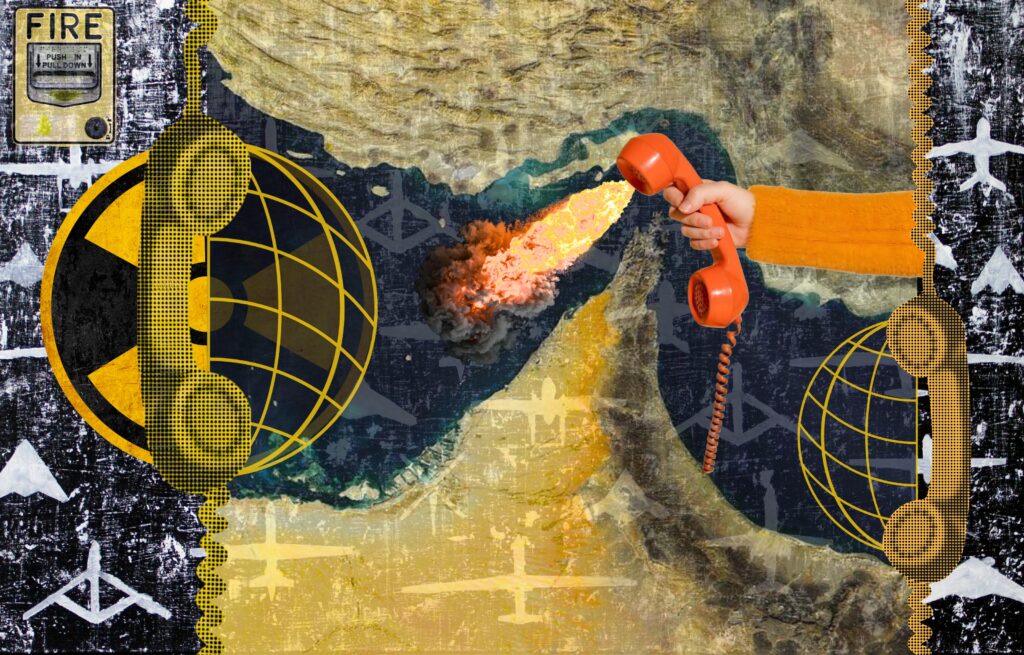
Analysts writing in publications as politically diverse as The New York Times, The Nation, and Pambazuka News have termed Washington’s failure in its war against Iran a “Suez Moment” for the US, referring to Britain’s humiliation in the wake of its 1956 assault (with France and Israel) on Egypt. Despite Britain’s overwhelming military superiority, its attempt to seize the Suez Canal ended in complete strategic defeat: Britain was “sanctioned at the UN, its currency was at the brink of collapse, its aura of imperial power had evaporated, and its global empire was heading for extinction,” Alfred McCoy wrote.
The parallel with Washington’s humiliation today is not exact. There is no power poised to take the mantle of imperial leadership from Washington as the US did from Britain in 1956. But the inability of the world’s top military power to defeat a badly overmatched Iranian regime, or to rally support from even longstanding clients or allies indicates that another overstretched empire is now in decline.
Glimpse of a “mega-catastrophe”
But the Iran War is more than that. It’s also a wake-up call about the dangers facing the entire world, a 21st-century echo of the Cuban Missile Crisis of October 1962 when the US and the Soviet Union came to the brink of nuclear war. The impact of that crisis rippled across the globe, forcing peoples and ruling elites alike to confront the fact that, with the nuclear genie out of the bottle, humanity was in a new era in which our destruction was all too possible.
The Iran War crisis is not as focused on the specific threat of nuclear war. But the world has become far more interconnected than it was in the early 1960s, leading to an expansion of the ways a global catastrophe may be triggered.
Slow media for fast times. Sign up for our newsletter.
The Iran War offers a wake-up call about all of them:
Global supply chains
First, it has demonstrated that, in a world economy where every country depends on global supply chains, a major disruption in one area can wreak havoc everywhere. Closure of the Strait of Hormuz has already led to energy shortages in numerous countries, as well as rising threats to the food security of tens of millions as fertilizer prices rise. And this is no mere temporary inconvenience: a May 11 headline in The New York Times warned that a “long term energy crisis looms.”
Fossil fuels
Second, oil is central to the global economic disruption, so concern with the world’s continuing dependency on fossil fuels is pushed to the fore. So is the link between use of military force, increased use of fossil fuels, and increased carbon emissions.
Asymmetrical warfare
Third, as a textbook example of the effectiveness of “asymmetrical warfare”—the use of inexpensive, easy-to-manufacture drones in particular—the Iran War has sparked a new discussion of how much chaos could be caused by small non-state actors utilizing such weapons. On the other side of asymmetry, the use of AI in US and Israeli military operations has added further urgency to the conversation about the danger AI poses to every dimension of human life. It’s no accident that Thomas Friedman got so freaked out about the danger from AI that he argued that “the United States and China, the two AI superpowers, need to figure out how they can (and surely will) continue to compete strategically while cooperating to neutralize these new asymmetric intelligence-age threats—not unlike what the United States and the USSR did to limit the proliferation of nuclear weapons in the Cold War.”
Nuclear weapons
Last, though not a standoff between nuclear powers as the Cuban Missile Crisis was, the Iran War has reminded the world that in an era when nuclear-armed powers perpetrate a genocide and threaten to destroy whole civilizations, the use of nuclear weapons is never off the table.
“A conjoined mega-catastrophe”
Adding up these dangers, Michael Klare delivers the punchline:
“Until recently, the shocks to global stability and safety—war, economic disorder, climate disaster, and AI-driven calamities—seemed relatively distinct. The crisis in the Persian Gulf, however, has offered us a first glimpse, however limited, of how they might become a conjoined mega-catastrophe.”
Doubling down on going the wrong direction
As with the “Suez Moment” analogy, today’s “Cuban Missile Crisis Moment” parallel is not exact. Both the 1962 Missile Crisis and the 2026 Iran War set off global alarm bells. But 64 years ago, ruling elites responded by trying to reduce the danger at hand, whereas today the main trend among the chief capitalist powers and their closest allies and clients is to double down on actions that go in the opposite direction.
The first nuclear arms agreement, the Limited Test Ban Treaty, was signed in 1963 and, as the Office of the Historian in the US State Department noted, “it was the rapid escalation of the Cuban Missile Crisis in October of 1962 that compelled leaders in both the United States and the Soviet Union to pursue more aggressively an agreement that could help them avoid the devastating destruction that nuclear warfare would bring.” The resulting checks on the nuclear arms race did not end Washington’s addiction to a militarist response to national liberation movements in Vietnam or elsewhere in the global South. But it did reduce the threat of nuclear conflagration and lessen Cold War tensions—and in doing so it created more favorable conditions for national liberation struggles to triumph and for social justice movements in the capitalist heartlands to make gains.
But today, the steps being taken by the ruling elites in most of the world are increasing rather than decreasing the dangers that the Iran War has thrust into public view.
The Trump administration may decide that ending this particular military “excursion” is the best of bad options. But it is doubling down on militarism instead of pointing out or even acknowledging the perils of a might-makes-right world order. Trump 2.0 plans to massively increase the US military budget, move AI central to its war-fighting apparatus, and continue with its $1.2 trillion program for weapons in space. There are no calls to go in the opposite direction from the leadership of the Democratic Party. Meanwhile, though leaders of the capitalist “middle powers”—from Canada and the EU through Japan and Britain—acknowledge a “rupture” in the previously existing (hypocritical) world order, they are pushing re-militarization as the way to navigate the new order coming into being.
Reconfiguring global trade but not global inequality
In the wake of the war’s closure of the Strait of Hormuz, governments and transnational corporations are scrambling to “reconfigure global trade” and “reorganize supply chains.” As the non-US based major players in the global economy search for the kind of stability that best serves their planning and profit-making needs, minimizing dependence on the US (because of Trump’s unpredictable use of tariffs) and the Strait of Hormuz are their new imperatives.
Though the steps being taken will result in a changed map of world trade and global supply lines, they don’t address any of the deeper problems in the global economy—in particular the steady flow of wealth upward that is creating truly obscene levels of inequality both among and within countries. The latest report from UNCTAD (United Nations Trade and Development) shows that the war has accelerated this trend, but did not cause it. “[The war’s] effects are most severe in developing countries,” UNCTAD notes, and “these challenges come on top of existing debt vulnerabilities. Around 3.4 billion people live in countries already spending more on servicing debt than on health or education.”
Elite voices challenging the structural roots of soaring inequality are, if anything, weaker in the wake of the Iran War than before it. Just a few years ago, several currents in the capitalist class were exploring alternatives to neoliberalism. Today there is a flurry of campaign talk about affordability coming from elite advocates of “abundance capitalism,” and significantly more pressure from below to tax the rich and break the grip of the billionaire class. But as is evident in the response to the war by the IMF and World Bank, the impulse to shift the entire burden to workers and the poor has reasserted itself with a vengeance.
As for fossil fuels and climate change…
Matters are complicated in terms of the Iran War’s impact on global use of fossil fuels. On the positive side, the realization that a country relying on fossil fuels can face supply cut-offs and price rises at any time is “supercharging” a shift in most of the world toward renewables. This year’s First International Conference on the Transitioning Away from Fossil Fuels, held in Santa Marta, Colombia from April 26–29 reflects this motion. The gathering “brought together delegations representing one-third of the world economy and resulted in plans to develop national roadmaps away from fossil fuels, along with new tools to address harmful subsidies and carbon-intensive trade.”
The US, Russia, China, India, Japan, and Saudi Arabia were not invited to Santa Marta, as the organizers saw these as blocking steps needed to move forward in the UN-sponsored gatherings. It is refreshing to see a “coalition of the willing” begin to take steps necessary toward concrete progress. But the organizers’ hard-headed realism still demonstrates the obstacles to preventing climate catastrophe. China, with its focus on renewable energy technologies, is making a generally positive contribution on this front. But the hesitancy (at best) of the other large non-attendees is a huge problem.
The US in particular—by far the largest per capita polluter on the planet—is not just a laggard in transitioning away from fossil fuels. Under Trump 2.0 it is aggressively pushing in the other direction. Current government policy subsidizes and promotes use of fossil fuels while doing everything possible to stop the deployment of sources of clean energy. This MAGA president’s heightened militarism likewise undermines a rapid transition to renewables: the US military is the largest emitter of greenhouse gases of any institution on Earth. And as long as the US keeps growing its already bloated military and either attacking or threatening other nations, those nations will build up their militaries as well, contributing to climate change and neglect of human needs as well as increasing the danger of war.
Can we take a different path?
Powerful class and political forces are pushing the world down this suicidal path: the racist, authoritarian Right, of which MAGA is the US contingent; the fossil fuel industry; Big Tech; and the bulk of global finance capital. They have roped a significant portion of the discontented masses into their orbit. And most of their elite opponents (exemplified by the leadership of the Democratic Party in the US) are either unwilling or unable to offer and fight effectively for a different course.
But there is a counter-trend, and at least here in the US, the current administration is losing support by the day. Opposition to economic inequality, to white supremacy and misogyny, to anti-immigrant cruelty, forever wars, and genocide has spurred other sections of the popular majority into action. Now, Washington’s debacle in the Iran War has shown the limits of imperial power (its “Suez Moment” aspect) and sounded the alarm about the “mega-catastrophe” that looms if the world stays on its current course (its “Cuban Missile Crisis” aspect). Both can be fuel for a leap in the scale and militancy of a global resistance.
The challenge to the Left is two-fold. First, to throw all the energy we can muster into the week-to-week resistance, working to increase its breadth and capacity for combat in both electoral and non-electoral action. Second, to offer a positive vision of a world in which the global majority experiences security and well-being. It means rejecting American exceptionalism and convincing the majority that a world order based on demilitarization, international cooperation in fighting climate change, international law, and an economic order that prioritizes labor, migrant, and human rights over corporate profit is desirable, achievable, and worth fighting for.
Did you enjoy this article?
Becoming a member is the best way to ensure we keep publishing articles that meet the moment. Memberships start at just $5 a month and come along with a variety of other perks; join us today.