
Just as sunlight on a sunny morning isn’t experienced as separated wavelengths and colors, we don’t live our lives as beings split into economic, cultural and political parts. For those of us working primarily with and through culture, how does this shape our work?
In 1944, the anticolonial surrealist, writer and politician Aimé Césaire argued for the importance of “poetic knowledge” in decolonization efforts. I first encountered this idea via Robin D.G. Kelley’s Freedom Dreams, where Kelley further explains that the poetic knowledge we can tap into as creative, culture-centered people focused on collective liberation is not simply about writing poems. Instead, this poetic knowledge is the vital practice of tending to experience as a whole. I interpret this as a rejection of the separation of the cultural, political and economic spheres of life. Achieving a radical cultural transition, requires more porous, intentional and disciplined practice that encompasses the historical and present-day interaction between the cultural, political and economic spheres.
When I was seventeen I travelled to Havana with a group of youth dancers, poets, actors and visual artists. There is one conversation – about freedom – that has stuck with me ever since. Not wanting the wool pulled over my eyes, I was pushing a Cuban travelling companion on the question of freedom – specifically about what I had heard to be a lack of freedom of speech. He responded to my argument; “What does freedom mean to you? Is freedom having housing guaranteed and free education and free art classes for whoever wants them? Does it mean having food even if no one has too much? Or is it going to the grocery store and being able to choose between twenty different kinds of cereal?”
What I experienced coming home from that trip wasn’t a utopian sense of Cuba, but an acute realization that the culture I lived in and my personal worldview was shaped by the political and economic systems. The political and economic system shape how people spend their time, what we value and how we are together. In a chicken-and-egg story, those systems were likewise shaped by cultural worldviews and histories. In Cuba, this included a revolutionary political ideology, but also a longer history of place, colonization, migration, religion, ecology and more. This experience made it abundantly clear that the same was also true in California. The political and economic systems that shaped the Bay Area were born from and creating culture where I lived; the class and race-based filtering of who lived where, the emphasis on individual achievement and competition, or the disruptive counter-culture ethos that would usher in the tech revolution.
Slow media for fast times. Sign up for our newsletter.
Many years later I’d see this analysis show up in the thinking of people concerned with culture and social change. Here are three framings of culture that I return to frequently and that resonate with this experience:
During an unpublished interview with Complex Movements in 2020, Sage Crump said, “Culture is made through people’s negotiation of the material conditions of their lives.”
Clifford Gertz: “Society’s forms are culture’s substance.”
Movement Generation: “There must also be a culture/worldview that makes the economy make sense to the people who participate in it, and that sets the limits of what is acceptable and what is not. In fact, that culture and worldview—the languages, stories, practices, rituals—evolve in dynamic relationship with all the other pillars [natural resources, work, governance, and purpose].”
Simply put, if culture is, as Sage has also said, “how we be together”, how we relate is shaped, constrained, and facilitated by basic physics: time (how we spend it, how much control we have of it) and space (where/how/in what conditions we interact). These are variables controlled and set by economic and political systems, as well as cultural worldviews and the longer residue of history. For example, for most people, how we secure housing is a function of how we spend our time (working, charging rent, making others work, etc). Similarly, who we interact with and how is a residue of things both historical and present, like segregation (political) and redlining (economic) and mortgage lending.
The broader movement around land – including land back, solidarity economic models, social housing, regenerative agriculture, etc – is a powerful example of this in action. Economically, many land justice efforts integrate a redistributive or solidarity economy approach to one of the greatest sources of wealth under capitalism. They frequently practice new politics of governance while staying engaged in the dominant policy sphere out of necessity. As places, they create new space and time for how we relate. They are engines – or gardens – of generative culture, complete with slugs, failed crops, hard work and bounty.
The entanglement of culture, politics and economics arrives at my front door as well. Two different cultures stem from how economics and politics shape the time and space of US Postal Service and Amazon delivery workers. Until he retired, I knew my postal worker. We’d trade fruit and stories, I knew about his trips to Vietnam, that his daughter was working in design, that his wife loves karaoke. He knew the names of everyone on our block and had a set route. I noticed when he had to take weeks off for a knee injury and he noticed when we were travelling. He was able to retire.
The right has fewer qualms about the ways these spheres interact. It isn’t that the right is winning the culture war, it’s that capitalist expansion and reactionary politics are winning as a cultural strategy.
I am kindly to the Amazon drivers – especially the woman who plays loud country music and rap alternately – but there is no time for any relation. There is no consistency or rhythm to our appearance in each other’s lives, driven instead by the purchasing habits of neighbors. The drivers are always rushed. We can trace the way this shapes culture further; the labor impacts on “associates” in Amazon factories with no time to be with their families or friends, the geopolitical negotiations that facilitate the rapid transport of goods or fossil fuels for plastics, or the intentional underselling that torpedoes smaller producers.
Challenges to Tending to Experience as a Whole
To tend to “experience as a whole” within social movements, we need infrastructure, belief and practices that cross the economic, political and cultural spheres. Part of this is rooted in how we – as practitioners – might be limiting our own imagination, skills and resourcefulness. The border policing of expertise in economics and politics is forceful and intimidating. But as social movement creatives and cultural workers, we might actually have more to pull from. As dream hampton reflected to Sage Crump during the early onset of the Russian invasion of Ukraine, “When governments fail, facilitation becomes governance.” And as a wise person – whose name I unfortunately cannot remember – shared in another gathering about economic justice for creative workers, the myth about artists being bad with money is frustratingly inaccurate. We are always stretching small grants and payments into something larger. Depending on your cultural worldview, it is the people with immense wealth lying around and serving no life-affirming purpose that are, in fact, bad with money.
Experience as a Whole also requires expanded and flexible support for working in porous and integrated ways. For example, liberal funders frequently have siloed program areas where arts & culture, economics and politics are structurally blocked from collaborating with each other. Many attempts to advance equity, justice, and cultures of belonging are limited to narratives, symbols and ideas, without practice-based alternatives to the hypercompetitive, exploitative consumerist and anti-public culture we swim in. A reticence to create opportunities for practicing and iterating around these ideas, as well as a reticence to name alternatives – socialism, solidarity economics, and deep democracy for example – leaves cultural power building on its own island, too often yelling into the wind.
The right has fewer qualms about the ways these spheres interact. It isn’t that the right is winning the culture war, it’s that capitalist expansion and reactionary politics are winning as a cultural strategy. For example, a 2025 report reviewing online media shows revealed that nine out of the top ten online media shows are right-leaning with over a third self-identifying as nonpolitical. It may be that young, right-leaning men are prime for this media form – many of these popular shows explicitly focus on victimization of American men – but this dominance does not come out of thin air. Conservatives have funded and built infrastructure with what appears to be little hesitation about the distinction between culture, politics and economics.
As somebody trying to shift culture, it can suddenly be overwhelming to keep all that in the frame. Are we supposed to change all of that? There is also a significant power imbalance – the wealthy and politically powerful are overwhelmingly invested in continuing the system that serves them. In spaces of asymmetrical power, cultural production, intervention and practice can and frequently does punch above its weight. But if we continue to ask people to shift cultural practices, norms and values without, as organizer and poet Aniya Butler shared with me, providing the material infrastructure to back that, we won’t build lasting cultural power and social transformation. Without intentional strategy that looks at the enmeshment of culture, politics and economics, we are asking people to shift culture through what is akin to an individualized behavioral plan. From public health research, we know that this is one of the least effective ways to shape change. We also know from public health that population level shifts – and individual behavior changes – are most effective when there are economic, political and cultural interventions at multiple scales, and when people feel in control of their own ability to shape their future.
From Culture as Catalyst to Experience as a Whole
Over the past two decades, there has been a proliferation of toolkits, frameworks and best practices for how culture can be more effectively leveraged in progressive and left social change efforts. Influential in my own work and more broadly, The Culture Group provided a theory of change to organize around, resulting in increased resources for narrative strategy, culture jamming and pop culture storytelling and interventions.
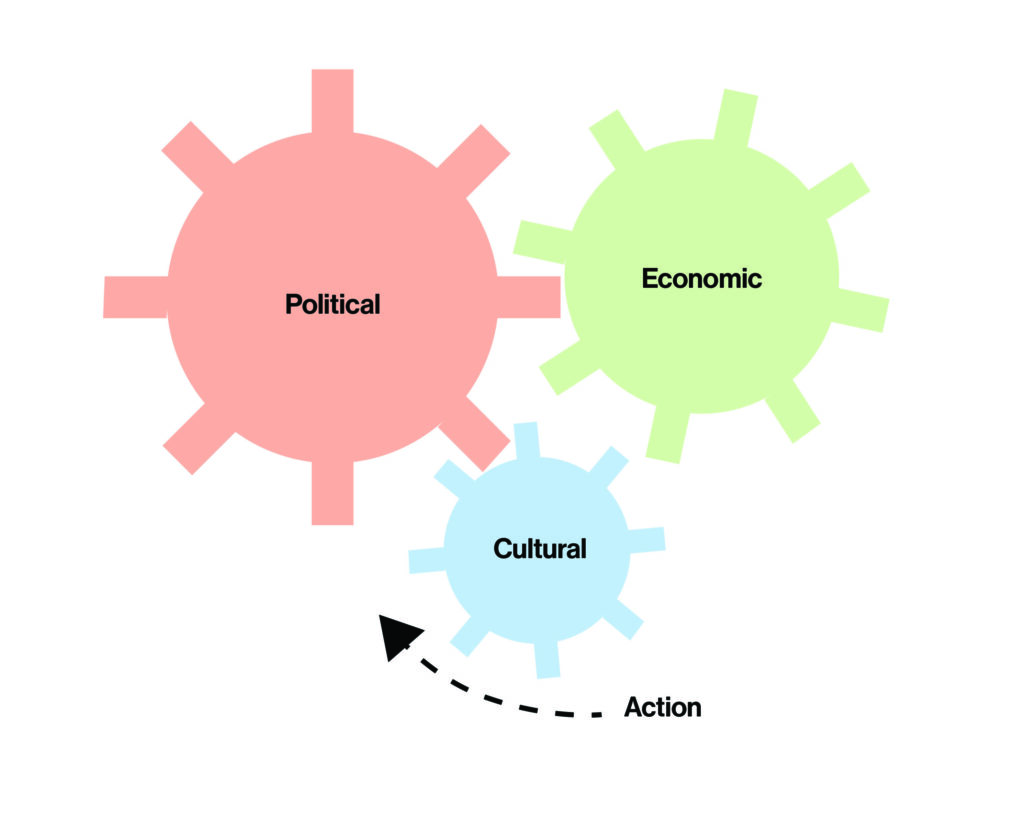
The idea at the core of this approach is that culture moves faster than politics. People live into non-dominant cultural norms faster than policy can create the opportunity to recognize, uplift and protect those norms. Culture is both the agent and object of change. One uses culture to shift culture, which precipitates change in policy and politics, which may affect change in the economic sphere as well. The three realms are like gears in a system. The little gear – which requires the least amount of torque – is where force can be applied to start the movement of the larger gears. This is hugely important because there are differences in power in the economic and political spheres and change there can be difficult and slow. Culture is organic, restless and insurgent; it gets through the walls. This approach is effective and essential as a tactic, but it can’t be the only way we approach culture change precisely because of the interrelation of culture, politics and economics. We have to find ways to disrupt siloed expertise in each area, knit them more closely together and push both the focus and practice of our approaches towards their enmeshment.
Experience as a Whole
Experience as a Whole is a cultural strategy approach that follows Césaire’s insistence that decolonization requires uplifting poetic knowledge, or the knowledge born of experience as a whole. This approach recognizes the historical enmeshment of culture, politics and economics. Experience as a Whole also rejects the consolidation and protection of power that comes from separating and policing expertise, practice and analysis in the economic, political and cultural spheres. This approach strives to encompass the complexity of lived experience as a primary lens for how we orient our work. As Audre Lorde writes in Poetry is Not a Luxury, “The quality of light by which we scrutinize our lives has direct bearing upon the product which we live, and upon the changes which we hope to bring about through those lives.”
In this approach, the work begins with experience as a whole, not a fragmented compartmentalization of experience. It focuses not on a discrete thing, but the relationship between things. In other words, it recognizes housing as not just shelter but as home and its many interlocking elements – history, sense of self, relationships, access to schools, safety, and on. As sung by Luther Vandross, “A chair is still a chair, even when there’s no one sittin’ there // But a chair is not a house and a house is not a home…”
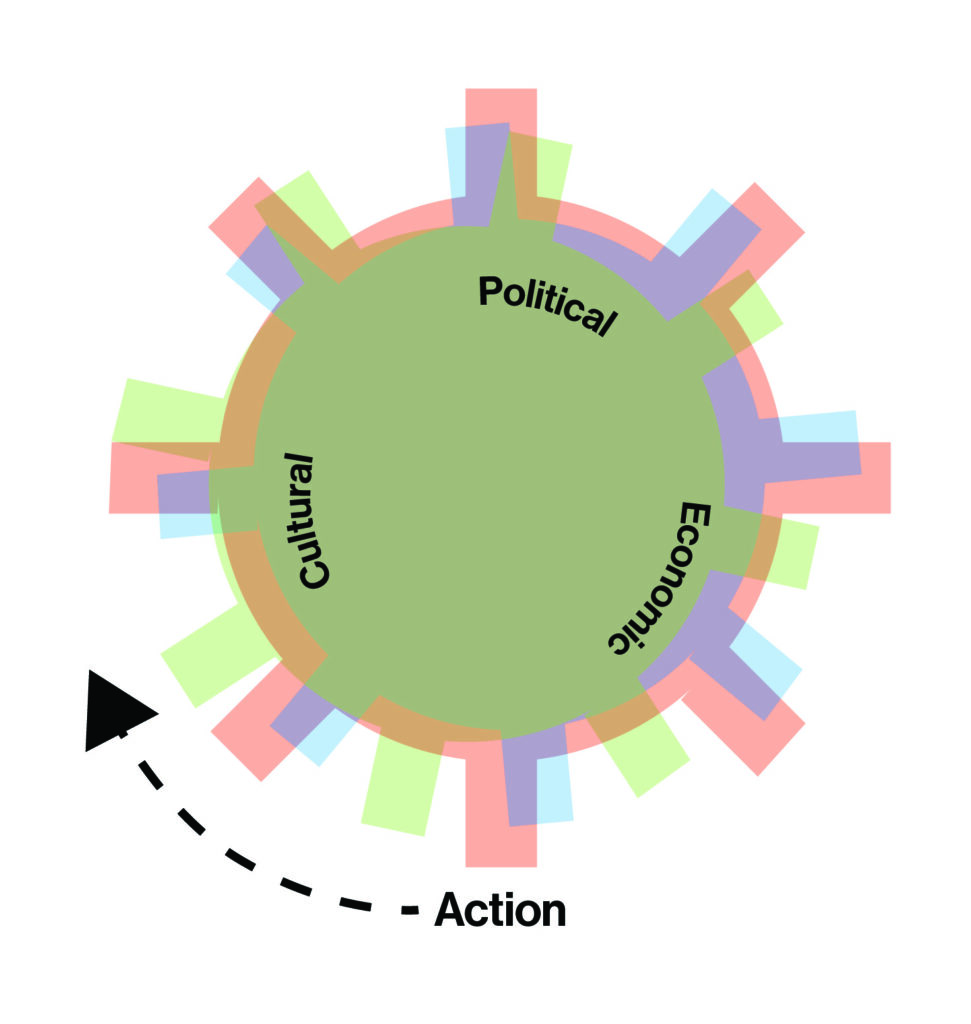
Experience as a Whole uses the holistic lens of analysis available to arts and cultural practice to reveal the interconnection of culture, politics and economics and to rework the arrangements within these spheres towards a liberatory culture.
This invitation requires us to struggle with nuance, complexity and at times, paradox. To that end, below are three examples from my own work where culture is both object and agent of change, and the work intentionally engages the interrelation of economic, political and cultural ways of being. I share these with vulnerability, knowing they are imperfect and mistake-filled in practice, incomplete in their telling here and each involving dozens of collaborators without whom this work wouldn’t have happened.
1. Building Power Fellowship (Richmond LAND):
I facilitated a fellowship that used the arts and participatory research as a way for six residents without formal real estate development expertise to envision and pursue development projects that would serve their broader communities. Using poetry, photography, surrealist games, and sculpture we began with a Freirian style, holistic analysis of the situation “as it stands” in order to identify development goals. This was supplemented by workshops on the restorative economy, cooperative economic models, city planning and traditional affordable housing development. Through creative outputs – a zine of oral histories and portraits, a documentary video, public events and parties – the fellows and staff at Richmond LAND built momentum, expertise and belief in the work, leading to organizing and policy campaigns, particularly around the ownership and governance of public land. Many of these were based on the ideas seeded through those original arts-based exercises that began with an analysis of “experience as a whole”. The projects contributed to a broader cultural emphasis on community led development in the city, and catalyzed efforts that brought land into community control.
2. Cultural Strategists-in-Government:
From 2022 to 2024 I worked on a program in Roberto Bedoya’s Cultural Affairs Division in the City of Oakland. Designed by Vanessa Whang and Bedoya, the program created a structure for shifting governance practices and policy through supporting partnerships between city departments and cultural strategists in Oakland. The program recognized that government has a culture – and part of that culture was to limit the deep, ongoing dialogue and input of residents who experienced Oakland’s government in practice. The cultural strategists were asked to be thought partners by drawing from their experiences and practices to shift government practice. The underlying thesis in the program was that the cultural strategists, all BIPOC Oaklanders, held deep expertise even if it wasn’t professionally recognized in governmental sectors. By creating this edge zone working space, this expertise – and the dialogue between cultural strategists and government workers would lead to policy and practice arguments towards belonging, cultural resonance and racial equity. By shifting these from 12-18 month projects to longer and deeper integration, the work can more effectively operationalize these deep shifts in democratic practice.
3. Gathering and Exchange:
Over the last three years I’ve increasingly focused my art practice on creating opportunities for gathering and exchange. In a culture where relationships are often created through some type of monetary underpinning, outcome-oriented goal or tit-for-tat, the practice is rooted in the idea that, “the exchange is the outcome.” Usually there is nothing more asked of people than to show up, participate and treat it as a learning space. Within the exchanges, people inevitably strategize and share resources. Conflict and disagreement arise, but the jockeying for power that can happen in groups of people who don’t know each other well is lessened by the absence of an outcome or an economic imperative placed on top of the relationship. What has been lovely to see is the way that over time, the spaces become ones of affirmation and support, even as people take on different issues and strategies or approach from different disciplines or sectors. In many ways, it is a small scale practice of the Zapatista saying, “creating a world in which many worlds fit.” Actions, collaborations and long-term partnerships have emerged out of these exchange spaces. At the basis of this is a rejection of the notion that our time is money and that it must always be producing something. By extension, this becomes a reclamation of time for the purpose of being in relationship.
These examples may look disparate, but there is an ideology that animates them. They derive from an analysis that culture, politics and economics are interconnected and that life is lived and experienced holistically. Durable, resilient and regenerative change on any front requires an awareness of how these spheres interact and shape each other. In this sense, it reflects a worldview that emphasizes relation, interconnection and sacredness of all things. In addition to the experience I shared in the opening, this ideology has been shaped by a wide range of influences including, but not limited to Aimé Cesaire, the Allied Media Conference, Audre Lorde, Brett Cook, Gina Athena Ulysse, Jaime Martinez Luna, Karl Marx, Manulani Aluli Meyer, Movement Generation, numerous Buddhist teachers, Nwamaka Agbo, Robin D.G. Kelley, Robin Wall Kimmerer, Sage Crump, and Winona La Duke. The influences could continue.
Experience as Whole is a cultural strategy approach that analyzes and tracks the ways culture is generated and responsive to the organization of material conditions, to time and space, to how we are together. It takes those elements as materials at our disposal for effecting cultural shifts and building resilient cultural power. We need many ways of charting, practicing and guiding a cultural transition, just as we need many ways of refusing, blocking and letting die the one that dominates today. Experience as a Whole is a reminder that our horizon – as those focused on cultural change – is not only the narrative or symbol or word, it is not a single issue, nor is it even culture alone. It is a reminder that when we begin with experience as a whole – when we begin with the sunlight and not its separated and categorized parts – it is a portal into a much broader horizon that will necessarily engage the political, economic and cultural. When practiced this way, we are working towards transformation of society – of life – as a whole, not a falsely isolated component. As the teaching by Pema Chödrön goes, if we place a small drop of water on a stone in the sun, it will evaporate quickly. But if we put it in the ocean, it will never be lost.
Did you enjoy this article?
Becoming a member is the best way to ensure we keep publishing articles that meet the moment. Memberships start at just $5 a month and come along with a variety of other perks; join us today.