
This month on the Attention Economy Navigator, our guide to what you should be paying more attention to, and what you can probably pay less attention to. And why those stories might not be what you’d assume.
You can also listen to the podcast episode featuring Justin Hendrix and Josh Elstro, or watch the panel plot these stories in real time on YouTube.
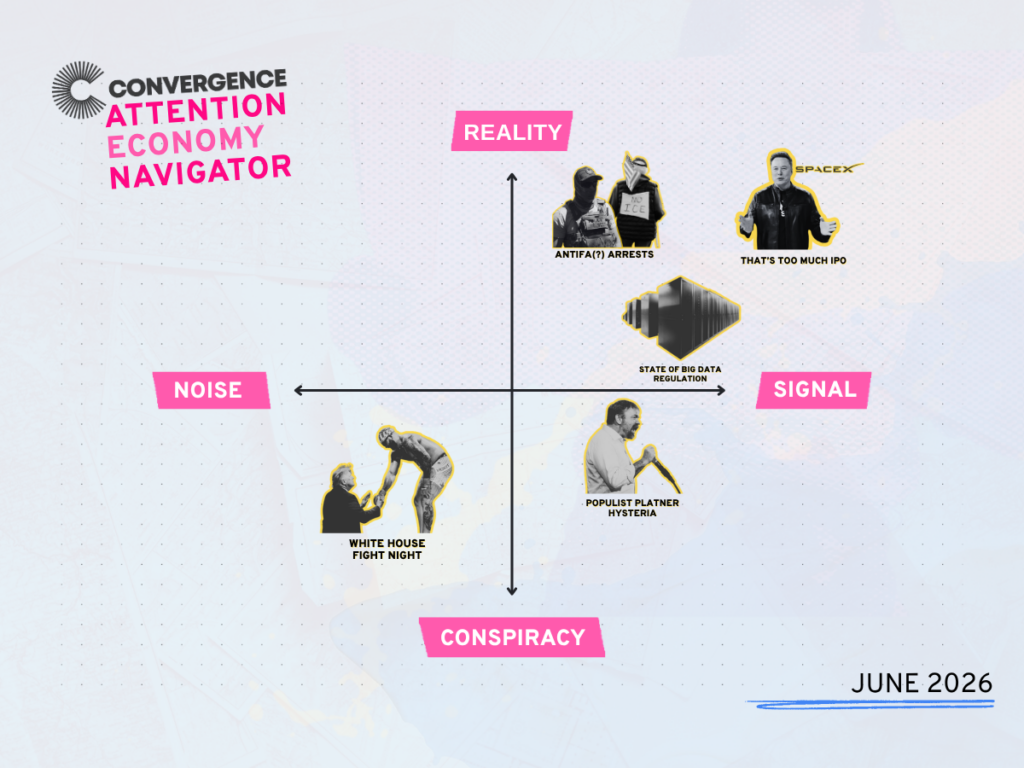
High Reality, High Signal
- Elon Musk becomes the “world’s first trillionaire” as a result of the SpaceX IPO, getting rid of a billionaire in the least ideal way possible.
- Musk is also a huge beneficiary of government largesse, from direct contracts to tax breaks to regulatory irregularities about the IPO itself.
- Josh points out the SpaceX IPO raised around $75bn for the company, nearly triple what the next largest IPO in history ($25.6bn) raised for Saudi Aramco in 2019.
- All the reporting suggests SpaceX is not profitable, nor does it have a path to near-term profitability; Justin points out the way that all these different Musk ventures packed into SpaceX, including rumors that Tesla could get rolled in there someday too.
- It’s also maddening to watch the ways that this media circus has successfully laundered Musk’s image in the business press in particular; let’s not forget that this is the same week he’s encouraging racist pogroms in Belfast on X and around the same time that experts are pointing out that the dismantling of USAID by DOGE was a major contributor to the current Ebola outbreak in the Democratic Republic of the Congo and Uganda.
- 15 people were indicted in Minneapolis for their Operation Metro Surge-related protest activities: it’s part of the ongoing weaponization of the Department of Justice against dissent, creating a drumbeat about who protesters are, what they want, and what the administration is doing about them.
- Cayden ties this to a bigger arc of indictments and raids over the past few months, including the Broadview Detention Center indictments in Chicago; the Prairieland Detention Center convictions out of Texas; and last week’s raid on the Ohio Organizing Collaborative, where the FBI sent over 100 agents to question people and seize computers.
- Justin points out that a big part of this story is, once more, the vulnerability created by push notifications from Signal chats. Cayden reminds us that you shouldn’t send a message you wouldn’t want read out in court, even if it’s hyperbolic, emotional, or jesting.
- Josh spent some time in the indictments; there are some important differences between the various cases we’ve been tracking, but each of these indictments is a test balloon to try new tactics and see what they can pull off.
- Justin flags that many of the big tech firms are also ready to cooperate with the government when it comes to law enforcement activities, and movement folks should plan accordingly.
- This month Reps. Jay Olbernolte (R-Calif.) and Lori Trahan (D-Mass.) submitted a massive (269 page!) discussion draft of a bill they’re calling the Great American Artificial Intelligence Act of 2026. This is the first systematic attempt to create a comprehensive legislative-side regulation of the AI industry.
- Most legislative AI regulation so far has been happening at the state level; Justin points out that there is a lot of ad hoc executive-side regulation of AI through the export control directives issued against Anthropic’s products, or declaring Anthropic a supply chain risk through the Department of Defense.
- Justin thinks the ad hoc nature of most federal action on AI illuminates how there’s no real plan to grapple with the impacts of AI on our society, and that Olbernolte and Trahan show some serious commitment to making something like this happen. Much of the tech policy debate is ultimately about who gets to make the rules.
- Cayden also found Sen. Bernie Sanders’ Capitol Hill panel about x-risk to be…perplexing.
High Reality, High Noise
- Nothing this month.
High Conspiracy, High Signal
- Josh is glad he doesn’t have to vote for Senate in Maine: it’s a messy situation where a lot of mainstream media ink has been spilled to discredit Platner and the questions people are raising are, frankly, good questions.
- Josh wants to know about Platner’s origin story: how did he become a candidate for Senate of all things as opposed to a lower office? How do we better develop candidates who have deep relationships in movements as opposed to being “Eddington candidates” who get politicized online and kind of…stay there?
- Cayden has appreciated reading Shay Stewart-Bouley (BlackGirlInMaine) on this; her takes seem clear and grounded about both who Graham is and what the moment calls for.
- The panel talks about the weird experience of having a massive digital record of things we’ve posted as elder millennials; the younger folks we know, including Justin’s students, who just aren’t posting at all may have learned the right lessons from us.
- We also chew on the question of what it takes to change, and what we need from people who have done harm to trust that they have changed; Platner’s character arc raises bigger questions of what accountability even means and what people’s values and ideals actually are.
High Conspiracy, High Noise
- UFC Fight Night at the White House (brought to you by Crypto.com and Polymarket) is the fragile masculinity version of musical theater for President Trump’s high camp performance impulse.
- There’s a real nightmare blunt rotation of sponsors for this event, which Josh reads as a way to understand the direction in which the economy is heading. It’s a sign of weakness in many ways: he charged into the White House saying he was going to bring back American manufacturing but nearly all the companies involved in this circus just want to make the economy into a casino.
- Cayden wonders how much of UFC Fight Night was about “winning back young men,” which is a highly speculative way of looking at this; Josh wants to know how much of this was about “triggering the libs.”
- The panel talks about the hyperreality of watching UFC fighters prepping in the White House; it feels like an elevation of the aesthetics and vibes of something conspiratorial into its final form.
Other Stories We’re Watching This Month…
- Is the “Knicks in 5” meme a Kalshi-supported psyop? Seems like it, to be honest. (We miss when internet culture was just the product of a bunch of weirdos making stuff that made them and their silly friends laugh.)
- The discourse around the Democratic Party’s 2024 “autopsy” is kinda cursed. There’s a lot of finger-pointing and not a lot of taking actual accountability. And the report makes no mention of Gaza and Israel, nor does it explain the decision-making process to simply anoint Joe Biden as the candidate.
- The UK moves to ban social media for kids under 16, part of a wave of efforts to limit social media use for young people. The are a lot of questions about how this is going to be implemented, and a lot of worries about how bans like this endanger and create more risks for the people they purport to protect.
- Ohio state politics blogger DJ Byrnes was arrested for telecommunications harassment, a misdemeanor, for allegedly texting a state senator a picture of cartoon ogre gonads. Whether or not he did it, it’s simultaneously goofy and serious: Byrnes is known for wry and biting critiques of conservative politicians in the state and there are questions about whether enforcement was intensified at the behest of a sitting politician.
Did you enjoy this article?
Becoming a member is the best way to ensure we keep publishing articles that meet the moment. Memberships start at just $5 a month and come along with a variety of other perks; join us today.