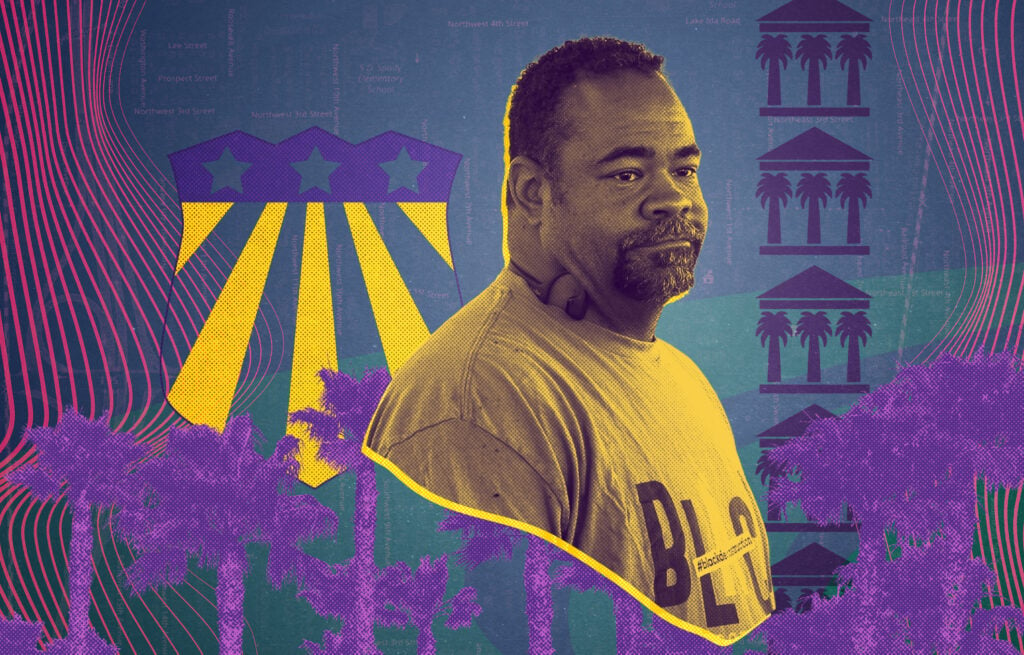
“Wealth is being extracted from Black communities. Dollars are moving out of our communities faster than they are coming in. We need to talk about how these communities are being kept poor.” These are the words of Alphonso Mayfield, a Florida labor organizer who reshaped organizing in the state and developed new generations of leaders. He passed away in January 2026.
Alphonso believed that unions should organize along with the communities they exist in, that community wealth must be developed through an array of strategies, and that the South is an arena of struggle that bears great consequence for the rest of the nation. Before we get into that, let’s go back to the quote.
The year was 2012. We were sitting inside the historic Donnie’s Restaurant in Delray Beach, Florida—not the Delray that appears in tourism ads; not the Delray filled with luxury condos, restaurants, and vacation homes with ocean views. We were in The Set, the historic neighborhood that is home of the Black community that built the city.
Delray Beach, with just 68,000 residents, has a roughly $10 billion economy. Of that wealth, millions of dollars flow from the labor, small businesses, and wages of residents from The Set. Yet the community itself had no grocery store, no local banking institution, and little say over development happening on their land.
Slow media for fast times. Sign up for our newsletter.
City leaders were negotiating major investments in the name of job creation. But residents had lived the history of segregation and disinvestment and knew the reality of what was being offered: seasonal and part-time jobs for the community, while corporations built wealth using the community’s labor, land, and tax dollars. People were rightfully outraged by this economic, social, and political injustice.
At that table sat Alphonso, President of Service Employees International Union (SEIU) Florida Public Services Union (FPSU). What was a labor leader doing in a community meeting about neighborhood development? The answer tells the story of how FPSU began transforming itself into a community union.
Alphonso believed that unions must see workers as whole people who are not just defined by the hours they spend at work. Workers live in communities shaped by housing costs, access to capital, public investment, and political decisions that determine opportunity.
For Alphonso, the labor movement had to engage those realities if it wanted to truly represent working people.
At the center of his leadership was a simple belief: Ordinary people should have the power to shape their communities and their economies.
He often described the foundation for change through four interconnected elements: capital, community, relationship, and agency. He believed that all of these were essential to transformation.
Capital mattered because wealth constantly flows through communities that are described as poor, but most often it is extracted rather than reinvested. Community mattered because individuals alone cannot build power. Relationships mattered because deep trust between people is the foundation for collective action. And agency mattered most of all, because people must believe their actions matter.
Without doing that work, movements would always struggle to build durable power.
Reimagining the Union
When Alphonso became president of SEIU Florida Public Services Union in 2009, he understood that traditional union strategies alone would not be enough to win meaningful gains for workers in a state like Florida.
Florida is a right-to-work state with one of the most hostile political environments for workers in the country. Conservative statewide policies, preemption of local laws, and attacks on collective bargaining have combined for decades to weaken worker power.
In response, Alphonso began building a new model: the community union. A community union recognizes that workers’ lives are shaped not only at the workplace but also in the neighborhoods where they live.
FPSU began developing community stewards: leaders who organized not just in workplaces, but also where they lived. The goal was to build local leadership, strengthen civic participation, and connect workplace struggles with broader issues like housing, public investment, and economic opportunity.
This approach produced real results.
In St. Petersburg, FPSU helped lead the People’s Budget Review, a community coalition that successfully reversed austerity budgeting and pushed the city to increase its tax millage rate to reinvest in youth programs, neighborhood development, and poverty reduction.
In Palm Beach County, FPSU launched Unify the Community, building leadership networks that connected workers, residents, and local organizations around shared community priorities.
These initiatives demonstrated how labor organizing could expand beyond contracts and grievances to become a vehicle for communities to have broader democratic participation over public resources.
Alphonso’s vision was to build a union that could address the full range of challenges its members confronted. A union that would fight to transform the conditions that keep our communities poor.
Building Community Wealth
Alphonso also believed that organizing people and winning elections would not be enough to transform economic conditions. Communities also needed ownership and access to capital.
FPSU developed a Community Wealth Building framework built around four strategies:
- Wages and ownership: fighting for better wages while building worker and consumer cooperatives that allow working people to build assets.
- Economic engines: partnerships with credit unions and community financial institutions that could provide capital to communities historically excluded from the financial system.
- Politics and policy: using the power built through organizing to influence public spending and economic development decisions, so communities benefit from local investments through directing public dollars toward community-serving institutions.
- Education and civic engagement: leadership development, financial literacy, and community participation in budgeting and policy.
Alphonso insisted that all four paths had to be pursued simultaneously because they reinforced each other. Crucially, he was willing to experiment with different structures—for-profit, not-for-profit, political vehicles, or, as he’d say, “no official structure at all, just people sitting around in a coffee shop”—to confront the problems in front of us. He understood that the traditional boundaries between labor organizing, economic development, and community building were artificial, and that breaking through them was necessary to build the kind of power that could actually transform people’s lives.
For Alphonso, this represented the future: communities not only advocating for change but also owning the institutions that shape their economic future.
One of the most ambitious examples of this work emerged in Delray Beach itself, with The Set Transformation Fund, a community-led investment strategy designed to combat displacement in the historic Black neighborhood.
Rather than development happening to the community, residents would help guide development and ensure the wealth generated from their land benefited them directly.
The community union model he built at FPSU demonstrated that a labor organization in the hostile terrain of the South can be a platform for community wealth, political power, financial inclusion, and democratic participation—all at the same time. The Set Transformation Fund in Delray Beach showed what it looks like when capital, community, relationship, and agency come together in a single place—residents controlling their own development, their own political infrastructure, their own future.
Organizing the South
Alphonso believed the past, present, and future of America is written in the South. What is happening to our nation, he so often stated, is a consequence of our inability to vanquish the ideas and systems of the Confederacy and allowing the legacy of racial hierarchy and economic exclusion to remain an active force in our organizing and politics. It has historically and still today continues to subvert democracy for the entire country.
More than half of the nation’s Black population lives in the South. It is home to the fastest-growing states in the country and will shape the nation’s political and economic trajectory for decades to come.
Yet historically, progressive movements have underinvested in long-term organizing in the South. He advocated for multi-year, multi-state, multi-organizational investment and a strategic plan that combined organizing, economic development, political infrastructure, and narrative power.
He exemplified his vision in Florida through his leadership in building long-term partnerships like Florida for All to build statewide alignment among organizations in workplaces, neighborhoods, campuses, and faith communities. Alphonso believed that no single organization was strong enough to lead the transformation we need on its own, but that collectively we could expand civic participation, train leaders, and strengthen political infrastructure capable of shaping state and local policy.
Legacy
Alphonso Mayfield lived a life devoted to building institutions that would outlast him. The community union he built at FPSU demonstrated that labor organizations can become platforms for community wealth, civic engagement, and democratic participation. The community wealth initiatives he launched showed how organizing can connect economic development and political power. The statewide alignment he helped forge demonstrated that organizations with different histories can build trust and collaborate for long-term change.
But perhaps Alphonso’s greatest investment was in people. His gift was to see the possibility in others around him and to help them see it in themselves. For two decades, he mentored us, sharpened our ideas, and challenged us to do things that made us uncomfortable. He saw power in even the smallest of ideas. We are, he said, significant in a time that we are being told that we are insignificant. And when our agency is connected to love and community, the world changes.
He so often reminded those around him that movements are multigenerational, that in this lifetime we carry the dreams of our ancestors and that we plant seeds whose full harvest we may never see.
Today, that work continues. For activists and organizers reading this—especially those working in the South or in other hostile environments—Alphonso’s life offers a set of lessons that we believe constitute a coherent path forward.
Invest in relationships before strategy.
The trust that Alphonso built through years of intentional relationship building was the foundation that made everything else possible. You cannot build durable coalitions or ambitious programs on a foundation of shallow or transactional relationships. Go deep with the people you are going to build with.
Hold a clear and audacious vision.
Alphonso’s North Star—that ordinary people should be able to shape their communities and economies—was simple enough to explain in a sentence and vast enough to guide two decades of work across dozens of initiatives. A clear vision does not constrain you; it liberates you to pursue multiple strategies and vehicles toward the same destination.
Be willing to build multiple types of vehicles.
Alphonso was not dogmatic about organizational form. He built unions, cooperatives, political coalitions, media and field companies, financial inclusion programs, and candidate pipelines. He partnered with CDFIs, credit unions, universities, faith institutions, and businesses. If a vehicle could advance the North Star, he was willing to experiment with it.
Confront racial division directly.
Alphonso was unsparing in his insistence that you cannot build power in the South—or anywhere in America—without dealing honestly with race. This means both structural work to dismantle systems of oppression and relational work to build understanding and trust across racial lines.
Think and act intergenerationally.
Alphonso always said this was multigenerational work. He was not trying to win in a single election cycle or even a single decade. That long-term orientation allowed him to invest in leadership development, institution building, and cultural infrastructure that would compound over time. It is a profound irony and a profound gift that his unexpected passing has made this lesson even more vivid: the vehicles he built are continuing to operate and grow because he designed them to outlast him.
It is now our responsibility to continue building the future he believed was possible.
Did you enjoy this article?
Becoming a member is the best way to ensure we keep publishing articles that meet the moment. Memberships start at just $5 a month and come along with a variety of other perks; join us today.