
Prager U, despite its name, is not a university. It is a conservative media organization that produces slick, ideology-driven videos designed to attract young people to the right, and it’s now in American classrooms. The Guardian reported in April that as teachers adopt its free lesson plans and the White House actively boosts its content, Prager U has become one of the most effective platforms for delivering right-wing political indoctrination directly to students.
This didn’t happen overnight. In September 2025, NPR reported that the Department of Education began partnering with conservative organizations—including Turning Point USA, the Heritage Foundation, and the America First Policy Institute—to design new “patriotic civics content,” despite federal law prohibiting government-directed curricula. The same administration revived the 1776 Commission, first created in 2020 to counter the racial justice uprisings and the 1619 Project. The 1776 Commission sought to recast American history as a patriotic narrative while erasing the realities of slavery and systemic racism. We are watching a coordinated effort to turn civic education into a pipeline for political obedience—and it is already in the classroom with American students.
Leftist movements committed to progressive change must meet this moment by building a national movement for political education. Political education, the process of learning that develops critical consciousness, shared analysis, and collective strategies for social change, is essential not only for countering the right’s co-option of civics, but for building a democracy capable of transformation rather than mere survival.
Political education has long been a practice among community organizers, and now it must extend far beyond activist circles. Unlike civics, which stops at explaining institutional structures and memorizing events, political education equips people to uncover the root causes of the issues we collectively face today. It interrogates power: who benefits, who is harmed, and how we can act together to build a just society. We need more spaces—in classrooms, online, and in the community—where people can engage with this deeper learning. At its core, political education builds a justice-oriented civic identity rooted in equity, solidarity, and collective dignity. It counters political obedience with political agency by developing the courage and capacity to practice democracy as a path toward collective liberation.
Slow media for fast times. Sign up for our newsletter.
How We Build Political Education Ecosystems
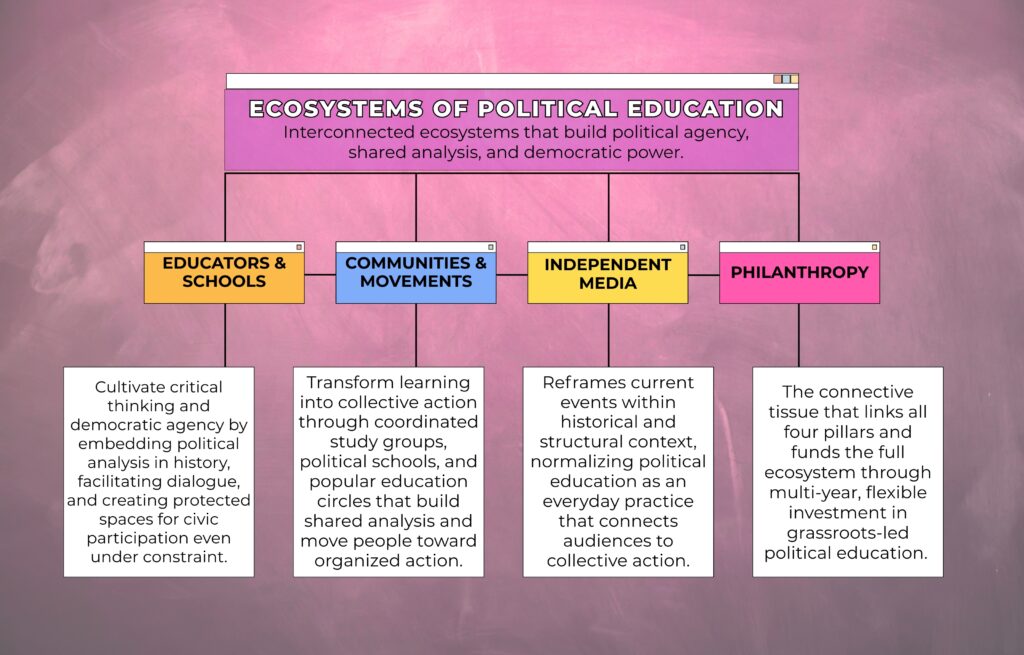
To counter authoritarianism and build a more democratic society, political education must be constructed as coherent ecosystems rather than a set of isolated efforts. What follows is a roadmap for constructing political education ecosystems that operate across schools, philanthropy, communities, and media, ensuring that learning, analysis, and collective capacity reinforce one another. This approach treats political education not as an accessory to democracy, but as one of its essential conditions. The proposal below is to both strengthen each ecosystem and connect them so that what educators build in schools informs what organizers develop in communities, what movement journalists amplify reaches philanthropists who fund it at scale, and what funders resource flows back to the people doing the work.
Students, Educators, & Schools
Students, educators, and schools are critical actors in building political education within a broader democratic ecosystem. However, we must acknowledge that educators across the nation face growing scrutiny and even legal risk for teaching contested histories or engaging students in discussions about race, power, and social justice. In this context, the task is not simply to adapt, but to act collectively to integrate political education into curricula under constraint.
Educators can embed political analysis in how they frame history, design lessons, and facilitate dialogue, even when explicit language is limited. Students can organize peer learning spaces, lead discussions, and build collective understanding beyond the formal classroom. Schools and educational communities can support this work by creating protected spaces—through extracurricular programs, partnerships, and community-based learning—where political inquiry and civic participation can continue. When these efforts are coordinated, political education becomes a sustainable practice that persists even in hostile conditions, and continues to cultivate democratic agency.
There are already examples of this work taking shape. The Chicago Teachers Union has developed classroom resources and campaigns, such as its Lessons for Resistance series and May Day teach-ins, that connect labor history, social movements, and contemporary politics. National unions have also invested in this approach: the National Education Association’s EdJustice initiative provides educators with training and resources to analyze structural racism in education and advocate for more equitable school systems. Beyond unions, organizations such as the Zinn Education Project bring educators, students, and families together through workshops, curriculum, and campaigns that connect historical understanding to present-day struggles. Youth-led groups such as Students Engaged in Advancing Texas further demonstrate how political education can translate into civic action, organizing students to advocate for policies related to mental health, financial literacy, free expression, and student representation in school governance. Together, these efforts show how schools and educational communities can serve as anchors of political education: connecting learning, analysis, and collective action.
Communities & Movements
Communities and movement builders play a critical role in sustaining political education, particularly as formal institutions become increasingly constrained by political surveillance, censorship, and hostility toward dissent. As spaces for open political expression narrow, political education must be cultivated through distributed, community-rooted practices that do not rely on institutional permission. The task is to intentionally build and connect outside formal institutions, both online and in person, into a shared ecosystem of learning and action.
These spaces, including community study groups, political schools, popular education circles, and digital commons, should not function as isolated efforts or individual platforms (which they often do today), but as coordinated sites of collective learning where people develop shared analysis, build relationships, and move toward organized action. Strengthening political education in this context means linking these efforts through collaboration, shared curricula, and ongoing exchange. Doing so allows decentralized spaces to reinforce one another rather than remain fragmented.
There are both contemporary and historical examples of how community-led political education functions as movement infrastructure. Organizations such as the W.E.B. Du Bois Movement School for Abolition & Reconstruction in Philadelphia and the Center for Political Education in San Francisco bring participants together for sustained study, collective analysis, and organizing practice, building the relationships and political clarity needed for action. These efforts build on a longer tradition of movement-based education. Institutions such as Brookwood Labor College, which trained labor organizers in the early 20th century, and its successor traditions, such as the Highlander Research and Education Center, demonstrate how political education has historically been used to develop leadership, strengthen organizing capacity, and advance social movements. In a moment marked by political disillusionment and social isolation, these models offer a path forward: political education as a shared, collective practice that reconnects people to one another and to the possibility of transformative change.
Independent Media
The media ecosystem, especially independent and social media, may be the most powerful pillar for normalizing political education as an everyday practice. Mainstream media rarely name power structures or offer structural analysis of why things are the way they are. Independent journalists, educators, and organizers have stepped into that gap, using podcasts, newsletters, and social media platforms to reach millions with the kind of contextualized, movement-grounded analysis that formal institutions either can’t or won’t provide. When this work is at its best, it reframes rather than simply informs. It gives people a way to understand their material conditions, situates current events within longer political histories, and connects individuals to collective structures where that analysis can deepen and lead to action. Progressives must recognize independent and social media as political education infrastructure, and invest in building it with the same intentionality they bring to other organizing spaces.
We saw this during the Black Lives Matter uprisings in 2020 and continue to see it in the context of the ongoing Palestinian genocide, where individuals have provided real-time political education at scale. Some have built sustained platforms dedicated to this work. Organizer Kelly Hayes, through her podcast Movement Memos and newsletter Organizing My Thoughts, offers political education grounded in movement strategy, helping audiences connect current events to organizing practice. At a different scale, political commentator Hasan Piker uses livestreaming to reach millions, integrating political analysis and historical context into accessible commentary that introduces broad audiences to structural analyses of power. Hasan connects his audience to political candidates running for office, including now New York City Mayor Zohran Mamdani, Rae Chen Huang, and Chris Rabb, and to movement organizing, using his platform to mobilize audiences from political education into direct participation in electoral and grassroots campaigns.
At the same time, individuals are organizing hyperlocal political education initiatives—such as teach-ins, study groups, and community forums—and, in moments of crisis, building rapid-response networks that combine education with action. Organizers like Flor Martinez (@FlowerinSpanish) demonstrate this bridge in practice, using her Instagram account to educate audiences about the conditions undocumented farmworkers face while mobilizing mutual aid and organizing efforts. Together, these efforts show how individuals can transform political education from isolated acts of learning into a shared culture that strengthens alignment, participation, and collective power.
The Movement Media Alliance, a coalition of independent, movement-aligned newsrooms including Prism, Scalawag, and Convergence Magazine, where this piece is published, represents one of the most promising examples of this work taking institutional form. These outlets share a common editorial commitment: treating readers as actors in collective change rather than passive consumers of information. That commitment is political education. Movement journalism, as the Alliance defines it, helps communities learn, make informed decisions, expand their solidarities, and share solutions to the issues most affecting them. It starts from lived experience, builds shared analysis, and points toward action. This is the same arc that popular education demands, and the kind of contextualized, power-conscious journalism that shifts how people understand the terrain they are organizing in.
Philanthropy
Philanthropy plays a decisive role in determining whether political education remains fragmented and under-resourced or becomes a durable feature of democratic life. In a political landscape where public institutions are constrained and movements are often forced to operate defensively, funders must treat political education as core democratic infrastructure, not as a peripheral or short-term intervention. This requires a shift from episodic funding toward long-term, flexible investment in grassroots-led political education embedded within organizing. Funders must be willing to support the full ecosystem outlined above—educators, community-based “third spaces,” and individual-led initiatives—while also resourcing the connective tissue that links them, such as curricula, convenings, and leadership development. This means funding political education as a practice that builds critical consciousness, collective analysis, and organizing capacity over time.
There are already models that demonstrate what this support can look like in practice. Organizations such as the Highlander Research and Education Center have long combined foundation support from institutions like the Ford Foundation and The Chorus Foundation with alternative revenue streams, including earned income from royalties on movement-linked cultural assets such as the song “We Shall Overcome.” The Highlander Center reinvests resources back into the ecosystem by funding fellows to implement community projects and by serving as a fiscal sponsor for smaller organizations.
Other organizations, such as the Center for Political Education and the W.E.B. DuBois Movement School for Abolition & Reconstruction, demonstrate the importance of diversified support models, including foundation grants, fee-for-service income, and fiscal sponsorship models. Together, these efforts show that true political education is not a one-off program, but an ongoing process that builds leadership pipelines, strengthens organizing capacity, and deepens democratic participation. Philanthropy’s role is not to reinvent this work, but to fund it at scale and sustain resources through multi-year grants, fellowship funding, fiscal sponsorship, and capacity building resources that allow political education initiatives to grow, experiment, and endure.
The type of philanthropic investment has historical precedent at scale. The London School of Economics was founded in 1895 by members of the Fabian Society, a group committed to advancing socialist aims through research, reform, and education rather than revolution. The New School for Social Research, launched in 1919, was founded by scholars who were pushed out of Columbia for opposing the US entry into World War I, and was funded by philanthropists such as Hiram Halle and the Rockefeller Foundation. The New School became a haven for Jewish and radical academics fleeing Nazi Germany. They started as investments by progressive funders on the idea that political education belongs at the center of public life, even if both institutions have since drifted from those foundational politics.
What Now?
No single pillar of these ecosystems can carry this work alone. Not schools operating under legal threat, not community organizations stretched thin, not independent media running solely on reader subscriptions, not philanthropists funding in isolation. Political education becomes the cornerstone of democracy only when these actors work together and treat it as infrastructure rather than a one-off program. The right figured this out decades ago. Prager U was built through sustained investment, coordinated strategy, and a clear theory of change about who shapes the next generation’s political imagination.
Progressives have the theory but are missing the sustained will to match it with resources and coordination at scale. The ecosystems that further political education exist, but are isolated from one another. The work now is to connect them through shared political education curricula, coordinated convenings, cross-sector relationships, and philanthropic investment that flows across all four pillars rather than into any one of them alone. The alternative is a generation educated in obedience, and a democracy that survives in name only.
Did you enjoy this article?
Becoming a member is the best way to ensure we keep publishing articles that meet the moment. Memberships start at just $5 a month and come along with a variety of other perks; join us today.