
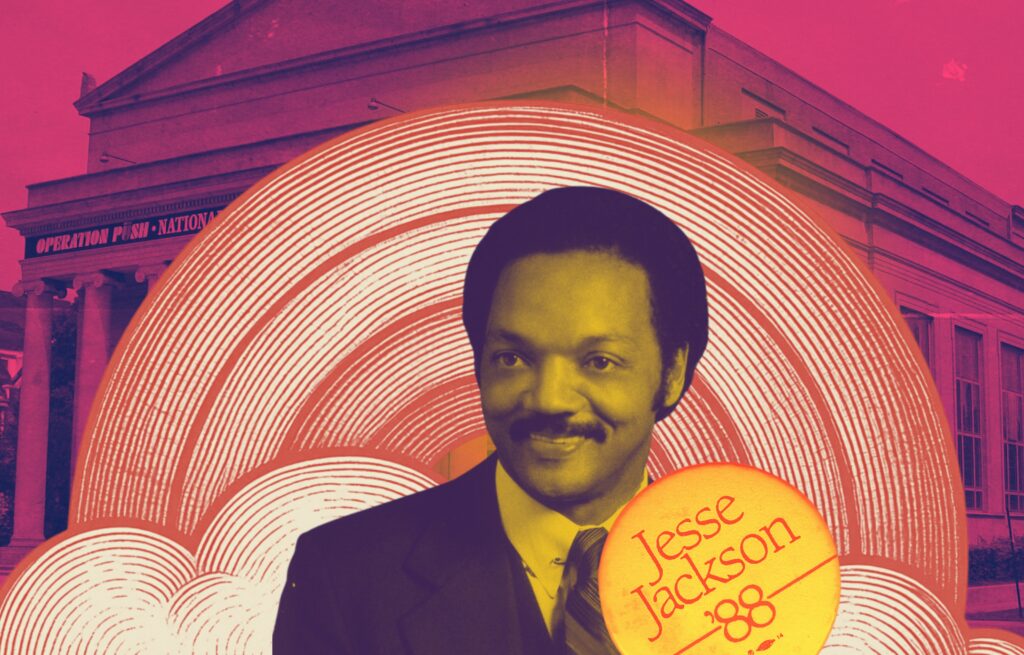
I usually shy away from the “great person” version of history. Yet leadership, deep strategic thinking, and charisma all matter. As we look at national elections in 2026 and especially 2028 and make our choices, Jesse Jackson’s historic runs indicate a cold-hearted review of dry policy positions is inadequate for our moment. We also need a candidate who moves people, and Jackson the human being was an extraordinary candidate. His personal and political history helped him motivate and inspire the resigned, frustrated and apathetic and inspire thousands to take up campaign work.
Jackson’s movement history was rooted in the Black freedom struggle. He organized with the Southern Christian Leadership Conference (SCLC) with Dr. Martin Luther King, Jr. They stood against the Vietnam War, bridging racism at home with militarism abroad. Following the heyday of the 60s, he formed and led Operation PUSH and eventually created the Rainbow Coalition. He brought those anti-war stances with him all the way through, always fighting to prevent “another Vietnam.”
In 1988 almost 7 million people voted for Jackson in Democratic primaries and caucuses. He won 11 states and carried much of the Black Belt South. He handily won industrial Michigan and pulled in support from farmers, Chicanos, union members and working people, LGBTQ voters, and of course the full range of the Black community from corporate leaders, small business owners, the Black Church, and everyday people. Jackson both centered Black voters and consciously built a rainbow coalition.
As we build the broad front needed to block the MAGA movement and agenda, we should also continue to draw inspiration and lessons from Jackson’s life, work, and his two presidential campaigns.
Slow media for fast times. Sign up for our newsletter.
Forty years later, Jackson’s model is an inspiration for most modern independent political organizations (IPOs). It showed the potential of creating an inside/outside multiracial campaign that shaped an electoral movement. It also showed the limitations of keeping the post-election movement as a closely-held organization that never fully realized its potential for broad front movement building.
What Jackson Got Right
Underneath the methods and formation was a political program that surpassed anything we’ve seen since. Hopefully we are building towards something similar today. The rediscovery of “economic populism” and winning over white working class voters is critical but is only part of Jackson’s genius. His history showed that being pro-Black and pro-racial justice is pro-working class, and that you can win masses of people of all races to this vision. Some of this was based on years of on the ground struggle, from the Black freedom movement to the picket line wherever there was a strike, worker, or consumer fight.
Jackson’s program explicitly proposed a massive transfer of wealth from the wealthy to working people and Black and brown people in particular. It included government projects that would hire people to rebuild infrastructure. It also went after the white-collar criminals at the top end of the drug trade, raised taxes on the wealthy, offered reparations to African American descendants of enslaved people, and offered free community college for all.
Looking back now, most stunning was Jackson’s pro-peace and anti-military agenda. Even before the Soviet Union collapsed and the Cold War ended, Jackson was calling for major cuts to the Department of Defense. To this day, virtually no national candidate takes on and calls for cutting the military budget. It’s untouchable and unthinkable. Lyndon Johnson was the last president to try to have both guns and butter and that ended as both a domestic economic catastrophe and decades of death and destruction fighting Vietnamese liberation.
In 1991, after the fall of the Soviet Union, we heard about the “peace dividend” and hoped that trillions of dollars could be freed up for human needs. Thirty-five years later, we’re still waiting. We’ve had wars on drugs, terror, Islam and now Iran. I’m hard pressed to think of a single major party candidate since who spoke earnestly about cutting the military to pay for social needs at home. While most candidates studiously avoid taking on the military, Jackson had the courage and insight to make it a central demand of his campaign.
Learning from Past Mistakes
Many of us who were active in the Jackson Campaign sought for the campaign to continue its work as a democratic popular organization. That wasn’t to be. Jackson’s Project PUSH and Rainbow Coalition were closely controlled by Reverend Jackson and close allies. While Operation PUSH and the Rainbow Coalition did important work, both were primarily vehicles for Jackson and not for a sustained and engaged mass movement.
In the subsequent decades, candidates from Obama to Sanders have also opted for controlled vehicles. Obama for America and Bernie’s Our Revolution each opted for tight control by the candidate who inspired their formation, which has left power on the table. In practice this has meant that the mass mobilization for an electoral cycle or two is limited in its future efforts and doesn’t fully realize its potential scale and impact. Fighting for structural reforms within the Democratic Party is important but so too is creating a vehicle where future candidates can build on the initial success.
As we hurtle to the critical 2028 presidential election it’s vital to have a clear institution-building lens connected to the electoral effort. Imagine asking possible 2028 Presidential contenders, “what will you leave behind after this campaign, win or lose?” It takes a movement and institutional capacity that lasts well beyond an election cycle to win and sustain the power necessary to transform our political and economic system.
Much has changed since chants of “Run, Jesse, Run” and “Win, Jesse, Win” lit up streets, pulpits and auditoriums, much of it for the worse. We’ve seen a full on assault on Black advancement, racial justice and small ‘d’ democracy. Immigrants are hunted for sport and spectacle. War drains the capacity for care here while ending human life abroad. Rhetoric aside, working-class life is more precarious than ever. As we look toward 2028, there is an opportunity for a candidate to galvanize a movement and shape an election. The lessons of Jackson’s historic runs for the presidency are deeply relevant to our moment.
Did you enjoy this article?
Becoming a member is the best way to ensure we keep publishing articles that meet the moment. Memberships start at just $5 a month and come along with a variety of other perks; join us today.