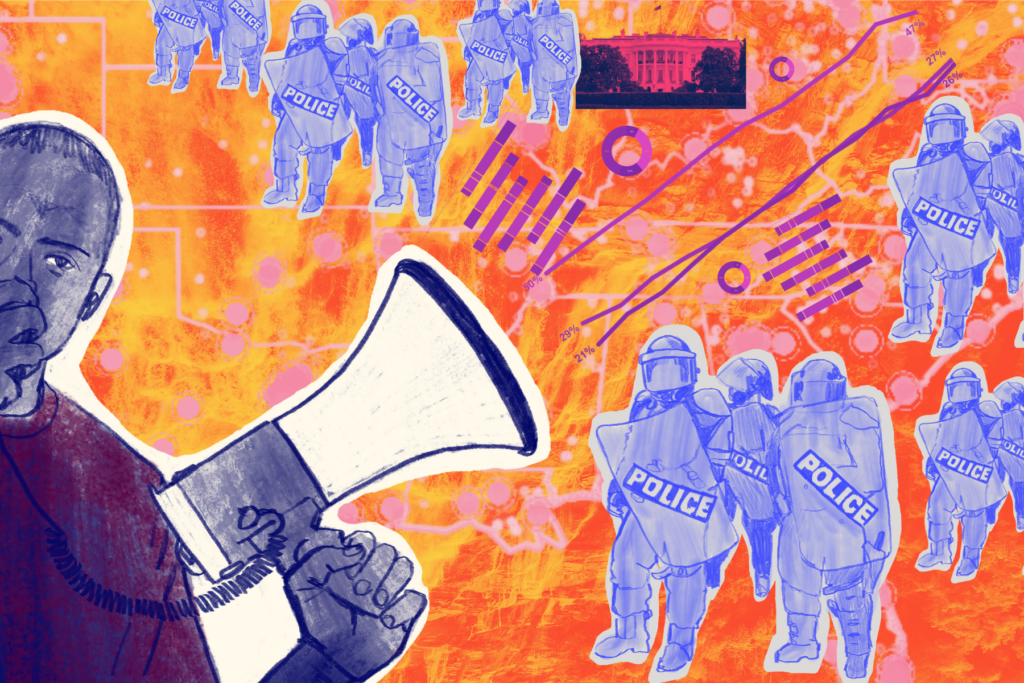
The rise of authoritarianism and the deployment of its many tools have incited calls to action and resistance across the United States. Authoritarianism’s actors must employ many tactics to gain and maintain control. Resistance movements in turn explore and engage multiple tactics to combat authoritarianism.
As a movement and liberation researcher with an organizing background, research is not a stand-alone product that exists in its own silo with the hopeful patience that it will be useful to someone, somewhere. It is an active practice and one of many tactics needed to build a strong organizing strategy.
Organizers and everyday people have recognized this and have engaged in grassroots research as resistance to many of the tactics being deployed by the Trump administration–from qualitative community input and documentation of conditions on the ground, to landscape mapping and tracking financial trails and corporate contracts, to tracking cases of state violence.
Authoritarianism’s Tools and Resistance Research
Tactic: Secret Police Forces
Government resourcing has grown exponentially for the Department of Homeland Security (DHS) and its agencies, including Immigration and Customs Enforcement (ICE), Customs and Border Protection (CBP), and Homeland Security Investigations (HSI). These investments are a clear attempt by Trump to develop his own secret police.
Slow media for fast times. Sign up for our newsletter.
The actors, practices, and directives of these agencies go largely unknown by the public and elected officials, while the impacts of their brutality are widely felt.
Exposing individual agents has revealed their ties to white supremacist groups and histories of perpetrating violence. Efforts to protect the secrecy of these agencies and their actors have been met with guerrilla research to raise public awareness and demand accountability. As a result, movement has been gaining in the proposal and passage of local bills that would ban ICE agents and other law enforcement officers from attempting to hide their identities by wearing face coverings.
Research on corporate collaborators who hold contracts with or host Trump’s “secret police” has been critical in developing direct actions, disruption of business, and pressure campaigns.
With support from immigrant-led and anti-authoritarian collectives such as the Black Alliance for Just Immigration and States at the Core, organizers in Minneapolis targeted Hilton Hotels after it was revealed that the chain was hosting DHS agents.
As part of the Boycott Target campaign, coalitions in Washington, D.C. host weekly pickets outside of Target stores. Protestors aim to expose the retail giant’s complicity with ICE and the company’s silence when two employees—who have U.S. citizenship—were arrested by ICE while working in a Target store in Minnesota.
To encourage everyday people to use research tactics, organizations such as the Immigrant Legal Resource Center have been hosting teach-ins on how to research their local collaboration with federal immigration enforcement agencies, such as 287(g) agreements. They also teach people how to implement and strengthen sanctuary laws to protect communities.
When Washington, D.C.’s Mayor Muriel Bowser claimed that the Metropolitan Police Department was not voluntarily collaborating with occupying federal forces, residents and organizers with the Families Not Feds Coalition presented photo and video documentation countering these claims. Exposing these truths and months of collective strategy led to D.C. city council unanimously voting to approve emergency legislation for increasing transparency from local and federal law enforcement in their collaborations.
Tactic: Centralizing Power
Reliant on capitalist interest, the relationship between authoritarianism and the ultra-wealthy is a power-building feedback loop. As billionaires profit from these policies and structures, centralizing power is essential to maintaining it.
Research collectives like Little Sis track corporate power, including vendors, investors, and partners of federal agencies to inform resistance campaigns. The Dream Defender’s Class Ruins Everything Around Me campaigns use research to identify billionaire and corporate targets and make it easily available and accessible online as a form of mass political education, and to aid in action that decentralize power.
Workers at Google and Amazon developed the No Tech for Apartheid campaign to expose and end the violent tactics of the Project Nimbus contract and its role in upholding colonial and imperial power. Purge Palantir researches and reveals how Palantir Technologies partners with the federal government to expand mass surveillance used to fuel ICE raids, deepen U.S. military presence abroad, and aid the genocide in Palestine.
Revealing these centralized networks of corporate enablers of state violence has informed movement tactics.
New corporations have been added to the Boycott, Divest, and Sanction (BDS) Movement lists. The movement has seen recent wins including closure of weapons manufacturing office, municipality and university divestment, and sale of Israeli bonds held in North Carolinian state pension funds, and New York City public hospitals committed to not renew contracts with Palantir.
Findings also informed targeted direct actions in Philly, Chicago, Boston, and Seattle outside corporate headquarters as part of the Eject Elbit and Capital One campaigns, and pickets lines and sit-ins by laborers and union members at Google and Amazon.
Tactic: Hiding Violence
Authoritarianism requires the use of violence to maintain power. Alongside the use of violence is the need to occasionally hide the evidence of violence. Expanding on tactics learned in community responses to outrage from police murders, which tracked police use of force through the Mapping Police Violence project, emergent collectives have begun mapping the presence and violence enacted by federal agencies.
Attempts to hide violence occurring in immigration detention centers, prisons, and jails have been met by community researchers collecting testimony and physical evidence of these cases. Project Salt Box, which sees open data as community defense, has begun mapping ICE vendors, leases, and tech partnerships nationally.
Journalists and advocates have researched and brought attention to ICE’s public data releases to reveal deaths and violations of federal standards in immigration detention centers. The Deportation Data Project has made hyper-local deportation data publicly accessible through FOIA requests. Everyday internet sleuths and journalists have used research tactics to examine social media and court records to uncover and identify DHS agents who have murdered community members such as Keith Porter, Renee Good, and Alex Pretti.
Tactic: Control of Information
Early actions of the Trump administration included removing public access to government data, and cutting funding to research, news, and education. Controlling access to information makes it easier to hide evidence, and prevents citizens and journalists from engaging in the research needed to fight back.
Federal datasets and federally-funded research projects include and reveal information on housing insecurity, markets and monopolies, criminalization and incarceration, and many more areas of public life. These datasets are often used to reveal disparities, track patterns of inequity, and advocate for social programs. Though many of these datasets cannot be recreated, many academic research centers rapidly developed archives of federal websites and datasets that were quickly disappearing. These archival methods help preserve public access to critical information.
For authoritarian regimes, controlling information allows for control of narrative and history and aims to inhibit truth-telling from the public. Even before the current administration, documentation efforts through public memory projects and digital archiving have revealed truths not uplifted through federal means, such as the Rikers Public Memory Project, Memory Lab Network, and Witness to Guantánamo.
On the ground, there continue to be countless projects that document, preserve, and share community accounts of their lived conditions and counter attempts to control information.
Tactic: Silencing of Political Opposition and Dissent
The Movement for Black Lives and CUNY Clear conducted legal research to expose the criminalization of protestors during the summer of 2020, a tactic of repression we continue to see expand. Currently, protestors of police violence, ICE, and the genocide of Palestinians, are being targeted. Arrests and criminalization of protestors and reporters have activated legal researchers, who have revealed unconstitutional arrests, false charges, and the lies of federal agencies. This research has been used in organizing campaigns to release protestors from custody and drop charges.
Alongside control of information, and through the use of secret police and violence, silencing political opposition and dissent gives the false impression that communities are not organized, fighting back, or experiencing wins. Suppressing collective efficacy, or the belief that if we fight, we will win, is a stratagem in itself to prevent dissent.
Research for World Building
Alongside these offensive and defensive strategies, research continues to be a tool to imagine, experiment, evaluate, and implement practices and infrastructure to build collective action and change material conditions. This is seen through the use of research methodologies to build collective governance models, solidarity economies, unions and associations, mutual aid, harm reduction systems, and alternative peoples’ institutions.
The curiosity of the collective can fuel both organized and autonomous research necessary for combating authoritarianism and shifting power to the people.
Did you enjoy this article?
Becoming a member is the best way to ensure we keep publishing articles that meet the moment. Memberships start at just $5 a month and come along with a variety of other perks; join us today.