“It’s funny to say this because I’m the leader of this organization, but the reality is I’m actually very uncomfortable being in charge.” Eve and I are in our regularly scheduled monthly coaching calls. Eve is a white woman in her mid-40s, a mother of three, and has been the Executive Director of a legal non-profit for the last 4 years.*
She goes on to explain that having and wielding power makes her squeamish, particularly when she needs to make decisions on behalf of the organization. Ten years ago when Eve was a junior staffer at a scrappy legal services non-profit, she experienced tremendous disorganization at the hands of unskilled managers. Supervisors were stressed, overworked, and didn’t have the right tools to lead in such a stressful environment. They frequently made decisions unilaterally, poorly explained, that created a feeling of burnout and resentment for those that they led. As a result, their staffers either left, became disgruntled and difficult to work with, or apathetic.
Now, 10 years later, this experience shapes Eve’s desire to lead in a way that does not replicate that mismanagement of power, but she doesn’t always know how. Eve is not alone–in our experiences working with non-profit leaders across sectors and issue areas, many have expressed that their commitment to sharing power feels at times in direct contradiction with holding leadership positions, particularly in hierarchical organizations.
In the last decade, we have seen widespread public critique of power hoarding within organizations. Tema Okun and Kenneth Jones’ frequently cited work names power hoarding as a key trait of white supremacy culture. Maurice Mitchell describes “reflexively anti-leadership orientation[s]” as an “overcorrection” to a critique of power hoarding.
Slow media for fast times. Sign up for our newsletter.
For those of us invested in robust and powerful social movements for change, we must ask ourselves: Do we need strong leadership if we are to bring about lasting justice and change? How do leaders lead well, without replicating existing systems of oppression? And what are the qualities of strong leadership?
Strong Leadership is Grounded Leadership
In our work coaching leaders and shaping organizations towards real impact, we have come to believe deeply in the necessity of strong leadership. Strong leadership enables fast and responsive decision-making amidst rapidly shifting economic and political conditions. Strong leaders strengthen the relationships and culture of our organizations, and nurture the growth of other leaders, a key ingredient to growing our movements. We continue to believe strong and powerful leadership is a necessity in both hierarchical and less-hierarchical formations if we are to cultivate robust and powerful social movements for change. Because of this, our response to the question, “Do we need strong leadership if we are to bring about lasting justice and change?” is a resounding “yes.”
At Guiding Threads, we describe strong leadership as “grounded” leadership: grounded in oneself, grounded in one’s people and lineage, and grounded in the firm conviction that we can and must build the world we yearn for through our work. This requires cultivating a precise relationship to power, something that we have built up through years of practice inside of our worker cooperative of mediators, facilitators, and organizational strategists. While our formation is non-hierarchical, it is leaderful. Each member comes with authority and power to act that is rooted in the skills and experience they bring. It is with this lens that we have worked with hundreds of movement organizations to develop a theory of leadership that can meet and develop each member or staff person where they are at.
“Grounded leadership is not power hoarding nor an aversion to power. Instead, grounded leadership is a thoughtful orientation towards power that inspires and influences others, equips others to lead, and enables a group to advance their work together.” – Guiding Threads Collective
The Leadership Pendulum
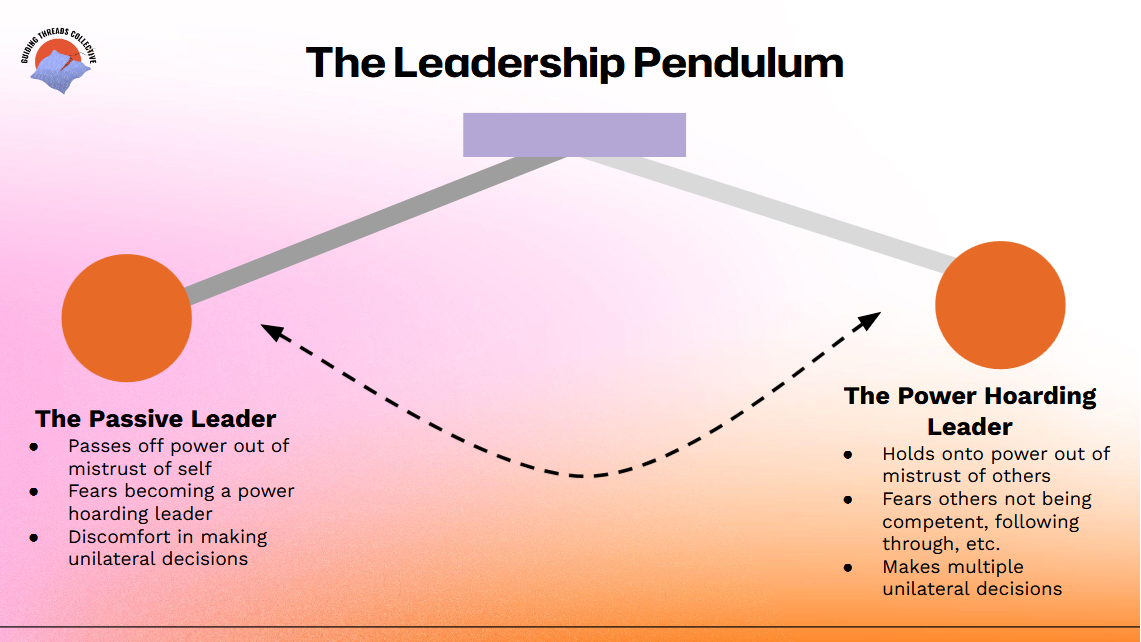
The leadership pendulum is a tool we’ve developed for leaders to reflect on their relationship to power. In our work, we often see two extremes in orientations to leadership and power: On one end of the pendulum we have the passive leader, who often shows up with an aversion to power and a mistrust of their own skills. Power feels scary, and so they desire to pass power and responsibility off to others as soon as possible. The passive leader often experiences a lot of discomfort making choices and opts to delegate or deflect significant or controversial decisions for fear of being accused of gatekeeping, monopolizing, or simply doing the wrong thing. This behavior can result in a lack of direction or cohesiveness for an organization, as decisions are passed off to folks who aren’t prepared, positioned, or responsible for making them.
On the other side of the pendulum we have the power-hoarding leader. Unlike the passive leader who struggles with trusting themselves, the power hoarding leader often has a high level of trust in themselves and their own competencies, but does not always trust their team. This can lead to unilateral decisions and can leave their team members feeling disconnected and discounted. It may come as no surprise that these types of leaders also struggle to receive feedback, as reflections about the impact of their behavior, patterns, and decisions feel threatening to their self-conception.
Grounded Leadership Takes Practice
It’s important to note that any of us can take on orientations to power and leadership represented in these two poles in moments of feeling ungrounded. Where each of us swings when we’re ungrounded is also shaped by our social identities and how we’re perceived by others. Leaders can sometimes be pushed into the poles of this pendulum because they are resisting the stereotypes placed on themselves as leaders of color, queer and trans folks in leadership, women, first generation leaders, younger leaders, etc. In our experience, if you hold more than one of these identities, the pressure to swing towards one side or the other can feel even greater. For example, we’ve witnessed younger leaders of color say, “I feel like no one takes me seriously,” which moves them into power hoarding as an ungrounded stance.
We believe that grounded leadership is a skill and set of practices that can be developed, nurtured, and strengthened in community, rather than alone.
For people who hold privileged identities–for example, being white, being a man, being a light skinned person of color–the fears about how we’re perceived may also push us into the poles of the pendulum. We sometimes hear white leaders say, “I don’t want to take up too much space in my leadership, particularly as a white person.” Taken too far, this can swing leaders into the stance of a passive leader–afraid to make any decisions out of risk of hoarding power or wielding power in a way that perpetuates systems of oppression. Inadvertently, this can become a way for white leaders to unconsciously absolve themselves of responsibility to take decisive action on behalf of the organizations and movements they lead. It’s important to recognize that ungrounded leadership is instigated by the ways that anti-Black racism, ageism, white supremacy and other systematic oppression show up in our organizations and ourselves, and part of the work of leaders is to excavate those internalized messages in order to cultivate a grounded sense of leadership that is in service of our movements.
In our work with leaders, we encourage the cultivation of self awareness about the ways that we are impacted by the systems of oppression we live within and are trying to change. This is also a pathway towards building trust in ourselves and our ability to lead from a place of groundedness, rather than fear.
We believe that grounded leadership is a skill and set of practices that can be developed, nurtured, and strengthened in community, rather than alone. We encourage leaders to identify the people who help strengthen their leadership practice–including coaches who encourage self reflection and growth, cheerleaders who support them emotionally and spiritually, peers who they are able to think alongside, team members to actively seek out and implement feedback from, and mentors who inspire and develop their leadership. With stronger leaders ready to steward our groups effectively and more leaders throughout and across our groups, our movements are more equipped to build the world we yearn for.
Reflection Questions:
- When you are ungrounded, where are you on the leadership pendulum?
- How does anti-Black racism, ageism, white supremacy and other systems of oppression contort your relationship to power as a leader?
- How does your leadership inspire and influence others? Equip others to lead? Enable your group to advance their work together?
If you are interested in learning more about the leadership pendulum, feel free to join us October 29th for our Fall Lunch + Lead Workshop entitled Grounded Leadership Practices for Leaders at All Level.
*Eve is a composite coaching client. All names and identifiable characteristics have been changed to protect the confidentiality of coaching clients.
Did you enjoy this article?
Becoming a member is the best way to ensure we keep publishing articles that meet the moment. Memberships start at just $5 a month and come along with a variety of other perks; join us today.