
It certainly is the worst of times–far too many crises and crimes to list here, horrifically dangerous, no center holds, and so on. And yet, not at all paradoxically, it is the best of times in a very long time for anyone who believes in an American Left, dispensing with the ignorant shibboleth that there has never been one.
Right now, a range of radically progressive, genuinely democratic, and openly socialist candidates are winning Democratic primaries and taking office all over the US. For a long time, any progressive activist engaging with electoral politics had to get past the ultraleft gobbledygook about “two capitalist parties” with no meaningful difference. Well, MAGA’s made that claim irrelevant. Today’s newer Left unapologetically operates within the loose carapace of the Democratic Party, meaning we use its ballot line, keeping in mind that by most countries’ standards, we don’t have proper parties, since anyone can run as a “Democrat” or a “Republican” and no one can be expelled.
By every measure, the Democratic electorate has moved sharply to the left. An overwhelming majority supports single-payer, Medicare For All, derided by the party establishment as Bernie Sanders’ pie-in-the-sky just ten years ago. Big Money’s stranglehold, from dogmatically rule-or-ruin pro-Israel donors and the Clintonite corporate world, the likes of Jamie Dimon palling around with Chuck Schumer and Hakeem Jeffries, is actively repudiated by Democratic voters in state after state.
A historian’s job is to put this remarkable upsurge in context. What can we learn from other times of similar mobilization?
Slow media for fast times. Sign up for our newsletter.
The glory days of the Socialist Party
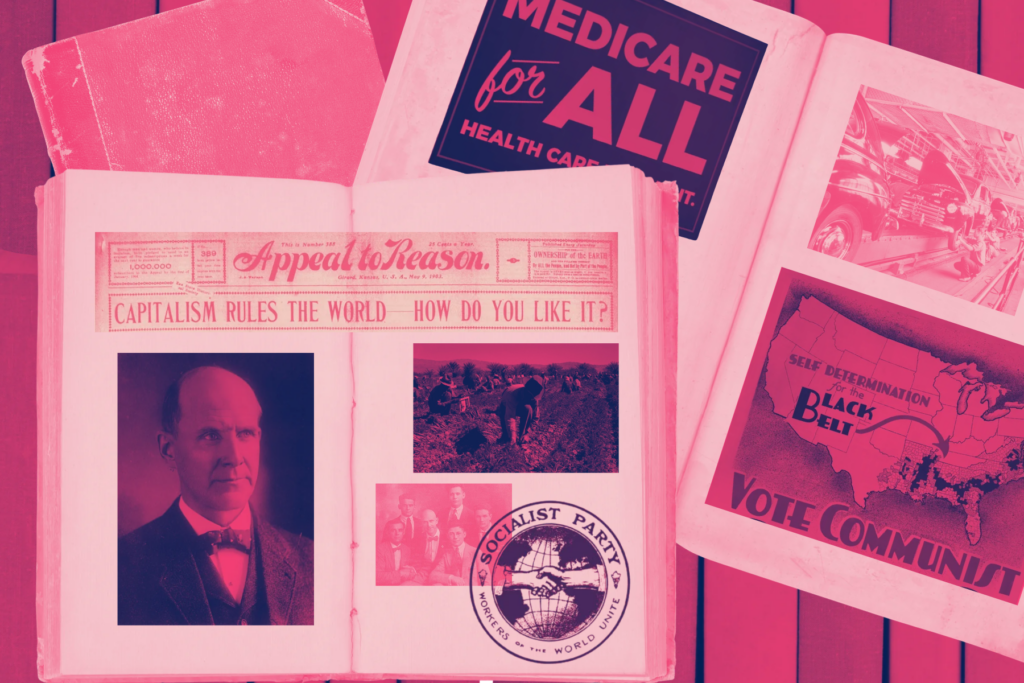
For the Democratic Socialists of America (DSA), as for Bernie himself, the relevant historical context is the Socialist Party’s (SP) glory days, circa 1900-1918. The SP’s perennial presidential candidate, the militant trade unionist Eugene V. Debs, notched a historic 6% in 1912’s presidential election, and roughly a thousand Socialists won election as city councilmen, state legislators, mayors of cities like Bridgeport, Reading, and Milwaukee, even a few to Congress. Though it’s hard to imagine now, as explored in James Green’s classic Grass-Roots Socialism: Radical Movements in the Southwest, 1895-1943, Oklahoma was Socialism’s banner state, where Debs got 16% in 1912 from an electorate of tenant farmers and sharecroppers!
The Socialist base was mainly in working-class communities, whether the Jewish Lower East Side, which sent Meyer London to Congress, or the Milwaukee Germans led by Congressman Victor Berger, who kept its city hall in Socialist hands until 1960. Their party peaked at 113,000 dues-paying members in 1912, when the US population was just over 92 million; “membership” meant a lot more then, when a comrade came around every month to collect.
The Socialists also had a remarkable press network. The Appeal to Reason, published out of Girard, Kansas, and mailed to several thousand volunteer distributors, had a circulation of 760,000 at peak. Immigrant Socialists published dozens of newspapers in their own languages, many with substantial readerships, like the Yiddish-language Vorwarts (The Forward); Paul Buhle’s classic Marxism in the United States is an indispensable guide to this early twentieth century world.
Woodrow Wilson’s Red Scare and the seismic impact of the Bolshevik Revolution fractured the SP, although the party held on for decades among anti-Communist leftists in the trade unions. Its longtime leader, Norman Thomas, was a respected figure, close to liberals like Eleanor Roosevelt in the 1940s and 50s. It finally broke apart over the Vietnam War and George McGovern’s candidacy in 1972, with the left wing led by Michael Harrington becoming the Democratic Socialist Organizing Committee in 1973, and then the Democratic Socialists of America in 1982 through a merger with the New American Movement. The Socialists’ right wing moved fully into neoconservatism, founding the Social Democrats USA, which barely exists today.
A different kind of party
Long before then, however, Socialists were eclipsed by the more militant Communist Party USA (CP), formed by left wing Socialists in 1919. The Communists were a different kind of party. The SP had pursued what used to be called “the parliamentary road to socialism,” meaning gaining office and governing as a means toward challenging, even eventually overturning, capitalism step-by-step. (Debs himself was much more explicit about “expropriating the expropriators” via Congressional action than today’s DSAers or Bernie.) The notion of a “parliamentary road” was never seriously proposed by CP leaders.
For a long time, they were the single white-led organization in the US that welcomed Black people and incorporated Black leaders.
The divisiveness of their political brand was exacerbated by electoral efforts proclaiming “Towards a Soviet America!,” as in William Z. Foster’s 1932 presidential campaign. The main difference from the Socialists was their mode of organizing. The CP was a disciplined formation led by dedicated cadre deployed where the Party sent them. Comrades at every level, in their neighborhood branches or party cells inside workplaces, carried out national strategies, always and everywhere focused on building organized class power. The vast working class upsurge of 1930-1945, when union membership went from two to fourteen million, is hard to imagine without Communist leadership in industries like steel, auto, and electronics, in the mines and on the docks. Party and Young Communist League membership peaked at about 100,000 in 1938, and an estimated million people read the Daily Worker. And the broad liberal-left Popular Front that CPers helped build in those years moved broad sectors of the US towards recognizing why fascism must be fought everywhere, from our own Deep South to Spain.
Electorally, however, their influence was minimal outside of New York City, where half the membership lived. Communists like Mike Quill, Ben Davis, Jr., and Pete Cacchione got elected to the City Council, and their close ally Vito Marcantonio represented East Harlem in Congress for seven terms, until 1951. Elsewhere, most party members evaded identifying themselves as Communists, for practical reasons, although the long-term costs of this semi-covert identity were real.
Where the CP built power, in Detroit, Chicago, New York, and along the West Coast ports (but not Oklahoma!), their influence was rooted in multiracial working-class communities, which points to the largest difference from the Socialists. Starting in the late 1920s, the CP explicitly recognized and acted on Jim Crow’s centrality to US politics, challenging racial terrorism not just during the defense of the Scottsboro Boys, but again and again, even into the 1950s. For a long time, they were the single white-led organization in the US that welcomed Black people and incorporated Black leaders. As Robin D.G. Kelley’s brilliant Hammer and Hoe: Alabama Communists During the Great Depression documents, when Communist organizers went into the Black Belt in the face of Klan and state terror, they set an example. Put that up against the CPs undeniably authoritarian and undemocratic practices and blinkered pro-Sovietism, which long outlasted Stalin. It’s quite a brew, both inspiriting and depressing.
Finally, like the Socialists, the Party never completely disappeared, despite overblown claims about McCarthyism destroying it. Deeply closeted and much smaller, CPers persevered; look at the obituary of Bea Lumpkin (1918-2026) in a recent In These Times, or the personal histories compiled by Jay Schaffner and others in Red Lives: Our Years in the US Communist Party, 1950-2000. People like these kept the Party alive long after Joe McCarthy succumbed to cirrhosis.
Learning from both traditions
What do we have to learn from these parties’ histories? Some would say we have more to learn from the Debsian tradition than from the later Reds. The open avowal of one’s socialist convictions and party membership, a platform and practice focused on municipal services and progressive laws minus the distortion of foreign models, let alone taking direction (and money, it must be acknowledged) from another government, are all valuable models. But we have something equally fundamental to learn from the Communists. Discipline is in short supply these days, on the Left and everywhere else. That’s been true since the New Left’s heyday, when the “movement of movements” went off in all directions. I mean discipline in every way–emotional, financial, logistical, organizational, ethical. Subordinating one’s own personal goals to a long-term, universalist strategy may seem anachronistic now, but with all their grievous errors (like endorsing Japanese incarceration during their hyper-patriotic World War II period), the Communists had a shared commitment to something larger.
Not cult or zombie-like, they moved as a whole body, sometimes wrongly and sometimes right. And when they got it right, we can learn from them, in particular regarding the necessity of challenging white supremacy and building anti-fascist unity. If we can embed that kind of tenacity and discipline in the inclusive socialist politics of joy that Zohran and AOC and Bernie have shown us, what a recipe for victory that would be.
Here’s a further point, perhaps harder to envision. In 2000, the sociologist Robert Putnam published his famous study Bowling Alone: The Collapse and Revival of American Community, describing the precipitous decline in habits of communal socializing across the US since the 1960s. That transformation had a special resonance for socialists and communists. They survived and sometimes thrived through community, neighborhood, and workplace affiliations, many of which were ethnocultural, based in shared languages, habits, and fraternal organizations.
Nothing exemplifies this vanished world better than my late friend Paul Mishler’s Raising Reds: The Young Pioneers, Radical Summer Camps, and Communist Political Culture in the United States. Paul traced how a network established by Jewish Socialists in the Workmen’s Circle in the 1910s and 20s spread into the communist milieu via the International Workers Order, founded in 1930, birthing several dozen camps, a few of which survive even today. Even into the McCarthy years, one could grow up in a left household, with networks of community support shielding one from repression, nourishing socialist and anti-racist values–it is no myth that “red diaper babies” played a disproportionate role in the New Left! If we want to build the socialist option in the US, we need to think in those ambitious terms: how to raise socialist families and whole communities which can dig in for the long term. Those needs are as urgent today as electing socialists to office as mayors or city councilpersons.
Did you enjoy this article?
Becoming a member is the best way to ensure we keep publishing articles that meet the moment. Memberships start at just $5 a month and come along with a variety of other perks; join us today.