
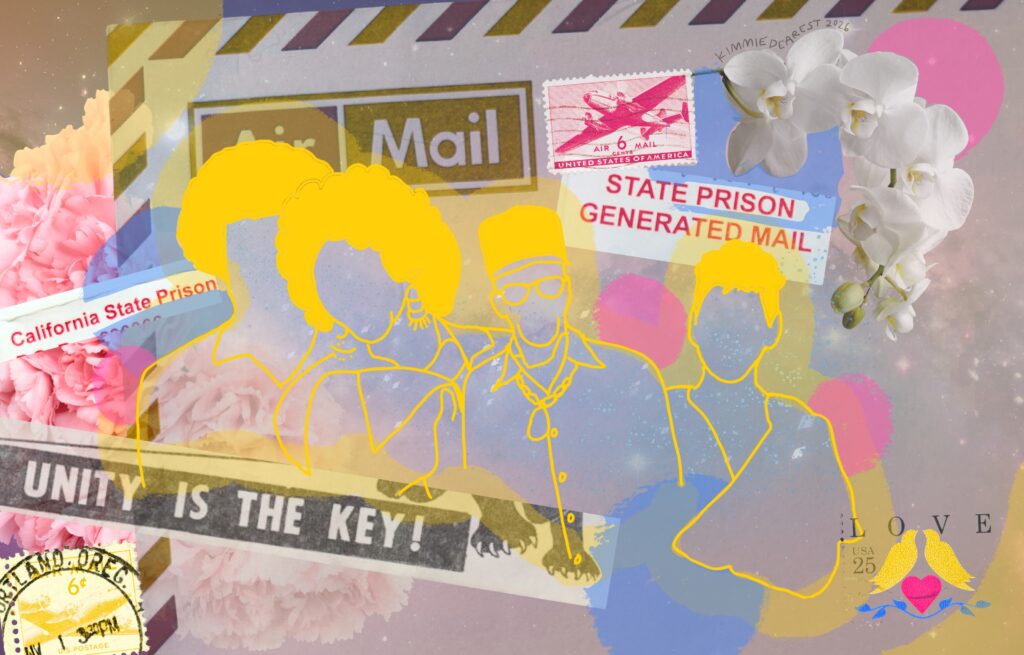
“Stiner,” a San Quentin Prison correctional officer yelled. “You’ve got mail.”
Nearly fifty years after COINTELPRO tore through the Black liberation movement, Watani Stiner found himself staring at a letter he was afraid to open. On the envelope was a name he never expected to see: Ericka Huggins.
Although Watani had not pulled the trigger that killed Ericka’s husband, the Black Panther Party leader John Huggins, as well as another party leader, Alprentice “Bunchy” Carter, he had known for decades that there was some accountability for having been part of something larger that made such violence possible. After attending a restorative justice workshop inside San Quentin, he found himself compelled to write to her—not to defend himself or explain away the past, but simply to share his truth and acknowledge his responsibility.
Writing that letter, he told me, was one of the hardest things he had ever done. “I struggled with how to apologize. I didn’t want to reopen old wounds for her. I didn’t want her to think I was trying to manipulate her or improve my chances of getting out of prison.”
Slow media for fast times. Sign up for our newsletter.
He wrote maybe nine or ten versions, he estimated, before finally sending it. Weeks later, Ericka’s response arrived. He couldn’t bring himself to open it. “I honestly thought it was going to say, ‘You’ve got a lot of nerve writing to me.’” Instead, he found something entirely unexpected. “It was one of the most beautiful and heartfelt letters I’ve ever received.”
It is difficult to imagine a more unlikely beginning to a friendship. It is also difficult to imagine a better place to begin thinking about what our movements need today. Because as I listened to Watani’s story, I realized we were talking about much more than history. We were talking about why movements fracture, why they lose sight and connection to one another. And what it might take to become whole again.
COINTELPRO, short for Counter Intelligence Program, was a covert and illegal FBI program that operated primarily from the 1950s through the early 1970s to surveil, infiltrate, disrupt, and dismantle movements the government considered politically threatening.
Watani Stiner has lived through chapters of American history that most only know through books. As a young man, he became involved with the Us Organization, one of the major Black nationalist organizations of the 1960s. After being wrongfully imprisoned for the deaths of John Huggins and Bunchy Carter, he escaped from San Quentin and spent six years in exile in the South American country of Guyana, then another fourteen years in Suriname, before the political violence there began to threaten the life of his family. He negotiated a deal with the US government: he would turn himself in and, in exchange, his family would receive asylum in the US. The government went back on its word, and Watani was taken away to serve two more decades in prison, while his family was forced to stay behind in Suriname.
While incarcerated, he became a writer, mentor, restorative justice practitioner, and one of the most respected elder voices inside San Quentin. Since his release, he has moved into the intentional community of Canticle Farm and has continued to work with young people, restorative justice practitioners, and movement organizers, helping new generations wrestle with questions he has spent a lifetime carrying.
History matters. State repression and the history of apparatuses like COINTELPRO are important to understand. COINTELPRO, short for Counter Intelligence Program, was a covert and illegal FBI program that operated primarily from the 1950s through the early 1970s to surveil, infiltrate, disrupt, and dismantle movements the government considered politically threatening. It was especially focused on Black liberation movements, using informants, disinformation, manufactured conflict, psychological warfare, and criminal prosecutions to sow distrust, prevent the emergence of Black leadership, and fracture organizations from within.
Yet as movements today wrestle with cancel culture, polarization, public call-out, shaming, and the seemingly endless ways we turn on one another, I found myself asking a different question: What does someone who survived one of the most coordinated government efforts to destroy social movements believe we most need to learn?
Understanding Watani’s story is not only important as a historical artifact. It also gives us the opportunity to carry forward the lessons of his struggle, and ensure that the lessons gleaned in the belly of the beast contribute to more powerful movements today. In honoring his struggle, we see how history is not frozen in time.
The Weaknesses Were Already There
When people talk about COINTELPRO, we often imagine a government program that infiltrated and destroyed movements from the outside. And it was. Watani didn’t deny that: “I consider myself a survivor.” Prison. Exile. Watching friends die. Watching movements fracture. He had survived all of it.
But what was most insightful was not how he talked about the state’s role in destroying movements. It was how quickly he turned our attention inward: “The weaknesses inside our movement existed before COINTELPRO. They only exploited those weaknesses.” Watani wasn’t minimizing the violence of the state; he was complicating the narrative by acknowledging our own responsibility.
We developed ideas like operational unity and unity-in-diversity, but there was also a tendency toward uniformity. Toward seeing one organization as more valuable than another.
There is plenty of responsibility to go around. COINTELPRO was a government run, multi-million dollar covert operation whose goals were, in the FBI’s own language, to “expose, disrupt, misdirect, discredit, or otherwise neutralize the activities of black nationalist, hate-type organizations and groupings, their leadership, spokesmen, membership, and supporters.” While the program utilized some of its most vicious tactics against Black radicals, it also targeted and destroyed liberation and anti-war movements across the country. They did, as a matter of policy, create movement fractures.
But for Watani, the accountability started with the ways he and his movement allies contributed to those fractures and gave COINTELPRO more fertile ground to sow distrust.
This lesson was not so different from what I had learned from so many other incarcerated people. All of them have, in some ways, survived forms of oppression and state violence: racism, generational poverty, segregation, the war on drugs. Their healing relied on locating their story within those larger social-economic-political contexts, but also about recognizing their individual responsibility in the harm. Reclaiming agency in their own story is essential.
As Watani reflected on those years, he didn’t spend our time talking about informants or surveillance. He talked about relationships: “We developed ideas like operational unity and unity-in-diversity, but there was also a tendency toward uniformity. Toward seeing one organization as more valuable than another.”
He described organizations slowly losing the habit of talking with one another. Differences that had once been creative became competitive. Healthy disagreement hardened into suspicion. Charismatic leaders centralized too much power. Jealousy emerged over who got to be the “vanguard.” Disagreements were hashed out in public spaces: “Once communication broke down, and once we began dehumanizing other organizations or seeing them as less legitimate, the movement became vulnerable.”
Watani returned again and again to one distinction that feels relevant today: Unity is not uniformity. Looking back on the movements of the 1960s, he reflected on Malcolm X’s enormous influence, and how different organizations inherited different aspects of his vision. “The Black Panther Party emphasized community survival and self-defense. The Us Organization focused on reclaiming our African history, values, identity, and culture. Other organizations emphasized self-determination, land, or political education. None of them carried the whole vision.”
“The mistake,” Watani reflected, “was believing our particular piece was the whole answer.”
As he spoke, I couldn’t help thinking about our own movements. Today, we often imagine fragmentation as something created by social media. Certainly, social media accelerates it. Perhaps the deeper question isn’t how quickly division spreads, but why fractures find fertile ground in the first place?
Watani isn’t asking us to agree with one another. He’s asking something much more difficult: Can we remain in relationship with one another even when we don’t agree? Because when we stop seeing one another as fellow travelers carrying different pieces of a shared struggle, we become remarkably easy to divide. And history suggests that someone, or something, is always waiting to take advantage of that.
Years ago, I remember a conversation I had with Luis Rodriguez, another movement elder. He told me that yes, infiltration did destroy movements. But he also told me something else that will always stay with me: Accusations of infiltration destroyed as many movements as actual infiltrators. He told me that the strength of a movement is in how much we trust each other, and how deep our relationships are. Once we begin pointing the finger and accusing each other of being infiltrators, of selling out, of not being radical enough, then we become our own worst enemy. Then, the state only needs to step back and watch.
A Different Kind of Accountability
As social movement activists, we often think of accountability as determining who was right and who was wrong. We debate intent, assign blame, and ask what consequences are deserved. But as I was listening to Watani speak of accountability, he was describing something much deeper. In working on that first letter he wrote to Ericka, he wasn’t asking himself, “Am I guilty?” He was asking, “What is my responsibility?” There is a profound difference.
The goal of COINTELPRO wasn’t simply surveillance. Its goal was to divide us and make us distrust one another.” The technologies have changed. But perhaps the underlying energy has not.
When Watani first encountered restorative justice, it wasn’t because he was searching for it. He laughed as he recalled that he attended the workshop mostly because it gave him an opportunity to leave his six-by-nine-foot cell for a few hours. The workshop was led by Fania Davis, one of the country’s foremost restorative justice practitioners. By the end of the day, something inside him had shifted. He approached her with a question. “I told her that I hadn’t fired the shot, so I didn’t feel responsible in that direct sense. But I did feel responsible for being part of an atmosphere that led to the deaths of two human beings.” He asked whether she thought Ericka Huggins, a friend of Fania, would be willing to receive a letter from him.
It would have been so easy for him to blame the state and build up resentment. Not only did Watani not pull the trigger, but now decades later, we know that the FBI sent forged letters to Black revolutionaries at the time to inflame tensions between the Panthers and organizations like the Us Organization. It would have been so easy for him to say, “It wasn’t me. I was wrongfully imprisoned.”
Yet, Watani wasn’t denying individual responsibility. He was expanding it. He was asking what it means to participate in cultures, organizations, and systems that make harm more likely, even if we are not the person who ultimately causes it. “Throughout my life, whether in prison, exile, or after my release,” he explained, “I have tried to distinguish between individual guilt and collective responsibility. I have never accepted responsibility for crimes I did not commit, but I have accepted responsibility for helping create a movement culture in which tragedy became possible. That distinction lies at the heart of restorative justice.”
I am left with curiosity. How do I contribute to an atmosphere in which it becomes so easy to see people in our movements as disposable? How do I co-create a culture where fractures are ripping apart movements and organizations left and right? What would it look like instead for me to contribute to a culture of deep belonging?
When Ericka agreed to receive his letter, Watani found himself confronting a different challenge: How do you apologize for something that cannot be undone? How do you acknowledge your place in history without claiming responsibility for what isn’t yours? He described rewriting the letter again and again: “I wanted the letter to come completely from my heart.”
There is something beautifully slow about his story. Nothing happened online. No public statements. No performative declarations. No audience. No likes. Just a man alone in a prison cell trying to find truthful words.
When Ericka’s reply arrived, he was terrified to open it. Yet, instead of condemnation, he found grace. “She didn’t simply offer forgiveness. She gave me something even greater: the gift of self-forgiveness.” Their story points us toward a kind of accountability that isn’t about determining winners and losers. It is trying to restore humanity and strengthen connection, not fracture them.
Watani told me that he and Ericka corresponded for nearly three years before meeting face to face. During that time, they didn’t simply revisit the past. They talked about their children. Their work. Their disappointments. Their hopes. It wasn’t a conversation about who was wrong. It was about getting to know the humans behind the harm. “Our humanity really began to emerge through those letters,” he said.
I couldn’t help thinking about how different that is from the ways we often encounter one another today. When so many of our conflicts happen on social media, we lack the multiple points of connection, of relationship, to make sense of ourselves and each other. We miss the wholeness that is essential to accountability, healing, and repair.
Humanity Cannot Be Infiltrated
Eventually, with the help of Fania, Watani and Ericka met at San Quentin. He described walking into the room, embracing her, and unexpectedly beginning to cry–something he rarely did. They spoke not only about John’s death, but about the movements that had shaped both of them. They compared memories, wounds, histories. Now, they consider each other the deepest of friends.
Listening to Watani recount this story, I was reminded of the importance of curiosity. The willingness to ask another human being, “Who are you? What did you experience? What did you see? What matters to you? How are you hurting? What would bring you healing?” It is the willingness to stay in relationship long enough for another person’s humanity to become visible again. “If I had to point to one experience that transformed my understanding of humanity,” Watani said, “It would be meeting Ericka.”
Lessons for Today
I asked Watani what he would want young organizers to know. His response? “Dialogue.”
He worried that movements today are losing the ability to remain in relationship with one another. Technology has transformed how quickly information (and misinformation) moves. Social media can connect us across continents, but it can also convince us that we know someone without ever having sat across from them. “Who benefits from this conflict?” he asked. “Who benefits from this division? Who benefits from this distrust?” Those questions feel as urgent today as they did fifty years ago.
He was careful not to equate social media with COINTELPRO. The contexts are different. The actors are different. But the underlying dynamic felt familiar to him. “The goal of COINTELPRO wasn’t simply surveillance. Its goal was to divide us and make us distrust one another.” The technologies have changed. But perhaps the underlying energy has not.
Near the end of our conversation, Watani offered one final reflection. “If we can hold on to our humanity and recognize the humanity in one another, it becomes much harder for anyone to divide us.”
I noticed he didn’t say, “if we can all agree with one another,” or “if we stop making mistakes,” or “if we find the one correct ideology.” He said, “recognize the humanity in one another.” Even across harm.
The humanity that emerged through years of letters with Ericka Huggins. The humanity that allowed accountability to become something larger than blame. The humanity that movements lost when they stopped talking to one another. The humanity that no program—not even COINTELPRO—can destroy unless we first surrender it ourselves.
“The weaknesses in our movement were already there. COINTELPRO only exploited them.” For me, that sentence is not an indictment, or even a warning. It’s an invitation. An invitation to ask not only how we resist the forces that seek to divide us, but how we cultivate the relationships that make division less possible in the first place.
Did you enjoy this article?
Becoming a member is the best way to ensure we keep publishing articles that meet the moment. Memberships start at just $5 a month and come along with a variety of other perks; join us today.