
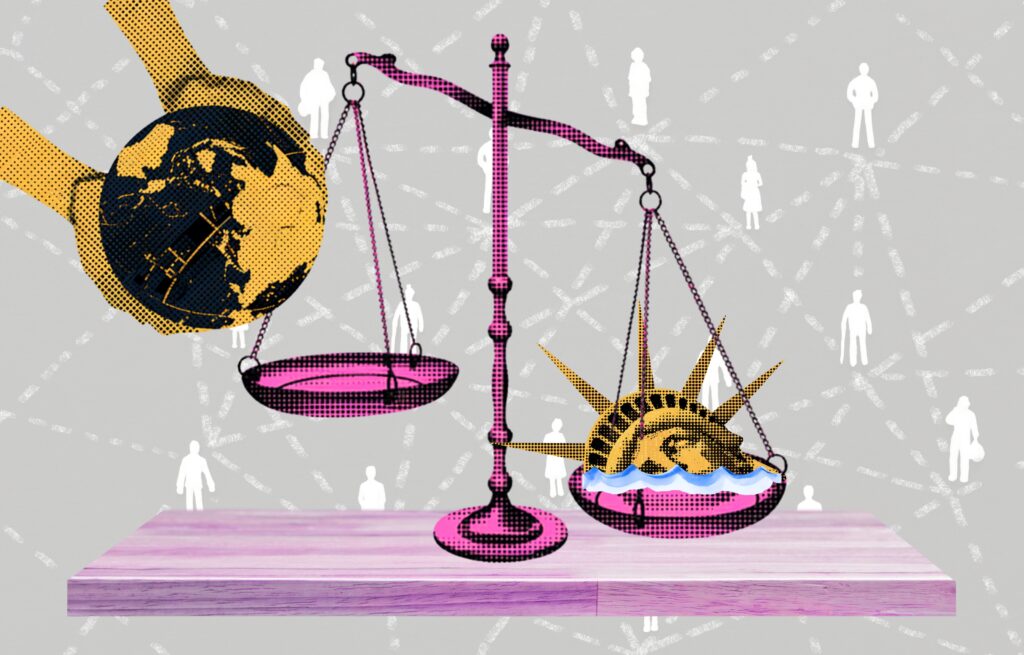
The US failure to win the Iran War is the most obvious sign that Washington’s capacity to dominate the globe is waning. But Washington retains immense military power and substantial economic clout. What policies the US government pursues in the final years of Trump 2.0 and after will have an enormous impact on what replaces the now-ruptured Washington-dominated world order.
The challenge—and opportunity—facing the Left is to make sure that US policies are not determined solely by the intra-elite battle between the “America First” MAGA bloc and a Democratic Party leadership still trapped in a Cold War mindset. We can galvanize support for a compelling alternative if we (1) are clear-eyed about the ways US power is and is not diminished; (2) are realistic about the difficulties of doing politics in a declining empire; (3) grasp the factors that favor progressive advance; and (4) promote a vision of a transformed role for the US in the world that addresses the most urgent needs of the global majority and can be realized given the balance of forces in today’s rapidly changing world.
US decline and US power co-exist
The introduction to the first issue of a new journal, Phenomenal World, captures the complexity of a moment in which US global power is declining but the guardians of the US empire retain unique strengths. The argument is worth an extended quotation:
Are we at the end of the American Century? The question looms over the turbulent global politics of this millennium—and, over the past eighteen months, has yielded answers that take the form of a seeming paradox. On the one hand, the United States appears as a waning hegemon, accelerating the transition away from its own unipolar era. On the other, each unprecedented shock reaffirms Washington’s unique privilege to directly reshape the world…
The United States is “forfeiting its role as the leader of the free world”… while “termites are slowly feasting away at the foundations of the dollar’s dominance”… On the other side of the ledger, a parade of extraterritorial military and economic violence coincides with blissed out financial returns, a $1.5 trillion defense budget proposal, the largest IPO in history, and related dreams of a new era of AI-induced primacy. The empire is in free fall, but also hanging steady; its claim to legitimacy has been shredded, but its extreme authority prevails.
Embarrassments of a sundowning autocrat, ruptured diplomatic alliances, and strategic defeat in Iran notwithstanding, who but Uncle Sam could incinerate girls’ schools, assassinate cabinets, bankrupt aid organizations, kidnap sitting presidents, and wage world-bending economic war?
The punchline is that even in decline the US will play a major role—perhaps even the dominant one—in shaping the next world order.
Empires in decline tend to go down hard
Empires in decline have historically tended to go down hard. They wage losing but very bloody wars. They furnish fertile soil for reactionary movements aiming to restore the lost glory of a (usually mythic) past. Such movements gin up “blood-and-soil” racist nationalism aiming at preserving or restoring social hierarchies. Their demagogic leaders demonize vulnerable communities and political opponents who allegedly “infect” the body politic and whose very existence is allegedly responsible for the country’s decline.
Slow media for fast times. Sign up for our newsletter.
It’s all there in MAGA today. This is largely the reason MAGA has been able to take control of the Republican Party and seize the initiative from a complacent and complicit Democratic Party leadership. Even as Trump’s popularity tanks, the fierce partisans of MAGA pathologies retain deep roots in white America—white Evangelical churches in particular—and are not going away any time soon.
An insurgency driven by the “Third World Within”
Fortunately, other factors indicate the potential for the US to break the general historical pattern of reactionary political blocs leading empires in decline.
First, this country’s large and growing population of people of color has a strong basis to identify with peoples abroad who have been negatively impacted by the militarism and racism of the US empire. They are connected to homelands in Asia, Africa, or Latin America via past or present kinship ties, and face structures of white supremacy that stand in the way of achieving full “Americanness.” And these structures are now being reinforced as the empire’s power wanes: the MAGA-packed Supreme Court has gutted the Voting Rights Act; MAGA ideologues spew racism-permeated claims that urban areas are rife with voter fraud; and Trump 2.0 continues its furious anti-immigrant campaign and flanks it with rhetoric claiming “heritage Americans” are the only first-class citizens. These are the material reasons why communities of color—the “Third World Within”—are less susceptible (not immune) to restore-lost-glory/make-America-great-again thinking than the white population. Of course it takes political work to move an anti-imperialist agenda in any sector, but it is no accident that past and present movements for racial and immigrant justice, the Black Freedom Movement in the first place, lean toward internationalism.
Second, the US has a rich history of antiwar, solidarity, and anti-imperialist movements, which remain reference points for significant sections of the population despite persistent ruling-class efforts to erase them from the country’s collective memory. The recent upsurge for Palestinian rights has rekindled interest in the anti-Vietnam War movement, the movement to end South African apartheid, and the “world’s second superpower” protests against the war against Iraq. The Left can draw important lessons from these movements that can help us understand why they have not yet been translated into a durable, institutionalized anti-empire political force. And for both the Left and the broad populace, the legacy of Dr. Martin Luther King, Jr.—despite efforts to sanitize his radicalism—stands as a reminder that US domestic and foreign policies are interconnected.
Third, an especially high proportion of conspiracy theorists, grifters, and incompetent toadies play important roles in the MAGA bloc, and its central leader is a corrupt, unstable narcissist. This combination has led MAGA to overreach on several battlefronts, alienating people it could have won over. This opens up opportunities for an insurgency built on multi-racial, gender-inclusive democracy, working-class economics and internationalism to find allies in fights against authoritarianism and oligarchy.
Fourth, as in the Vietnam era, figures from the national security establishment are re-thinking basic assumptions about US policy and even critiquing American Exceptionalism: Daniel Ellsberg then, Ben Rhodes today. This opens up possibilities for a serious “inside” effort, as well as bolsters the indispensable “outside” pressure from social movements and public opinion for deep-going change. The explicit opposition to war-making and anti-migrant scapegoating and the implicit critique of American exceptionalism coming from the current Pope is also a factor on our side of the scales.
Fifth, in the wake of the Gaza genocide and then Washington first starting and then losing the war against Iran, there is wider public questioning of US foreign policy than at any time since the years immediately following the Vietnam War. More people than ever before are open to fresh ideas about the wisdom of foreign wars, the US–Israel “special relationship” and the role the US should play in the world in general.
And on the global level…
Finally, on the global level, no power is directly challenging the US and vying to replace it as a new global hegemon. The only possible candidate would be China, and the Chinese leadership, in both rhetoric and practice, is refusing to take on such a role. On the contrary, while China does seek changes in international institutions such as the IMF and the World Bank, and in the “norms” of international relations, its priority at least for this next stage of world history is minimum inter-state conflict and maximum international stability. The Chinese leadership seems to think if nuclear war or climate catastrophe can be avoided—and China will do its part to prevent those outcomes—it will inevitably become the world’s paramount power.
This means that no country on earth poses any kind of military threat to the US. US capital does face economic competitors. There are plenty of bad actors across the globe and authoritarianism is on the rise worldwide. But dangerous as these negative factors are, there are no serious military threats against the US “homeland.” (The violent threat that does in fact exist, small-group terrorism, is mainly a response to imperial aggression, and would be drastically reduced if not eliminated with a transformed foreign policy.) And almost all of the world’s governments—including the one in Beijing—favor preventing any nuclear arms race and cooperating on fighting climate change.
Under these circumstances, we can envision a world order coming into being that is far better than one shaped by MAGA’s notion of a world where “the strong do as they can and the weak suffer what they must,” or by the Democratic Party leadership‘s dream of restoring something close to US global hegemony. To make it possible, we will need to assemble the forces required to put a US government in power that changes course enough for a movement of the global majority to bring it about.
An initial hypothesis
The starting point for a transformative vision that benefits both the majority of the people in the US and across the globe is recognizing that we live in a deeply interconnected world, where security for the people of any one country depends on security for people of all countries, and where the well-being of the working class and popular majority in any one country is tied to the well-being of the working class and popular majority everywhere.
The foreign policy platform that flows from the above prioritizes global cooperation to combat threats to human survival (including those posed by fossil fuels); demilitarization (including nuclear disarmament initiatives); and new frameworks for international trade and economic policies that prioritize labor, human, and migrant rights over corporate profit. Additional priorities include creating a global mechanism to regulate new technologies such as AI, and building a global health infrastructure (including but not limited to strengthening the World Health Organization) capable of tackling current health issues and responding rapidly to future threats.
Such a platform would include measures to strengthen and democratize the UN, the World Court, and other institutions of global governance in ways that make relations among and within states consistent with the UN Charter and the Universal Declaration of Human Rights.
Solving political disputes via diplomacy rather than military force will need to be a core plank of this new foreign policy. US defense policy would be reoriented toward “sufficient defense,” meaning the maintenance of a military that is only large and strong enough to defend the country against a foreign attack. Such a policy would cut at least 50% from the current defense budget and remove all US troops and bases from foreign soil.
Grassroots movements calling for each of the above already exist in the US; experts and scholars in and out of academia and think-tanks can help flesh out specific workable details on each point. A sustained effort to tie all these threads together and make the overall package a rallying point for insurgent movements and progressive elected officials and candidates can create a pole of attraction in mainstream politics and influence the 2028 elections.
An urgent step on a longer road
If we succeed, the effect will ripple far beyond the US. Instead of a global dystopia in either its America First (MAGA) or American Primacy (Clinton–Biden) varieties, we could help set favorable conditions for movements in all countries—especially in the global South—to make gains for democracy, workers’ rights, and peace.
A US government that moved even part way in the direction of global cooperation would alleviate the main source of economic bullying and threats of violence that currently afflict the nations of the global South. It would set conditions that are less favorable for a global authoritarian Right that thrives on the spread of violence, inter-state conflict, and demonization of “the other.” It would increase opportunities for radical movements which do best when they have maximum democratic space and cannot be dragged behind one or another banner of “national security.”
A breakthrough in moving this kind of agenda would still fall short of the transformation we need. Until capitalism is dismantled in at least a major portion of the world, powerful forces will work to undermine any government basing its policies on peace and human rights. A defeat of capitalism on that scale is not on the near-term agenda, but the battles that will shape the next world order are already underway and being waged between scenarios that are possible to achieve. We as a Left can develop and offer a positive vision and invite the public to compare it to the perspectives of our class adversaries. Or we can abstain from doing so and relegate ourselves to the margins as a new world order comes into being.
Did you enjoy this article?
Becoming a member is the best way to ensure we keep publishing articles that meet the moment. Memberships start at just $5 a month and come along with a variety of other perks; join us today.