
For so many organizations, there is a massive gap between the conditions our people deserve, and what we are able to provide. Nonprofit structures bound by regulations and funding restrictions have set us up with unrealistic expectations. The scale of needs left unmet at the societal level by defunded government infrastructure and profit-driven corporatized systems of care are far too great for the nonprofit sector to close the gap. Even long before this current administration, racialized and gendered capitalism, privatization, neoliberalism, and rising authoritarianism have stripped, undermined, and stunted our systems of community care. When justice-oriented organizations move towards embodying liberatory values, we often have outsized expectations of what we will be able to do within these constraints, and we lack sufficient resources to fully embody our vision.
In early 2020, the early stages of the COVID-19 pandemic and the uprisings for Black lives following the murder of George Floyd intensified the urgency and tensions already present within organizations. Many movement organizations found themselves in a moment of internal reckoning, and a wave of internal conflict has been sweeping social justice organizations since. Many organizations are in the process of transforming—or, in some cases, sunsetting.
As this piece is published in early 2026, the context for movement organizations has intensified dramatically under the rise of fascism. Organizations are being attacked from increasingly dangerous and absurd angles because their politics differ from the far right administration. The administration has made threats to take away organizations’ federal tax status 501(c)(3), which offers tax deductions to contributors. So many nonprofit organizations have structured the resourcing of their operations around this charitable giving model, and if that tax status is taken away it would destabilize critical work across sectors, issues, and regions.
That said, it is also important to remember, as Le Tim Ly of Center for Empowered Politics reminds us, “If you lose your tax status, it’s not the end of the world. It doesn’t mean that your organization needs to stop operating. You’ll have to operate a little differently, but you can still operate.”
Slow media for fast times. Sign up for our newsletter.
Nonetheless, it is no surprise that within this context and more, we are seeing an uptick in interpersonal conflict and political difference playing out within so many organizations. This piece offers examples of how organizations are approaching organizational culture shifts, with the hope that others will see they are not alone in navigating these challenges and will identify some practices they can try out in their own organizations.
This piece highlights the need for:
- Re-examining Cultures of Urgency
- Facing Outward: Clarity of Organizational Purpose, Power and Scope
- Facing Inward: Right-sizing Roles, Pace, and Communication
- Balancing Facing Outward and Inward: Transformation at Three Levels
If much of what follows sounds familiar, it is because these patterns and challenges are found across broader movements and society at large.
Re-examining Cultures of Urgency
Whether a sense of urgency arises from societal conditions or is internally generated, organizations must recognize the importance of choosing which fights we will and won’t take on. This will allow us to wield our best impact, build power, collectively set our pace with intention, remain grounded and avoid burnout.
These are tough times. Shifting conditions at a societal level also have deep impacts at the interpersonal and individual level, all of which inform the culture of organizations. Bill Fletcher, Jr. has characterized the political moment of this decade as a tectonic clash of climate and economic crises having profound impacts on people and politics and creating global anxiety. Add the global rise of authoritarianism and the shifting of a political era, and it’s no wonder organizations are, or at minimum feel like they are, in crisis.
This can help us make sense of the fact that we often feel like we are living in an exhausting and constant state of urgency. Our communities, organizations and the broader nonprofit sector are facing an increased onslaught of attacks since the 2024 elections.
Some resources for shoring up organizational infrastructure to protect against opposition attacks:
- Weathering the Storm Toolkit by RoadMap Consulting
- Community Defense Resource Hub by Muslims for Just Futures.
Urgency is frequently framed as a source of conflict in social justice organizations. Tema Okun’s influential 1999 piece names urgency as one warning sign of white supremacy culture. Unfortunately, as Okun herself points out in the 2021 remix of the widely circulated 1999 piece, this article has often been weaponized and used opportunistically throughout the movement to justify behavior that is not always constructive, and to avoid accountability and rigor in the workplace. In a June 2023 discussion entitled “How (Not) to Dismantle White Supremacy,” Sendolo Diaminah suggests having conversations across the whole organization about what can go wrong both when we “do urgency too much” or when we move as if “there is no urgency at all.”
At a movement-wide level, we need to dig into the role of urgency in our work without flattening the concept. We cannot overlook the true urgency of struggles for survival as we contend with multiple crises, and we understand urgency is an important ingredient in any revolutionary or liberatory movement. We also need to be aware of the manufactured sense of urgency fostered by white supremacy culture and the nonprofit industrial complex, which can influence our interactions and undermine our relationships.
Candice Cason and Bill Fletcher, Jr work with organizations to strengthen their organizational development and political clarity. They posit that there are two main ways that urgency tends to manifest in movement work:
- Grounded urgent response when our constituency is under acute duress, based on accurate assessments of our power and capacity (rapid response to urgent crises).
- Ungrounded self-imposed urgency based on outsized assessments of our power and capacity, which can lead to a lack of effective strategy, planning and interpersonal communication.
Cason and Fletcher make the case that often an organization’s state of urgency can be rooted in lacking clarity of purpose, and taking on a scope of work that exceeds their capacity. At any given moment, many issues are truly urgent, but our organizations may not have the power to influence or resolve the issue. There is no one answer to every scenario, but any call for urgency deserves our pause to assess with clarity what capacity and power we actually have to address the issue, and to determine at what pace and scale we will do it.
Facing Outward: Clarifying Organizational Purpose, Power, and Scope
Identifying our best contribution at a given moment can be challenging, especially for organizations with liberatory values, who value intersectionality, who bring people together in multi-racial, multi-gender, multi-generational, multi-class, multi-regional relationships, who have a systems change approach. There are great strengths in this multi-multi approach, and it also requires us to navigate a high volume of contradictions. When we orient toward bridging and connecting across issues and political tendencies, at any given moment our base and peers are facing many crises. Because we want to be able to address them all, we may override our sober assessment of our power to implement our best impact, and act on our hopes more than on our reality. When organizational leadership sets over-ambitious goals, it can limit time for reflection and dialogue and lead to a lack of political alignment.
Collective study of relevant political frameworks
When the people in an organization are not on the same page about the political frameworks they reference, it can amplify interpersonal strain. Often in movement organizations, political frameworks and ideological influences are referred to casually and without a deep understanding of the ways they apply to our work. This can lead to an uneven sense of clarity and alignment.
Collective study can equip us to understand where our membership and staff align or need deeper debate, given the multiple political tendencies we navigate and represent. Collective study can also help us recognize when political frameworks are being used to justify “cherry-picking arguments.” Maurice Mitchell defines this in Building Resilient Organizations as “Using incoherent or decontextualized arguments and perspectives to add perceived legitimacy to a position or oneself.”
Organizations can start with identifying and discussing core political frameworks and organizing traditions that inform the organization’s strategic orientation and theory of change.
Some common frameworks that inform the work of liberatory movement organizations:
- Abolitionism, Black Feminisms, Dialectics, Disability Justice, Feminist Economy, Forward Stance, Healing Justice, Just Transition, Transformative Justice, Transformative Organizing, among many others.
Power mapping under shifting conditions
Believing strongly in something does not translate into the power to change it. Organizing to change systems with liberatory values can be both inspiring and heartbreaking. When we set organizational goals based on the righteousness of our strong ideological frameworks, without an analysis of our actual power under the current conditions, it can set us up to fall short. Over time, this continual over-extension can erode trust and lead us to overcorrect by spending too much time tending to internal dynamics or planning too much programming that doesn’t actually shift conditions, keeping us off balance all the time.
Power Mapping is a tried and true tool for movements to ground our strategies in an assessment of the power we have to influence our targets at a given moment. There are different methods to approaching power mapping, but the core purpose is to examine and identify who has power to make the change you seek; who has influence over those powerholders; and which of those relationships your organization has the power to influence. As conditions shift on a regular basis, especially in times like these, we need to revisit our power mapping regularly based on what we know at a given moment.
These power mapping tools are oriented toward campaign planning. But we can use them in overall goal setting for the people within an organization to have a shared understanding of what we do and don’t have the power to influence at a given moment.
- Beautiful Trouble Power Mapping Tool
- Gender Equality Network offers a brief video about how to approach Power Mapping
- The Commons Social Change Library compiled a set of power mapping tools
Clarifying Organizational Division of Labor in Coalitions
The competition inherent in non-profit culture can set the stage for movement organizations to always be trying to stand out as unique. This can lead us to operate with siloed strategies rather than being in regular dialogue with each other about an overall movement strategy that we each play a role in. There are many tools for defining the division of labor and roles internally for project management within organizations (see below in Clarifying Roles and Decision Making).
What if we also take this approach in coalition building? What if organizations engaged in more dialogue with each other to identify a division of labor across our movement? In conversations about making risk assessments for organizational strategy, Che Johnson-Long of Vision Change Win says, “We’re all tired right now. Frankly, we don’t have time to isolate or try to reinvent the wheel and invent new strategies when our partners may have already thought through this thing. We are going to be each other’s biggest resources.”
Maraam A. Dwidar’s article Winning Coalitions Have the Right Kinds of Differences makes the case for our movement to determine a division of labor not just within our staff structures, but in the architecture of the relationships across organizations. “Successful coalitions have clear and durable architectures that govern membership, leadership, and decision-making. These structures enable coalitions to develop the capacity to plan over long periods of time and learn from each iteration of advocacy. They can also clear up ambiguities that tend to cause coalitions to break, such as murkiness about how to make decisions, who is or isn’t in the coalition, and the role of each partner.”
This is not to say it’s simple, but if we want to grow our power it can only serve us to talk more with our peer and partner organizations about what each of us are doing, and make agreements about how to share information and work in tandem without duplicating each other’s work.
Facing Inward: Right-Sizing Roles, Pace, and Communication
Once the people in an organization have alignment around political frameworks, clarity of their purpose and power, and clarity about their unique movement level contribution, they will then be in a better position for assessing urgency and right-sizing the roles, pace, and communication within the organization.
Practitioners like Holiday Simmons and Raquel Laviña have worked with movement organizations to introduce new practices that can be used among staff and membership to begin transforming organizational culture. Both Simmons and Laviña have a background in Somatics, which Simmons describes as a healing modality rooted in movement theory, psychotherapy, and bodywork. Somatics on a group level aims to promote organizational well-being by identifying both individual and collective responses to pressure, in order to determine and assess subconscious embodied responses, for the sake of aligning an organization’s values to their practices.
Somatic practice can help us to be grounded in our bodies as we engage with each other and the work of the organization. Laviña draws from her experience in Transformative Organizing, and both also bring expertise in organizational development and other methodologies as it makes sense for the particular needs of the organizations they work with. Simmons also works with organizations to understand and address how patterns associated with anti-Blackness may manifest in aspects of organizational culture, daily operations, and interpersonal interactions.
In the work to re-examine how urgency shows up internally, Cason notes that when organizations lead with ungrounded urgency, we often skip steps and exacerbate underlying unresolved tensions and microaggressions. She notes that this can happen in many ways, and in particular in how anti-Black racism, or anti-Blackness, shows up in our work. We need to look out for claims of white supremacy culture being leveraged against Black leaders and other leaders of color, while still examining and remedying the very real anti-Blackness that permeates our organizations.
Sage Crump is a culture strategist, coach, artist, and movement facilitator who expands and deepens the relationship between the cultural sector and social justice organizing. Crump notes that when organizations begin to address anti-Blackness, one of the first challenges is a perceived lack of definition. She utilizes the work of Black feminist scholar and cultural historian Saidiya Hartman Scenes of Subjection: Terror, Slavery and Self-making in Nineteenth-century America to support organizations developing a grounded lens for recognizing anti-Blackness and a way to begin to address it. Hartman’s text calls on us to examine the “terror of the mundane and quotidian… the violence perpetrated under the rubric of pleasure, paternalism, and property.” Some ways this shows up in organizational culture, for example, can be: repeated instances of prioritizing the pleasure or comfort of non-Black people in planning programming and agendas or topics of discussion; or well-intentioned non-Black folks advocating for what they assume Black staff and members want or need in a paternalistic manner without actually confirming said Black folks’ own perspective on the matter. Addressing anti-Blackness in our organizational cultures requires organizational commitment along with individual self-reflection, and involves increasing our ability to recognize, identify, take responsibility for and repair tendencies of anti-Blackness more immediately when they occur.
Clarifying Roles and Decision Making
Many breakdowns in interpersonal communication can often be traced back to a lack of clarity about roles or decision making, no matter how an organization is structured. It is much more possible to utilize any of the following tools and practices when there is shared understanding about people’s roles and the decision-making process.
In project management there are three common approaches to identifying and clarifying roles among a team – MOCHA, DARCI, RACI. Check out descriptions and a comparison of these three models in this guide by Nonprofit Learning Lab.
Approaching planning through a Rhythm of Action
The Rhythm of Action model of planning and decision-making identifies four main cycles of work: 1) Ideation and Consultation; 2) Assessment, Negotiations, and Decisions; 3) Implementation; and 4) Celebration and Evaluation. This model allows us to reflect on where we are strong or weak, and name where we are in the cycle of work.
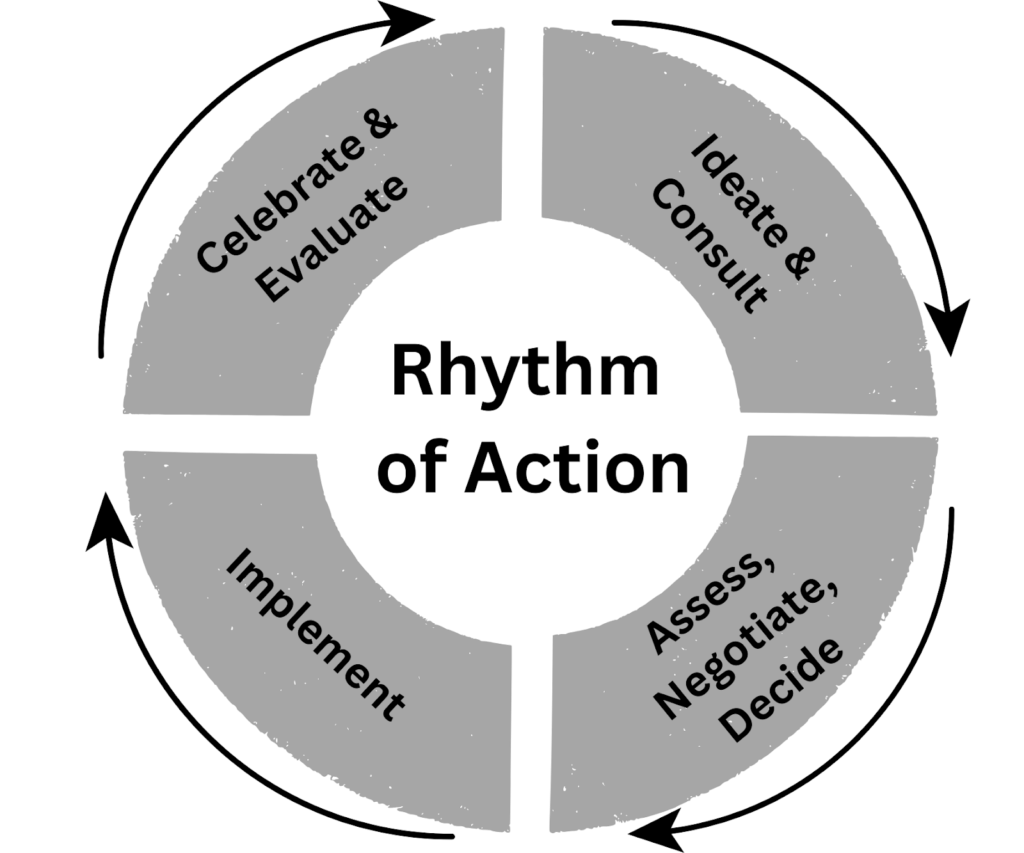
[image created by Grogan-Brown, based on drawings from Simmons and Laviña, who drew from an original version by generative somatics]
Issues around pacing aren’t simply solved by doing less work. We also need to pay a proportionate and appropriate amount of attention to each stage in the Rhythm of Action. For example, Negotiation sets us up for stronger Implementation; Evaluation helps us Ideate based on what did or didn’t work and where we got to most recently. When we shortcut and only move between Ideation and Implementation, we skip crucial steps of Assessment, Negotiation, Celebration, and Evaluation that can inform our planning. It is not linear either—we may need to backtrack in the cycle to course-correct at times. Investing in each part of the cycle allows us to know what we are best at, how to maximize our impact, and where we need to put more focus. Rhythm of Action doesn’t resolve it all, but it can give us clear discussion points to navigate differences about priorities, and can uncover ways that anyone on staff may be reluctant to let go or put down any of the work that we have committed to, even when we are overextended.
It takes practice to develop this Rhythm of Action within an organization. Some common tendencies that can surface are:
- Some people don’t feel confident or practiced at negotiation or assessments, or are uncomfortable stating disagreement, and will need support to engage.
- Some people may advocate primarily from their vantage point if they are not seeing the whole picture, and will need information that they may not be taking into account.
- If there is a lack of clarity about who is making the final decision, or what stage we are in, we can then also misunderstand the purpose of any of these conversations. It is important to name when a conversation is about decision makers consulting and getting input from others, and when a conversation is about making a collective decision together.
- A healthy rhythm of action involves people being willing to state their disagreement out loud to each other within the process, while also being willing to try something on, implement decisions without resentment, and bring feedback to the evaluation.
Strengthening individual & collective ability to hold Courageous Conversations
Laviña and Simmons define a “courageous conversation” as a discussion in which people share their views openly and honestly, with mutual direct and respectful communication, even when it might be difficult or uncomfortable. Often uncomfortable conversations surface unconscious harms or habitual practices that can be transformed. Once these are surfaced, the organization and its people can make agreements about how to move forward more intentionally.
Persistent tensions can impact team cohesion and trust. By strengthening our ability to engage in courageous conversations live in the moment when they are needed, we can improve our practice of identifying, addressing and resolving conflict or difference before moving forward. Some ways to strengthen this ability are:
- Create safe spaces in smaller groups or one-to-one to share interactions that impacted us, and respond, acknowledge, and reflect on the impact of our actions.
- Identify a neutral word or phrase that allows for anyone to ask for a pause to name when a courageous conversation is needed.
- Create open space during in person gatherings and encourage participants to use those times to have courageous conversations with each other.
These kinds of courageous conversations can be tough, but most often they help teams surface and resolve issues in real time and move forward together.
Balancing Facing Outward and Inward: Transformation at Three Levels
A healthy organizational culture balances work that is both outward and inward. As stated in one of the Rad Ops Principles: “Strategic pauses to get aligned, pivot our approach, or tend to internal dynamics should ultimately strengthen the outward impact of our organizations. Conversely, focusing solely or disproportionately outward can overshadow the internal cracks, causing more imbalance. Balance making the workplace as liberatory as we can, while not spending all of our capacity focused inward at the expense of our larger mission, and vice versa.”
The Transformative Organizing model is about creating deep change at three levels simultaneously, and posits that in order to truly transform society, we also must be willing to reflect on and evolve ourselves and our interpersonal relationships. Organizations are one site where we can practice transformation of ourselves and our relationships to each other as we work for societal level change.
Even with a strong division of labor and a clear understanding of decision making, power plays out among teams in multiple ways and can have an impact on organizational culture. Laviña supports organizations to understand how to recognize both the positional power of senior leadership within the organization or of people who are more privileged in society, and also the influential power that any leader in the organization can wield, influencing the organizational culture through mood, morale, and unity (or lack thereof). Courageous conversations, mutual feedback, self-reflection and negotiation are practices that anyone can initiate, and ways that everyone can collectively care for the organization.
There is no one-size-fits-all solution. Organizational culture shift is a long term process, a path of constant learning and growing. In these transformations we often go through heartbreak and betrayal of trust. We try our best ideas and still mess up big time; we discover that what seemed like the best option was not the best for everyone; we’ve thought we were communicating clearly only to uncover later how unclear we were all along. People can feel dissatisfied with the effectiveness or depth of progress and choose to move on. Some expectations will not be met by organizational shifts, and the timeline will not satisfy everyone. Sometimes we make advances, sometimes we suffer setbacks, and often the conditions do not allow us to embody our liberatory values that we believe in so deeply.
Still, transformation is possible, and many organizations have shifted their culture in myriad ways. Especially in the conditions of 2026 and beyond, we need to be able to pivot together. It is the collective commitment to self-transformation, and willingness to stumble and try again, that will equip us to face future assaults clear-eyed, to make our next best moves, and continue to transform ourselves, our interpersonal relationships, and our society.
The Rad Ops project offers a framework and resources that aim to support the resilience of movement organizations in these times. Follow on IG here, subscribe for email updates here, and subscribe to the podcast on the Convergence Magazine platform or wherever you get your podcasts.
Did you enjoy this article?
Becoming a member is the best way to ensure we keep publishing articles that meet the moment. Memberships start at just $5 a month and come along with a variety of other perks; join us today.