
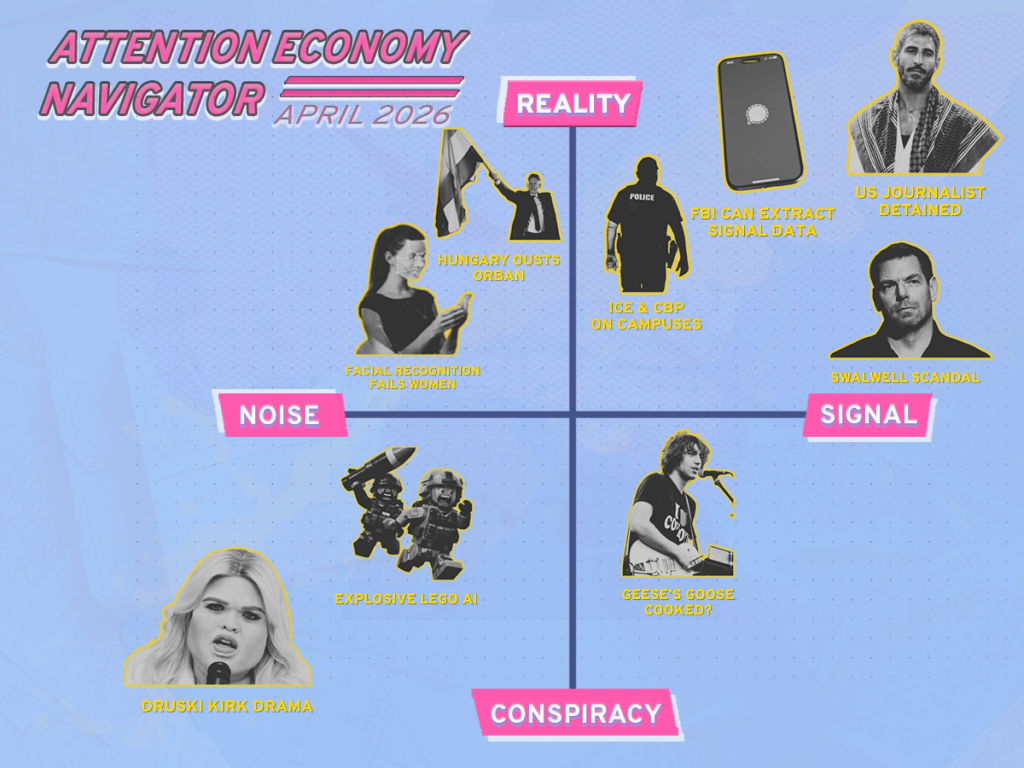
This month on the Attention Economy Navigator, our guide to what you should be paying more attention to, and what you can probably pay less attention to. And why those stories might not be what you’d assume.
You can also listen to the podcast episode featuring Negin Owliaei and Bridget Todd, or watch the panel plot these stories in real time on YouTube.
High Reality, High Signal
- Using forensic investigation methods, the FBI was able to extract copies of incoming Signal messages from Prairieland defendants’ iPhones. It’s real because it’s actually happening and it has some very real implications for people’s real lives.
- “Forensic extraction” is a bit of a black box even for privacy and tech experts.
- There’s friction between Signal as an app (which continues to be the best-in-class encrypted messaging app) and the operating systems it runs on.
- There are ways to keep yourself safer when using Signal; you can change what information is displayed in push notifications. Negin calls on us to resist digital nihilism!
- We unfortunately had to talk about Rep. Eric Swalwell. The Democratic Congressman and frontrunner for Governor of California has been outed as a serial sexual predator in the workplace.
- Rumors about Swalwell’s inappropriate sexual behavior towards his staff, particularly towards young women on his staff, have swirled for years.
- Cayden flags that there’s a conspiratorial element here: Swalwell was pulling a lot of support across the Democratic Party establishment, who were willing to overlook the rumors about his behavior. This is, unfortunately, all too common.
- Bridget hopes this is a sign that we’re abandoning the myth that a leader’s personal behavior can somehow be separated from their leadership and ability to wield power ethically.
- There’s something happening in the culture around men in politics and violence against women right now that feels downstream of the Epstein scandal and #MeToo. Cayden clocked a KQED politics reporter reflecting on-air about the media’s complicity in these issues by not asking harder questions sooner.
- Student organizers are fighting back against 287(g) agreements on campuses, and some of them are even winning.
- You love to see student organizers winning; Bridget points out that this generation of student organizers are up against a lot more than we were when we were coming up.
- Negin also points out that so much work on issues like this happen behind the scenes and we don’t see it until the results are in, and that the downstream effects of wins like this keep student organizers safer in the face of ongoing repression.
- Journalist Ahmed Shihab-Eldin has been in a Kuwaiti prison for over a month now for re-sharing video coverage of the US-Israel military operations in the Gulf. Kuwaiti authorities claim that Shihab-Eldin is threatening “national security” through his coverage.
- This is the worst kind of high signal, high reality story that doesn’t get enough coverage and discussion.
- The panel thinks a lot about how post-9/11 “national security” regimes have really shaped what we can and can’t say, and given cover for some pretty extreme government overreach.
- Negin points out that we know Shihab-Eldin’s story because he’s relatively well-known, but who might we not know about because they don’t have the same kind of audience?
High Reality, High Noise
- How are people digesting Peter Magyar’s victory in the Hungarian elections? Not everyone is taking the right lessons here, and it’s still early days to understand what is happening (and what will happen in a new Hungary).
- Negin raises a flag about the lessons the New York Times editorial board appear to be taking about the campaign (spoiler alert: it’s primed to throw immigrants and other marginalized people under the bus).
- Cayden wants us to be vigilant about what lessons our own movements take from this election result; claim no easy victories!
- Negin takes issue with the kind of “conventional wisdom” from her Senator Elissa Slotkin that “what it takes to win in the middle of the country is different than what it takes to win on the coasts.”
- Cayden points out that we need to run progressive candidates in not conventionally progressive districts as a test of strength and to build our power and ability to win. Shoutout to Analilia Mejia for winning the House seat vacated by Mikie Sherrill as an example of this!
- AI-powered facial recognition is being used to deny food benefits to pregnant and post-partum people in India, and the story highlights a lot of the problems with devolving decisions to “AI.”
- Cayden points out that there are human decisions at every level of a program like this, but using AI allows us to pretend no one is accountable besides the machine.
- This isn’t just a tech failure: it’s a policy failure. Why not just give people the food they need?
High Conspiracy, High Signal
- Is Brooklyn-based band Geese a psyop or nah? Wired repeated the hype from the band’s PR firm that claims to have been able to game the algorithm on TikTok to blow up their most recent (and critically acclaimed) album, Getting Killed.
- It’s actually really hard to “hack” social media algorithms like this, and what does it mean that a major tech publication just repeats the story that the PR people send them? Don’t just reprint what’s essentially a press release for a tech company!
- Cayden thinks that in some ways this is a story about how we desire so badly to think we can control these algorithms on some level when our experience is of being controlled by them in terms of where our attention is focused.
High Conspiracy, High Noise
- The meme war over Iran has commenced, and maybe Iran is winning? AI-generated animated Lego meme videos are covering the internet and they’re pretty effective at narrating the war from the Iranian perspective.
- These videos literally repeat conspiracy theories alongside real happenings, like the Minab Girls’ School bombing.
- We also don’t know for 100% certain who is making these: they might be amplified by the Iranian state, but it’s unclear where they’re coming from.
- Cayden points out that not long ago people were abuzz about the far Right’s meme game, but the tables can turn very fast. We love it when someone trolls a troll.
- Erika Kirk is not suing Druski over his “How Conservative white women in America act” skit.
- Druski never said he was impersonating Kirk, but the internet certainly read it that way (including Grok, which inaccurately identified Druski as actual Erika Kirk).
- The litigiousness is super credible because the fakes are good and it makes sense that engagement farmers would use this story to grab and keep our attention. Negin points out that some of the credibility is because of what happened after Charlie Kirk was shot.
- Cayden wonders about the magnetism of Erika Kirk and our desire to share stories about her; Bridget points out Erika Kirk’s start was in reality TV, so she’s used to doing things to grab and keep our attention.
Did you enjoy this article?
Becoming a member is the best way to ensure we keep publishing articles that meet the moment. Memberships start at just $5 a month and come along with a variety of other perks; join us today.