
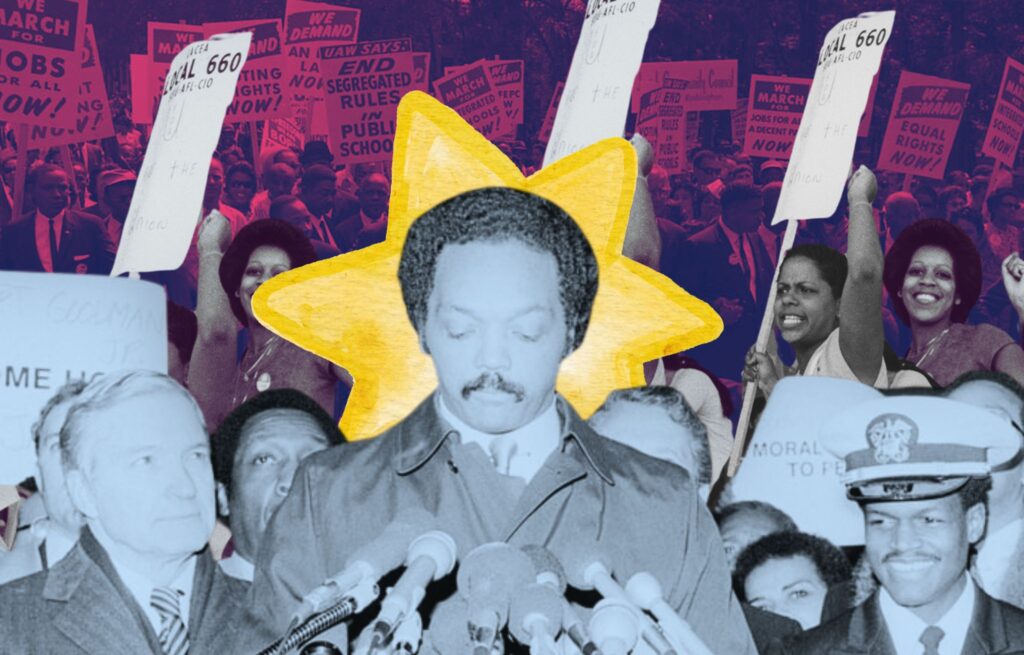
“Run, Jesse, RUN!”
It was such a great chant – our members loved it! It rolled off the tongue and was great to build to a crescendo as we marched to attend our first rally with Reverend Jackson for his 1988 presidential campaign. We were marching not only to Rev. Jackson’s rally, we were marching forward to build a grassroots army of low-wage workers and community members through our union and community allies. This army would make campaigns like Rev. Jackson’s, and others, possible.
We were small, but determined, maybe 50-60 home care workers, members of SEIU (Service Employees International Union) Local 880, the union I helped found, along with our allies from ACORN (Association of Community Organizations for Reform Now), the national community organization that helped our independent union get started nationally just ten years before.
Essie Stinson, who provided care for seniors and people with disabilities, and one of our recently elected officers, was on the bullhorn leading us in chants as we marched down Michigan Avenue with our banner, wind whipping off the lake, the cold February gales no match for the feisty workers.
Slow media for fast times. Sign up for our newsletter.
Essie was a key member-organizer who helped organize the 400 home care workers at StaffBuilders Services, one of the largest home care agencies in Illinois. Marching was nothing new for Essie.
Behind her, holding our banner was Irma Sherman, President of 880. Irma was a stroke survivor, former union steward at Mercy Hospital, and now home care worker who helped lead the 200 workers at McMaid, an aptly named agency, to a union election and first contract just a few years before.
Next to Irma were Wilma Murray and Vernell Morris, also veterans of the McMaid and StaffBuilders organizing campaigns and who, several years before led a march of scores of home care workers through their boss’s neighborhood in west suburban Oak Brook, Illinois, braving the neighbors’ dogs as they demanded recognition.
We were headed to the Congress Hotel, where Rev. Jackson was having one of his rallies on the way to the Democratic Convention, just five months away. Irma Sherman was running as a Jackson delegate to the DNC, and many of those on the march had passed petitions to gather signatures for Irma’s successful candidacy.
As we marched up to the hotel, some of the other Jackson supporters, at first stunned by our loud chants, started waving and joining in as we opened the doors and poured in with our members. We were loud as others joined in our chants of “We’re Fired Up, We Won’t Take It No More!” and “Run, Jesse, RUN!”
Many had spoken of Rev. Jackson’s giving voice to the voiceless, but here we were, no longer voiceless, raising our own voices, our own chants ever louder to “Run, Jesse, Run!”
Sparking Hope
This is how it was at hundreds of rallies and marches as Rev. Jesse Jackson took on the Democratic Party power structure in his 1984 and 1988 campaigns for president. He helped lead the registration of millions of new voters, and mobilized millions more to become the second Black candidate to campaign for the presidency.
As a community and union organizer Rev. Jackson’s campaigns for the presidency sparked hope for our members – and me.
During his first campaign, we were still just United Labor Unions (ULU) Local 880. We were the smallest union local in Chicago, but we punched above our weight in politics.
So, every afternoon, as we house-visited home care workers all over Chicago, we registered them and their families to vote – that was the easy part.
As an independent union, we only had one small bargaining unit of 200 home care workers. And it was at a private sector agency we had recently organized but still hadn’t won a union contract. But this was part of a new, but rapidly expanding home healthcare industry and workforce that we, SEIU, and other unions wanted to organize.
And the workers, overwhelmingly Black and Brown women, with some men and a handful of white workers, desperately wanted a union—and just as desperately wanted Jesse Jackson to run for president. Through building the union, they helped Jackson build the campaign.
Learning to think Big and Register Bigger
Much of the infrastructure for Jackson’s Chicago campaign was developed a year prior, during the push for Mayor Harold Washington. The movement behind Washington registered over 100,000 voters in his victorious 1983 and 1987 campaigns and catapulted him over both the incumbent mayor, Jane Byrne, and the former mayor, Boss Richard J. Daley’s son, Richard M. Daley. His campaign relied on these newly registered Black, Brown, and progressive white voters. One of the first electoral victories of a nascent Rainbow Coalition.
In 1983, we’d only just begun labor and community organizing. But we immediately launched into the hard work of registering voters and getting them out to vote. So, every afternoon, as we house-visited home care workers all over Chicago, we registered them and their families to vote – that was the easy part.
The harder part was mass-based voter registration we’d do in the mornings. We’d go to social services offices and high traffic areas in our members’ neighborhoods, with Essie, and Irma and Wilma and Vernell, and many others, and set up tables and registered folks to vote from 10 am until 2pm. Then we’d go out and do our house visits to sign up home care workers as union members, or doorknock with ACORN to sign up ACORN members to build up our community organizations.
We eventually recruited and trained crews of members and volunteers to bring in more and more new registrations at a greater volume. By slowly door knocking, house visiting, and working the tables on site, we were able to register thousands of new voters. 1,000 new voters, then 2,500 voters, and then 5,000 new voters.
Years later, we presented copies of registrations to Mayor Harold Washington at a large Voter Registration and Get Out the Vote rally of 880 and ACORN members, right before the February 1987 Democratic primary. Afterwards, we registered thousands more, helping to power Mayor Washington to his second victory.
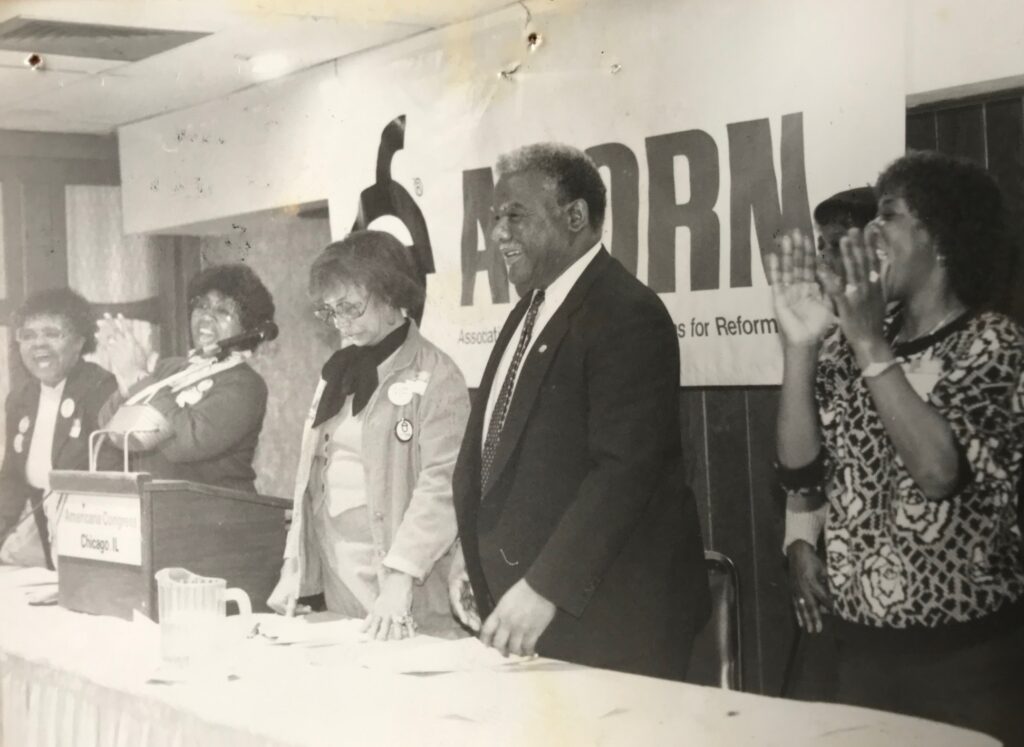
In those days, Rev. Jackson was a crucial supporter and ally of Harold Washington—his fight at the 1972 Democratic National Convention unseated Boss Daley’s delegates with a set of progressive delegates and allies, opening up the closed party process. He led a successful boycott by Black and Brown Chicagoans of Mayor Jane Byrne’s ChicagoFest in the summer of 1982 and showed what could be done with an organized base—and the ChicagoFest boycott turned out to be one of the sparks that led to Harold Washington’s victory one year later.
Our analysis was that the “Party of the People” had left the people decades before and had become the party of the Democratic bosses and their corporate and wealthy sponsors who really called the shots.
And now, Rev. Jackson was going to take on the Democratic machine nationally and run for president on the strength of millions of new Black and Brown and progressive white voters long ignored before Election Day. It was exhilarating!
Building Independent Politics
We eventually affiliated with SEIU in 1985, but in 1984, our independence allowed us the freedom from the internal politics and Democratic Party alignment of larger “international” unions and the freedom to back who our members wanted.
Some of our union staffers from United Labor Unions took leaves of absence to help build labor support for Rev. Jackson. Our ACORN sister organizations did voter registration and get out the vote and ran our members as delegates to the 1984 and 1988 Democratic conventions.
This was all unusual at a time when most unions relied instead on their endorsement bets and deals with the Democratic machine.
Local 880 with our ACORN partners were very involved in electoral politics at the local, state, and national level – identifying, recruiting, and training members to run for delegates to the Democratic National Convention in 1980, 1984, and 1988. This was done to open up the Democratic Party and move it in a more progressive direction for working families, with Rev. Jackson.
Our analysis was that the “Party of the People” had left the people decades before and had become the party of the Democratic bosses and their corporate and wealthy sponsors who really called the shots. They talked at election time like they were “for the people,” but forgot about the people in between elections and did nothing as the corporations destroyed the economy and cut back on public benefits for working families. We learned to get involved in politics early. We learned not to be intimidated by large campaigns. And we learned to register voters at scale, despite our small size
Our members loved electoral politics and campaigning, and we used campaigns like Jesse Jackson’s and Harold Washington’s to build support on our issues and demands while building our organization and its political muscle.
On top of registering people to vote, we had to think and act bigger in order to register and re-register the tens of thousands of Black and Brown voters that the Democratic Party machine purged every year from the voter rolls.
At the time, Black and Brown Chicago voters were on the rise—raising expectations coming out of the victory of Harold Washington over the racist, corrupt, and overwhelmingly white Democratic machine that had ruled Chicago for over 50 years.
Organizations Build Campaigns
We helped build Jackson’s campaign by building up our own organizations and taking ownership of our local conditions by first pushing for Mayor Washington. We registered thousands of voters for Mayor Washington and Rev. Jackson. Essie Stinson, Irma Sherman, Wilma Murray, Vernell Morris, and many others, went on to sign up tens of thousands of home care and childcare workers in Chicago and Illinois, and built 880—today known as SEIU HCII—into the largest union local in the Midwest, representing over 90,000 workers.
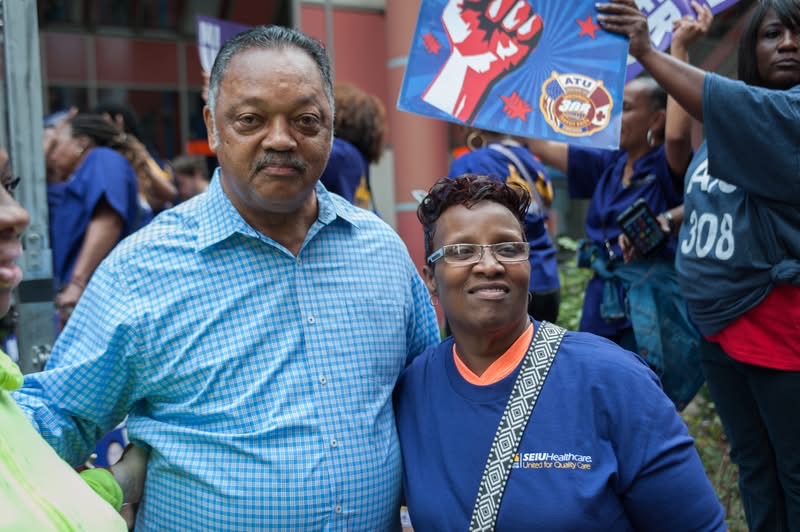
They later worked with a guy named Barack Obama when he formed Project Vote in Chicago—again registering over 100,000 voters in 1992, and elected Senator Carol Moseley-Braun, the first Black woman ever elected to the U.S. Senate.
Most historians and political pundits don’t know or don’t care about the salt-of-the-earth people who marched with Harold Washington and Jesse Jackson, and are still fighting for living wages, decent benefits, a dignified retirement, and a better world. Harold Washington, Rev. Jackson, and Barack Obama could not have succeeded if not for the Essie Stinsons, the Irma Shermans, the Wilma Murrays, and the Vernell Morrises.
And Jesse Jackson played his role, by bringing movements together, providing a big vision for what was possible, and keeping hope alive.
Did you enjoy this article?
Becoming a member is the best way to ensure we keep publishing articles that meet the moment. Memberships start at just $5 a month and come along with a variety of other perks; join us today.