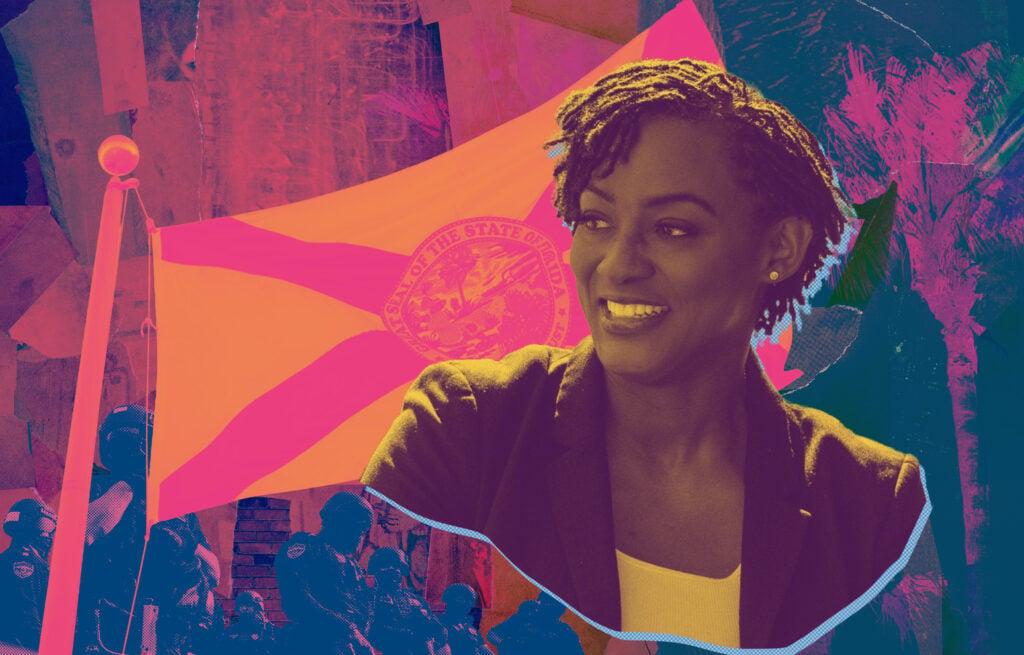
An hour after the Supreme Court gutted the Voting Rights Act in Louisiana v. Callais, the Florida Legislature voted to approve new congressional maps that eliminated two majority–Black districts and could help Republicans gain four more seats in Congress. One state legislator refused to let the vote happen quietly.
For nearly four hours, State Representative Angie Nixon disrupted the session, delaying the vote and forcing the chamber to confront what was at stake. Dangerous times call for bold leadership. Nixon has built her political identity around exactly that instinct. Now, she’s running for the United States Senate.
To some, the campaign looks impossible—a long shot in a state Democrats have increasingly written off as unwinnable. Nixon sees something else: an opening.
A sixth-generation Jacksonville resident, mother of five, small business owner, and former labor organizer, Nixon has spent her career fighting battles against Goliath. She understands Florida not as red or blue, but as a home to millions of working-class people, who feel disillusioned by a political establishment that has become increasingly hijacked by the billionaire class. With the nation’s second-largest Black population, third-largest Latino population, and nearly a third of voters unaffiliated with either major party, Nixon sees the possibility of building a multiracial working-class coalition in Florida capable of reshaping the state’s political future.
Slow media for fast times. Sign up for our newsletter.
The idea that Florida is unwinnable, she believes, has become a self-fulfilling prophecy as Democratic donors have largely abandoned the state in recent years, while Republicans doubled down on their investment. Democrat Andrew Gillum lost the governor’s race to Republican Ron DeSantis by less than half a percentage point in 2018. The path to victory, Nixon believes, is year-round organizing and a commitment to reaching the majority of people in the state who are infrequent voters and are divested from a political system that feels distant from their lives by focusing on the bread-and-butter issues that matter to them. Florida voters have grown wary of politicians of both parties who are beholden to corporate interests and don’t seem to know or talk to working people. It is not enough for Democrats to be against Trump and DeSantis; they need to paint a vision for the state and the country that speaks to people’s material needs. Running for statewide office gives Nixon an opportunity to show the country that working people across the political spectrum can be organized—even in a state that looks red on a partisan map.
At a certain point, I had to ask myself: if we believe organizers should govern, then why not us? Why not people who know how to listen, build coalitions, knock doors, sit in living rooms, stand with workers, and move people from fear to action?
The organizing stakes extend far beyond Florida. Democrats’ long-term path to congressional and presidential majorities increasingly runs through the South. Census projections and reapportionment trends continue shifting political power away from the Northeast and Midwest toward Sun Belt states like Florida, Texas, Georgia, and North Carolina. Abandoning those states could reshape national politics for a generation.
Nixon’s campaign is, in part, an argument against political retreat. And her political track record exemplifies this spirit. When DeSantis led the nation in book bans, Nixon opened a bookstore in Jacksonville that employs local youth, provides free tutoring, serves healthy lunches in a food desert, and hosts Black history workshops. When DeSantis called a special session focused on Israel and Iran one month after October 7, Nixon introduced a ceasefire resolution and was one of only two legislators to support it. Nixon was the only state legislator to receive a score of 100 percent on their voting track record for supporting bills that impact conditions for working class Floridians and that oppose corporate interest.
You cannot write off a state and then be surprised when people feel written off.
In the face of relentless attacks against Black people, immigrants, organized labor, and progressive organizations, Nixon has been a champion for working class Floridians. Nixon has arguably one of the most isolating jobs an organizer can have, working in one of the most far right, pro-corporate legislatures in the country. But in the face of what might feel alienating, Nixon knows she is part of a working class majority and leads with courage and a deep moral compass. Nixon’s leadership continues in the rich legacy of radical Black politics, following in the footsteps of leaders like Chicago Mayor Harold Washington, Fanny Lou Hamer, and Jesse Jackson, who saw themselves not as politicians or careerists, but as as community organizers, taking on political power and relentlessly committed to a dignified future for the working class majority.
Who is Angie Nixon
Delaney Vandergrift: Tell us who Angie Nixon is. What brought you into the movement, and why are you still fighting?
Angie Nixon: I am a mother, a sixth-generation Jacksonvillian, a former union organizer, a small business owner, and a state representative. But before any title, I am someone who comes from working people and believes deeply that everyday people deserve power over the decisions that shape our lives.
What brought me into the movement was seeing people I loved work hard and still struggle. I saw families doing everything right and still being crushed by rent, low wages, medical bills, underfunded schools, and politicians who seemed more concerned with corporations than with the people who keep this state running.
I am still fighting because the conditions that brought me into this work have not disappeared. In many ways, they have gotten worse. Florida families are paying more for housing, insurance, food, healthcare, and childcare, while corporations and special interests keep getting richer. I believe we have a responsibility to organize our way out of that. Not just complain about it. Not just survive it. Organize, build power, and change it.
Elections to Shift Power to the People
DV: Many of us see the need for people who come from union and community organizing to run for office, but the decision to jump in the race I imagine is not an easy one. You first ran in 2020 for the state legislature from your union and community organizing work. How did you make that decision and what did you hope to accomplish?
AN: It was not an easy decision, because organizing work is my home. I did not run for office because I wanted a title. I ran because I had spent years fighting alongside workers, parents, young people, and communities who were being ignored by the same political system making decisions about their lives.
At a certain point, I had to ask myself: if we believe organizers should govern, then why not us? Why not people who know how to listen, build coalitions, knock doors, sit in living rooms, stand with workers, and move people from fear to action?
When I first ran for the state legislature, I wanted to bring the movement with me into the Capitol. I wanted working people to have someone in office who understood that policy is not abstract. Rent is policy. Wages are policy. Healthcare is policy. Whether your child’s school has resources is policy. Whether your vote counts is policy.
I hoped to accomplish what I am still trying to accomplish: shift power back toward the people. That means fighting bad bills, advancing bold ideas, and making sure people who are usually talked about are actually heard.
Being Arrested Was Not the Goal
DV: You were recently arrested for speaking out against the dismantling of the Voting Rights Act. Tell us about what happened and why you took action in this way.
AN: I took action because voting rights are not just a procedural issue. They are about whether people get to have a say in their own future.
Florida has been ground zero for attacks on democracy. We have seen attacks on voting access, attacks on fair representation, attacks on Black political power, attacks on protest, and attacks on the communities that have historically had to fight the hardest just to be heard. When politicians manipulate maps and weaken representation, they are not just drawing lines. They are deciding whose voices count and whose voices they think they can erase.
I participated in a sit-in outside Governor DeSantis’ office because people needed to see that this moment requires moral clarity. I was there to demand accountability, to speak out against unfair maps, and to call attention to a state government that is making life harder for working families while trying to make itself less accountable to voters.
Being arrested was not the goal. The goal was to make it clear that we cannot normalize the dismantling of democracy. We cannot act like authoritarian politics are just another policy disagreement. When people’s voting power is under attack, silence is not neutral. Silence helps the people doing the harm.
DV: You often describe yourself as an organizer first and a politician second. What does that distinction mean to you in practice? How has organizing informed your time in the Florida legislature and the kind of senator you would be?
AN: I am a labor and community organizer with nearly two decades of experience working with everyday people across the state of Florida to make this place better for working people. Organizing is at the core of who I am.
Being an organizer first means I do not see people as voters only during election season. I see them as leaders, neighbors, workers, parents, tenants, caregivers, students, and community members who already have wisdom and power. The job is not to speak for people. The job is to organize with people so their power becomes impossible to ignore.
In the legislature, that means I do not just look at a bill and ask whether it sounds good on paper. I ask: who does this help, who does this hurt, who was at the table, and who was left out? I think about the mother trying to keep the lights on. The worker afraid to speak up. The renter getting priced out. The young person wondering if Florida has a future for them.
As a senator, I would bring that same approach. I would not go to Washington to become part of the club. I would go there to fight for the people who are locked out of the club. That means building coalitions inside and outside government, using the office to organize, and refusing to let corporate interests define what is possible.
Stories of Jacksonville
DV: You are a sixth-generation Jacksonvillian. What does it mean to represent the place you are from in elected office?
AN: It means everything.
Jacksonville is not just where I live. It is where my roots are. It is where my family history is. It is where I learned what community means, what struggle looks like, and what resilience feels like. Being a sixth generation Jacksonvillian means I carry the stories of people who built lives here through hardship, faith, labor, love, and determination.
Representing the place I am from is personal. When I fight for housing, I am thinking about families in Jacksonville. When I fight for schools, I am thinking about our children. When I fight against voter suppression, I am thinking about generations of Black Floridians who had to fight for the ballot and still have to fight to make that ballot count.
It also keeps me grounded. I know who I am accountable to. I am accountable to the people who raised me, the people who organized with me, and the people who are still trying to make a way out of no way.
Electoral politics cannot be abandoned to the same people who created the crisis. We need movements outside the halls of power, and we need movement people inside those halls too.
DV: You opened a bookstore after the Florida Legislature passed legislation that bans books and Black history in schools. Why a bookstore?
AN: I opened Café Resistance in 2024 in response to the book bans that were happening. Education has always been important to me and my family. When my daughter was 7, we co-authored a book, The Adventures of Moxie McGriff about a little girl struggling with self-esteem. My daughter didn’t like her hair or her skin complexion. She also did not like to read, and so we made a promise that if we wrote this book, that she would have to read more books in order for us to be able to write it.
The kids in our neighborhood don’t see books with protagonists that look like them—especially now that the State of Florida, through laws like the Stop WOKE Act and “Don’t Say Gay” bill [Parental Rights in Education bill (HB 1557)] has banned thousands of books from our schools and censored classrooms. Our bookstore is fighting that. We offer free Black history lessons on the first and third Saturday. We host mental health workshops. We give away free Plan B emergency contraceptive pills. We invite the LGBTQ community to host conversations that build bridges. It’s a bookstore but more importantly, a safe place and community hub. It’s a safe space.
The Democrats Have Given Up on Florida
DV: You’re running in a state many national Democrats have written off. Why do you believe Florida is still worth fighting for?
AN: Florida is worth fighting for because the people of Florida are worth fighting for.
Too many national Democrats talk about Florida like it is just a red state on a spreadsheet. But Florida is millions of working people, Black families, Latino communities, union households, young people, immigrants, veterans, educators, service workers, caregivers, renters, and small business owners who are trying to survive an affordability crisis.
Florida has not been lost because people stopped caring. Florida has been lost because too many institutions stopped investing, stopped organizing, and stopped showing up consistently. You cannot write off a state and then be surprised when people feel written off.
I believe Florida is still winnable, but not through shortcuts. Not through consultant politics. Not through only showing up six months before an election. We win by organizing year round, leading with cost of living, building trust in communities that have been ignored, and giving people something real to vote for.
DV: Your campaign centers working class people. What do mainstream Democrats still misunderstand about working class politics in states like Florida? What does the Democratic Party need to do differently?
AN: Mainstream Democrats too often treat working class voters like a message problem instead of a power problem.
Working class people do not need more polished language about their pain. They need leaders who will actually fight the forces making their lives harder. They need to know who we are with and who we are willing to take on.
In Florida, working class politics has to be rooted in material reality. Rent is too high. Insurance is unaffordable. Wages are not keeping up. Healthcare costs too much. Childcare costs too much. People are working two and three jobs and still falling behind. If our politics does not start there, people will tune us out.
The Democratic Party needs to be clearer, bolder, and more consistent. We need to stop chasing respectability from the people funding the crisis. We need to stand with workers, unions, tenants, parents, and communities under attack. We need to organize in places that are hard, not just places that are comfortable. And we need to understand that people do not come back to politics because we shame them. They come back when they believe politics can actually change their lives.
Angie’s Vision
DV: Florida has become one of the least affordable states in the country. What is your vision for Florida and the country?
AN: My vision comes from my years of organizing in the labor movement under the leadership of my brother Alphonso Mayfield, who passed last year.
People should be able to live where they work, get care when they are sick, raise their children with dignity, retire without fear, and have a real say in the decisions that shape their lives. People should only have to work one job to live, and that same job should also be enough for you to save money and even go on vacation.
People should not go into debt because they got sick, or because they wanted an education, or because of the costs of gas, utilities, or groceries. Right now, families are being squeezed from every direction while corporations and a small group of billionaires are making more money than any other time in human history, more money they can even spend in this lifetime, and not paying their fair share in taxes.
My vision is for a country where we build housing people can actually afford. Where we stop price gouging. Where workers can join unions without fear. Where healthcare is treated as a human right. Where public schools are fully funded. Where we invest in climate resilience before disaster hits. Where we protect democracy because people cannot fight for a better life if their voices are being silenced.
Government should work for working people, not corporations. We have enough wealth in this country for everyone to live with dignity. At least 88 of the country’s largest corporations, making $105 billion in profit, paid zero dollars in taxes. The problem is not a scarcity of resources. The problem is power.
Lessons from the South
DV: Many progressives nationally focus on coastal politics. What lessons should they learn from organizing in the South?
AN: The South teaches you that organizing is not romantic. It is disciplined, relational, and long term.
You cannot parachute into Southern communities with slogans and expect people to trust you. You have to listen. You have to understand history. You have to respect faith communities, labor networks, neighborhood leaders, elders, young organizers, and people who may not use the same political language but understand injustice very clearly.
The South also teaches you how authoritarian politics work. We know what voter suppression looks like. We know what divide and conquer looks like. We know how racism, anti-worker politics, attacks on LGBTQ people, attacks on immigrants, and attacks on public education are used to keep working people from uniting.
But the South also teaches hope. Some of the most powerful freedom movements in this country came from the South. If you can organize here, you understand that courage is not about easy conditions. Courage is about fighting anyway.
DV: Organized labor has faced intense attacks in Florida. What role do unions play in rebuilding political power nationally?
AN: Unions are essential because they are one of the few institutions that can still bring working people together across race, geography, gender, and background, around shared material interests. I came up through the labor movement, organizing with SEIU Florida Public Service Union.
When workers organize, they learn democracy in practice. They learn how to have hard conversations. They learn how to identify leaders. They learn how to take collective action. They learn that the boss is not all-powerful when workers stand together.
That is exactly the kind of muscle our democracy needs.
Nationally, unions can help rebuild political power by grounding politics in the workplace and in people’s daily lives. A union contract can make politics real. It can mean higher wages, safer conditions, healthcare, pensions, dignity, and a voice on the job.
In Florida, attacks on labor are attacks on democracy. When politicians weaken unions, they are weakening one of the strongest vehicles working people have to challenge corporate power. Rebuilding labor power is not separate from rebuilding democratic power. It is central to it.
I do not blame people for being disillusioned. But I also do not want people to surrender their power.
DV: How do you navigate governing and organizing inside a legislature that is deeply hostile to your values?
AN: You have to be clear about what power you have and what power you are building.
In a hostile legislature, sometimes the immediate fight is stopping harm. Sometimes it is exposing what is happening. Sometimes it is forcing a conversation they do not want to have. Sometimes it is using the office to amplify movements outside the Capitol. And sometimes it is planting seeds for fights we may not win today but can win later if we keep organizing.
I do not confuse being outnumbered with being powerless. The majority may have the votes, but we have the people. We have the truth. We have the ability to organize, document, communicate, and build pressure.
That requires discipline. It requires knowing when to negotiate, when to call out harm, when to use procedural tools, when to stand with community, and when to refuse to normalize what is happening.
I try to govern with my values intact. That means I will work with anyone when it helps people, but I will not pretend that attacks on working people—on our democracy—are normal politics.
When I introduced the resolution for a ceasefire in Gaza in 2023, I was called a terrorist, I was called an antisemite—because I wanted peace, because I did not want our taxpayer dollars to pay for thousand-pound bombs to kill children, schools, journalists, humanitarian and healthcare workers. During the debate on the House floor, I broke down in tears. In response, they called me all kinds of stuff—“ignorant,” “dumb”—and then, they got up and turned their backs.
After the debate, I looked at my phone, and my text messages were going off from people saying, “Thank you,” “We see you,” “You on the right side of history.”
That’s what it’s about. Sometimes I feel alienated but I remember I am a part of an American majority, I am a part of a working class majority that every human deserves to live a dignified life. I might feel alone in Tallahassee, but I am not alone.
Don’t Surrender Power
DV: What would you say to voters who feel disillusioned with both parties and no longer believe politics can materially improve their lives?
AN: I would say: I understand why you feel that way.
People have been promised a lot. They have watched politicians come through their communities, ask for votes, and disappear. They have watched both parties fail to fully confront corporate power. They have watched costs go up while wages stay behind. They have watched government move quickly for the wealthy and slowly for everyone else.
So I do not blame people for being disillusioned. But I also do not want people to surrender their power.
Politics is not just what happens in Washington or Tallahassee. Politics is who gets housing. Who gets healthcare. Who gets clean water. Who gets paid fairly. Who gets to vote. Who gets protected. Who gets ignored.
If we walk away, the people causing the harm do not walk away. They keep governing. They keep writing the rules. They keep taking more.
My message is not, “trust the system.” My message is: organize to change it. Demand more. Hold us accountable. Join with your neighbors. Join a union. Show up locally. Push elected officials. Run for office. Build power where you are.
I am running because I believe politics can materially improve people’s lives, but only if we stop treating politics like a spectator sport and start treating it like collective action. Florida is not a lost cause. Working people are not a lost cause. Democracy is not a lost cause. But we have to fight like we believe that.
Before you go...
Convergence Magazine is an independent journal of movement strategy, powered by readers like you. Your membership ensures we can remain rigorous, critical, and accountable to our movements. Become a member today.